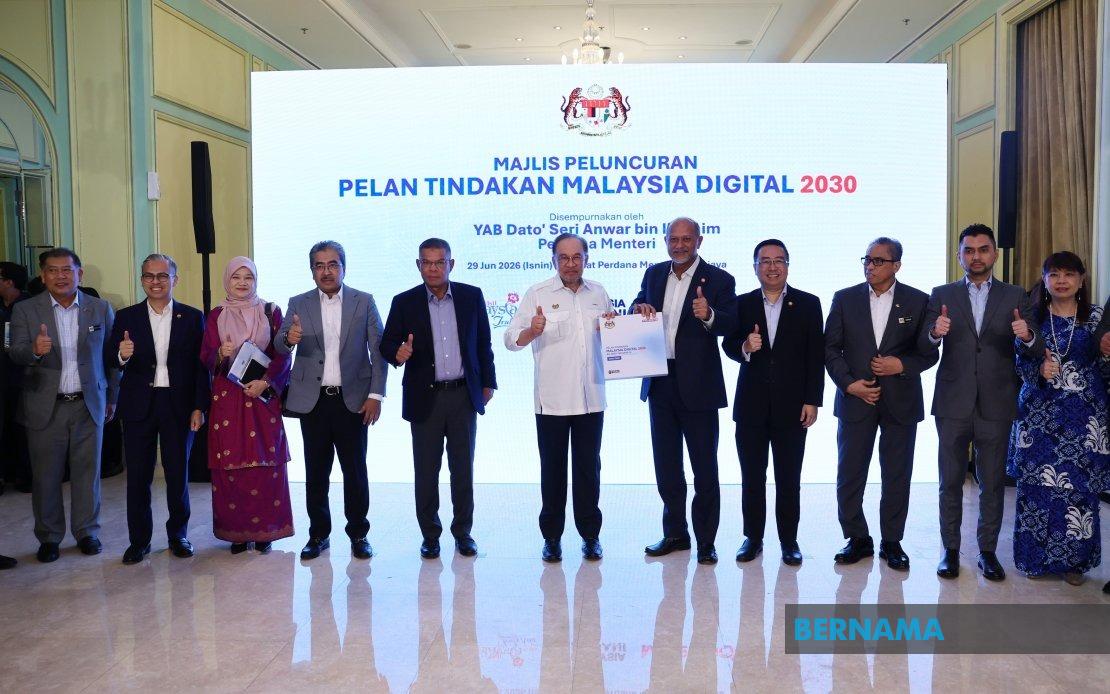
Malaysia has taken a transformative step towards cementing its role as a regional artificial intelligence powerhouse with the launch of Malaysia Digital 2030 (MD2030), a sweeping national action plan spanning 2026 to 2030. Prime Minister Datuk Seri Anwar Ibrahim unveiled the strategy in Putrajaya on June 29, marking a decisive shift away from Malaysia's historical position as a consumer of foreign technology towards becoming a homegrown innovator and producer of digital solutions.
The initiative represents a watershed moment in the country's digital evolution. Rather than simply adopting technologies developed elsewhere, Malaysia now positions itself to create and export its own innovations, a crucial transition for a nation seeking to escape the middle-income trap and secure prosperity for its citizens in an increasingly digital global economy. The launch was overseen by key government figures including Digital Minister Gobind Singh Deo, Communications Minister Datuk Fahmi Fadzil, and Chief Secretary to the Government Tan Sri Shamsul Azri Abu Bakar, underscoring the whole-of-government commitment to this agenda.
The ambitions underpinning MD2030 are substantially ambitious. The action plan targets expanding the digital economy's contribution to gross domestic product to 30 per cent by 2030, a significant leap that would position digital as a primary economic engine. Simultaneously, the government aims to create 500,000 high-value digital jobs, addressing both employment concerns and the need to develop a knowledge-intensive workforce capable of competing globally. Additionally, the plan forecasts RM4.5 billion in public sector savings through digitalisation and commits to delivering 95 per cent of government services fully online on an end-to-end basis, fundamentally reshaping how citizens interact with state institutions.
The framework governing MD2030 rests upon seven interconnected strategic pillars, each assigned to a lead ministry in a coordinated governance structure. The Government pillar, overseen by Chief Secretary Shamsul Azri, will establish GovTech Malaysia to enhance public service delivery and digital infrastructure for state operations. The Economy pillar, headed by Investment, Trade and Industry Minister Datuk Seri Johari Abdul Ghani, concentrates on branding "Made by Malaysia" digital products, accelerating technology adoption in High Growth High Value sectors, and leveraging data, digital assets and intellectual property as strategic economic assets. This pillar directly addresses Malaysia's need to develop competitive advantages in emerging digital markets where Southeast Asian nations are increasingly competing.
Infrastructure development forms another critical component, with Communications Minister Datuk Fahmi Fadzil leading efforts to ensure nationwide high-quality internet connectivity while simultaneously building sustainable digital infrastructure including data centres, cloud computing facilities and smart city platforms. This pillar recognises that technological excellence cannot flourish without robust underlying systems, a lesson learned from previous development initiatives. The Talent pillar, steered by Human Resources Minister Datuk Seri R. Ramanan, addresses workforce readiness through a comprehensive talent policy framework and agile transition initiatives designed to position Malaysia as a regional and global digital talent hub, essential for attracting and retaining skilled professionals in an intensely competitive market.
The Society and Trust pillars reflect the government's recognition that technological transformation must remain anchored to citizen welfare and security concerns. Under the Society pillar led by Women, Family and Community Development Minister Datuk Seri Nancy Shukri, the plan commits to promoting inclusive digital participation through the Malaysian Digital Inclusion Index, rural community empowerment and socially impactful digital solutions, ensuring that technological benefits are distributed equitably across urban and rural populations. The Trust and Security pillar, overseen by Digital Minister Gobind, balances innovation with safety through operationalisation of the National Data Commission and development of the National Digital Trust and Data Security Strategy 2026-2030, addressing growing citizen anxieties about data privacy and cybersecurity in an increasingly connected environment.
The Innovation pillar, led by Science, Technology and Innovation Minister Datuk Chang Lih Kang, forms the philosophical heart of MD2030. It aims to strengthen the pathway from research through commercialisation by establishing a robust Research, Development, Commercialisation, Innovation and Economy ecosystem. This represents a critical infrastructure for converting academic discoveries into marketable products and services, a transition where many developing economies struggle. By systematising this journey, Malaysia seeks to create sustainable innovation capacity rather than relying on sporadic breakthroughs.
Implementation of this ambitious agenda will require coordination across multiple specialised agencies. The National AI Office, National Digital Department (GovTech Malaysia), Malaysia Digital Economy Corporation, CyberSecurity Malaysia, MyDIGITAL Corporation and Malaysia Centre for the Fourth Industrial Revolution will serve as the operational machinery driving MD2030 forward. This institutional architecture demonstrates recognition that achieving such comprehensive transformation demands distributed leadership and expertise rather than centralised control.
Digital Minister Gobind articulated the strategic imperative underlying the plan, emphasising Malaysia's determination to transition from technology consumer to respected digital innovation producer. He stressed the Digital Ministry's commitment to ensuring this transformation is grounded in trust, data security and robust governance, acknowledging that rapid technological change without safeguards creates vulnerabilities. The whole-of-government approach, he indicated, would ensure coordinated implementation across all agencies, preventing the fragmentation and duplication that often characterises large-scale government initiatives.
The MD2030 vision extends beyond mere economic metrics. It envisions a Malaysia where artificial intelligence is seamlessly integrated across all aspects of daily life, data functions as a strategic national asset, intelligent and autonomous systems represent the norm rather than exception, and citizens thrive alongside rather than in competition with technology. This holistic framing distinguishes MD2030 from narrower digitisation efforts, positioning technology as a tool for comprehensive societal transformation rather than isolated economic sector development.
For Malaysian businesses and workers, MD2030 signals substantial opportunities alongside significant adjustment challenges. The 500,000 high-value digital jobs represent transformative employment opportunities, particularly for younger, digitally-native Malaysians. However, achieving these targets requires accelerated skills development and potentially painful transitions for workers in legacy industries. The emphasis on "Made by Malaysia" products suggests government support mechanisms and protections for local digital enterprises competing against established global tech giants, a policy approach that carries both promise and risk depending on implementation efficacy.
Regionally, Malaysia's MD2030 launch positions the nation as an increasingly serious competitor in Southeast Asia's emerging digital economy hierarchy. While Singapore remains the established tech hub and Vietnam attracts manufacturing investment, Malaysia's focus on developing indigenous innovation capacity and positioning itself as a regional trade hub creates a distinct strategic positioning. Success in executing MD2030 could attract investment, talent and partnerships from across the region and globally, strengthening Malaysia's geopolitical influence in an era where technological capability increasingly determines national influence.
The MADANI Government's commitment to ensuring MD2030 delivers inclusive and equitable transformation reflects acknowledgment that technology-driven development can exacerbate inequalities if poorly managed. The specific pillars addressing society and digital inclusion represent attempts to prevent a digital divide where rural populations and lower-income groups are left behind by rapid technological change. Whether these intentions translate into effective policy implementation will determine MD2030's ultimate success in achieving genuine national transformation rather than narrowly concentrated benefits.

