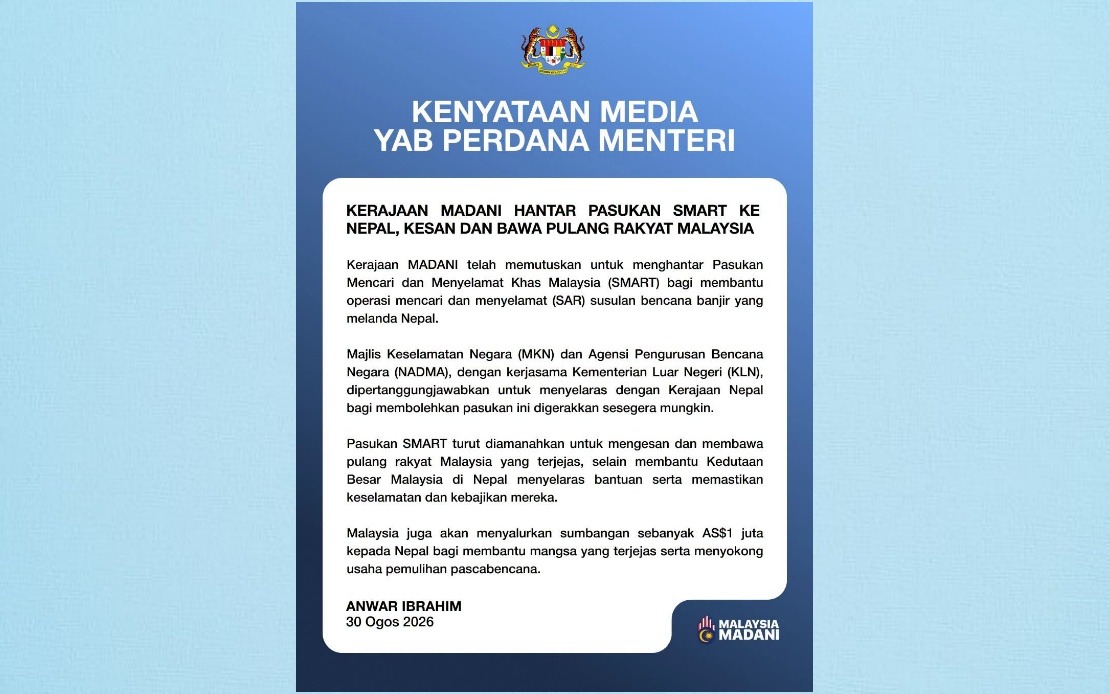
Malaysia's government has moved swiftly to respond to the humanitarian crisis unfolding in Nepal, where devastating floods and landslides have wreaked destruction across the Himalayan nation. Prime Minister Datuk Seri Anwar Ibrahim announced on August 30 that the MADANI Government has authorised the immediate deployment of the Special Malaysian Disaster Assistance and Rescue Team (SMART) to support ongoing search and rescue operations, marking a significant contribution from Southeast Asia to the relief effort in the aftermath of the August 26 disaster that struck Rasuwa district.
The coordination of this emergency response reflects the depth of institutional frameworks Malaysia has established for international disaster assistance. The National Security Council, the National Disaster Management Agency, and the Foreign Ministry have been entrusted with working directly with their Nepalese counterparts to ensure the SMART team can mobilise and operate effectively on the ground. This multi-agency approach underscores how Malaysia treats cross-border humanitarian crises as matters requiring coordination at the highest policy levels, rather than ad-hoc charitable gestures.
The SMART team will undertake multiple mandates during its deployment, extending beyond traditional search and rescue operations. Team members have been specifically tasked with identifying Malaysian nationals affected by the floods and ensuring their safe evacuation and return home. This dual focus on both universal humanitarian assistance and protection of its own citizens reflects the balancing act that countries must perform when responding to international disasters. The Malaysian Embassy in Nepal will receive direct support from the SMART team in coordinating broader aid distribution and managing the welfare of affected Malaysian communities throughout the recovery period.
The severity of the situation confronting Malaysian officials became apparent when the Foreign Ministry confirmed that 55 Malaysians remained uncontactable in the days following the disaster. This substantial number suggests that significant Malaysian populations reside or travel through the affected areas, likely including workers, tourists, and expatriate communities. The inability to reach these individuals immediately highlighted the communication breakdown that often accompanies such disasters, where infrastructure damage and overwhelmed local authorities struggle to account for the missing. For Malaysian families awaiting news, the deployment of SMART represents both a concrete rescue operation and a reassuring signal that their government is taking active measures to locate their loved ones.
Beyond the deployment of personnel, Malaysia has committed US$1 million to Nepal's immediate and longer-term recovery needs. This financial contribution carries significance not merely in its monetary value, but in demonstrating Malaysia's willingness to share the burden of reconstruction with the Nepali government and international community. Post-disaster recovery represents a protracted challenge that extends far beyond the initial emergency response phase, encompassing rebuilding of infrastructure, restoration of livelihoods, and psychological support for traumatised populations. The Malaysian pledge acknowledges this broader recovery landscape and positions Malaysia as a stakeholder in Nepal's path back to stability.
The August 26 flash floods and landslides that triggered this emergency response represented a particularly destructive natural disaster, with Rasuwa district bearing the brunt of the geological violence. Mountain regions like those in Nepal are particularly vulnerable to the cascading effects of extreme precipitation, where steep terrain accelerates water flow and destabilises soil conditions. Landslides triggered by saturated earth can block valleys and create secondary flooding hazards, compounding the initial disaster's impact. The combination of flash flooding and landslides creates a multi-layered emergency that demands specialized rescue capabilities, precisely the kind of technical expertise that teams like SMART are designed to provide.
For Malaysia, the deployment represents an opportunity to demonstrate its capacity for regional leadership in humanitarian affairs. As a middle-income Southeast Asian nation with developed disaster management infrastructure, Malaysia has increasingly positioned itself as a contributor to rather than merely recipient of international aid. The SMART team's deployment to Nepal builds on Malaysia's growing profile as a country capable of marshalling resources and expertise to assist neighbours in crisis. This soft power dimension—though secondary to the genuine humanitarian imperative—carries implications for Malaysia's regional standing and diplomatic relationships.
The response also illuminates the interconnectedness of modern Asian societies, where Malaysian citizens scattered across diverse countries become points of connection between nations during crises. When disasters strike in distant lands, they suddenly render visible the normally invisible networks of migration, commerce, and tourism that bind regional populations together. The 55 uncontactable Malaysians represent threads connecting Malaysia to Nepal, requiring government action to restore severed communications and ensure protection of national citizens abroad.
The coordination mechanisms activated by Malaysia's response demonstrate how countries leverage multilateral and bilateral channels during emergencies. The Foreign Ministry's role in liaising with Nepal's government, the military's provision of SMART personnel, and NADMA's mobilisation of technical resources reflect how modern disaster response draws on capabilities distributed across multiple government agencies. Such coordination, when executed effectively, can accelerate response times and ensure that international assistance complements rather than duplicates local efforts.
Looking forward, Malaysia's engagement with Nepal's recovery will extend beyond the immediate emergency phase. International disaster assistance traditionally encompasses three phases: the emergency response captured by SMART's deployment, the early recovery period where temporary shelter and medical care dominate, and the longer-term reconstruction phase where the US$1 million commitment becomes crucial. How these resources are deployed and whether they flow through official channels or Malaysian non-governmental organisations will shape the practical impact of Malaysia's assistance and the trajectory of bilateral relations emerging from this shared crisis.

