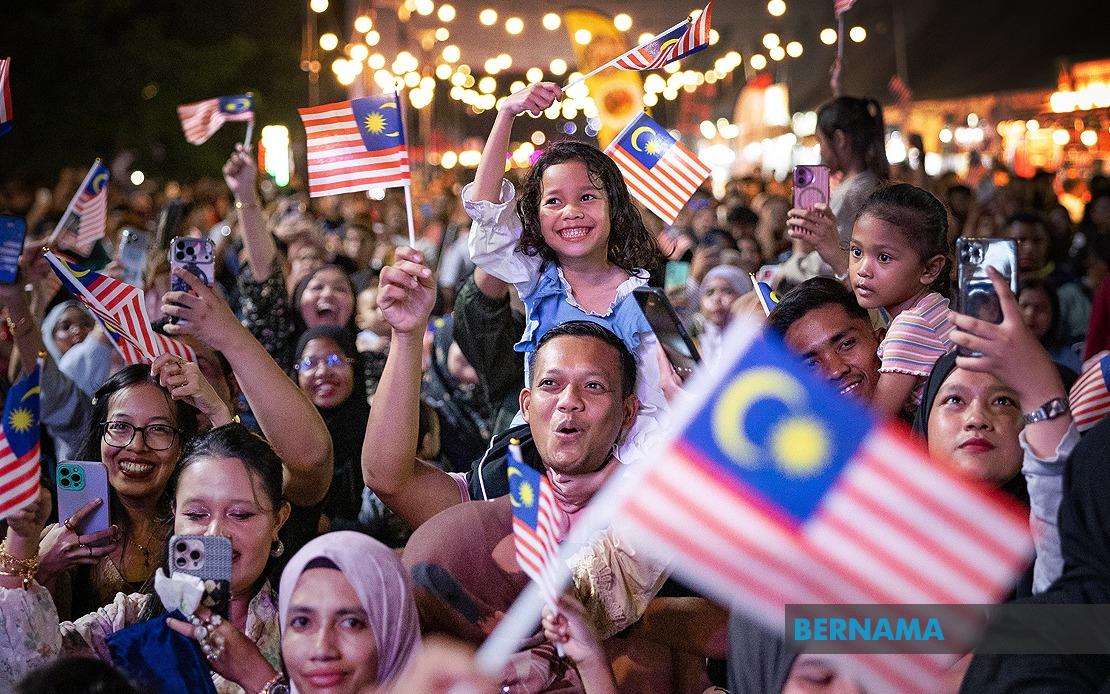
The nation's 69th National Day Eve unfolded with infectious patriotic energy on August 30, drawing crowds of unprecedented scale to celebrations spanning multiple states. The milestone occasion reinforced the deeply rooted connection between Malaysians and their independence, as families, youth and community groups congregated in town squares and sports complexes to share in the collective moment of national pride.
Kuala Lumpur's Dataran Merdeka emerged as the epicentre of festivities, welcoming more than 100,000 visitors who arrived progressively from early evening onwards. The historic landmark, bathed in luminous projections on the Sultan Abdul Samad Building's façade, transformed into a sea of waving Jalur Gemilang flags as the crowd settled in for the 'Kita Bagi Jadi @ Ambang Merdeka 2026' concert experience. This carefully curated spectacle blended contemporary Malaysian music with narratives of the nation's historical journey, creating a multimedia immersion that resonated across generational lines.
The 90-minute concert programme featured a diverse roster of homegrown artists including Aina Abdul, Aman RA, Nadia Aqilah, Asmidar, Haziq Rosebi, Mimifly, Izen Kong and Pasya, supported by approximately 350 backing performers who delivered intricate choreography and stagecraft. The production emphasised cultural diversity and historical storytelling, positioning the celebration beyond mere entertainment into a pedagogical exercise in national consciousness. This format reflects an emerging trend across Southeast Asia where National Day observances increasingly function as vehicles for transmitting national narratives to younger demographics through experiential cultural engagement rather than formulaic ceremony alone.
The evening welcomed prominent dignitaries including Hannah Yeoh, Minister in the Prime Minister's Department (Federal Territories), and Kuala Lumpur Mayor Datuk Seri Fadlun Mak Ujud, signalling the administrative significance accorded to the occasion. As the scheduled countdown approached midnight, the VAT 69 Commando unit executed a dramatic skydiving display that punctuated the anticipation building among the assembled throng. The national anthem Negaraku resonated across the square, followed by a meticulously choreographed parade of decorated vehicles and contingent formations, each representing different sectors of Malaysian society and governance infrastructure.
The climax arrived when Menteri Besar Datuk Seri Amirudin Shari, who had arrived at 9.20 pm, led the assembled crowd in shouting 'Merdeka' at the stroke of midnight. This ancient invocation of independence, repeated three times in traditional fashion, triggered a spectacular pyrotechnic display synchronised with elaborate light projections. The finale concert featuring established artists Datuk Ramli Sarip, Datuk Awie, Gerhana Skacinta, Merrah and Wani Kyrie extended the celebration into the early morning hours, maintaining momentum and engagement throughout the night.
Perlis state also witnessed substantial participation, with over 46,000 attendees converging at a sports complex venue that offered expanded programming beyond the capital's focus. The Perlis celebration commenced with the state anthem and martial arts demonstrations, establishing a decidedly multicultural tone that acknowledged the martial heritage embedded within Malaysia's independence struggle. Chief Minister Datuk Seri Ab Rauf Yusoh's presence, alongside his wife Datin Seri Zuriyah Abd Aziz and state executive council members, underscored the political machinery's commitment to grassroots engagement during such occasions.
Beyond the headline performances, venue organisers implemented auxiliary activities designed to sustain engagement throughout extended evening hours. The programming encompassed the Bulatan Sultan Azlan Shah Run for early morning enthusiasts, Jualan Rahmah stalls emphasising community spirit, curated thrift markets, health screening services, competitive karaoke contests, novelty attractions and sustained live performances. This holistic approach transformed National Day Eve from a concentrated evening spectacle into an extended social experience accommodating varying preferences and participation styles.
The significance of these celebrations acquired additional resonance through messaging delivered by constitutional authority. Tuanku Syed Sirajuddin's royal address articulated the philosophical underpinning of national independence, emphasising the sacrifices and unity among diverse populations that secured freedom from colonial rule. His emphasis on knowledge, integrity, collective cohesion and individual responsibility to the nation provided moral scaffolding for the celebratory atmosphere, reminding attendees that patriotic expression carries attendant obligations toward national stewardship.
Muhammad Sanusi's contributions to the Perlis celebration similarly reinforced this interpretive frame, urging public appreciation for independence as something requiring active safeguarding rather than passive enjoyment. This messaging suggests an evolving discourse within Malaysian political leadership acknowledging that subsequent generations require continuous reinforcement of the values and sacrifices underlying the nation's existence as an independent entity. The repeated emphasis on unity across racial and religious lines carries particular resonance in contemporary Malaysia, where social cohesion occasionally faces pressures from competing identity narratives and economic anxieties.
The nationwide participation across both metropolitan and state venues indicates sustained public investment in National Day observances despite ongoing socioeconomic pressures and political complexity characterising Malaysian public life. The cross-generational attendance patterns, from young children to elderly citizens, suggest that independence remains a unifying national touchstone transcending partisan divisions. For regional observers, Malaysia's capacity to mobilise such visible celebrations while managing ethnic and religious diversity offers comparative insights into how Southeast Asian nations navigate the tension between authoritarian efficiency and democratic legitimacy in staging national identity moments.
The extended programming reflecting diverse entertainment, wellness and community elements demonstrates evolving sophistication in how Malaysian authorities approach civic engagement beyond electoral cycles. Rather than treating National Day as ceremonial obligation, contemporary celebrations increasingly function as platforms for distributing public goods, building social capital and transmitting values through experiential participation. This model potentially offers templates for other Southeast Asian nations seeking to deepen democratic engagement while maintaining social cohesion during periods of rapid modernisation and generational transition.

