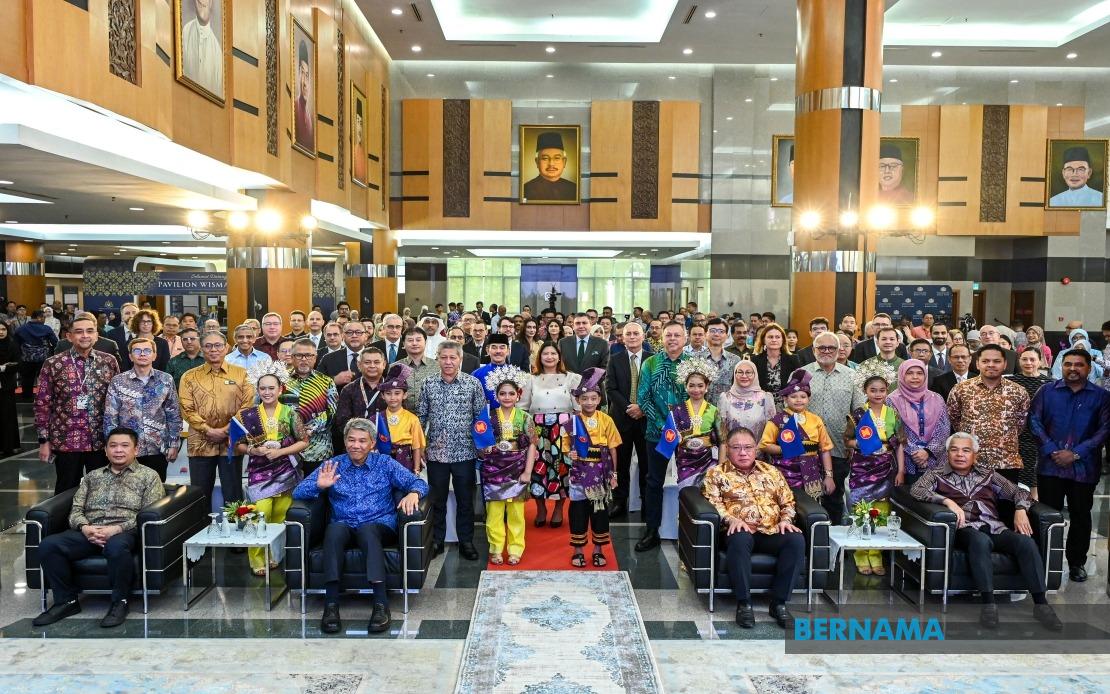
Malaysia marked a significant milestone on Monday with celebrations honouring almost six decades of involvement in ASEAN, the 11-nation Southeast Asian regional bloc that has evolved considerably since its inception. The commemorative event, held at the Foreign Ministry in Putrajaya, drew approximately 300 attendees including government officials, diplomatic representatives and international organisation representatives, underscoring the importance Malaysia places on its continued participation in regional affairs.
The gathering, themed "59 Years of Navigating Together," was officially opened by Foreign Minister Datuk Seri Mohamad Hasan, with support from Tourism, Arts and Culture Minister Datuk Seri Tiong King Sing and Deputy Foreign Minister Datuk Lukanisman Awang Sauni. The substantial ministerial presence reflected Malaysia's institutional commitment to maintaining and strengthening regional partnerships. The celebrations incorporated multimedia presentations and ceremonial elements, including a screening of documentary material tracing Malaysia's journey within ASEAN since the organisation's founding, followed by a formal cake-cutting ceremony led by the Foreign Minister.
Established through the Bangkok Declaration signed on 8 August 1967, ASEAN emerged from an agreement between five founding nations—Indonesia, Malaysia, the Philippines, Singapore and Thailand—designed to foster regional cooperation and stability during a volatile geopolitical period. The grouping has since expanded significantly, absorbing new members as Southeast Asian nations sought to participate in structured regional frameworks. Brunei joined in 1984, followed by Vietnam's accession in 1995. Laos and Myanmar entered together in 1997, Cambodia joined in 1999, and most recently, Timor-Leste became the 11th member state following its admission during the 47th ASEAN Summit in October of the previous year.
The Foreign Ministry's formal statement emphasised that ASEAN's institutional architecture rests on three foundational pillars: political-security cooperation, economic integration, and socio-cultural exchanges. This tripartite framework has enabled member states to address diverse challenges while building consensus on collective responses. The statement characterised ASEAN as demonstrating "strength, solidarity and resilience," qualities that have proven essential as the region navigates complex international dynamics, regional tensions, and transnational issues ranging from maritime security to pandemic response.
For Malaysia specifically, nearly 60 years of ASEAN participation represents a substantial investment in multilateral diplomacy and regional institution-building. As one of the founding members, Malaysia has played a central role in shaping ASEAN's development, contributing to the formulation of regional norms, practices and decision-making procedures. The country's Foreign Ministry explicitly framed the 59th anniversary as a moment for reflection on mutual contribution and shared commitment, suggesting that Malaysia views its ASEAN membership not merely as a diplomatic arrangement but as integral to national interests and regional stability.
The expansion of ASEAN from five to 11 members over the past four decades has fundamentally altered the organisation's composition and operational scope. Each new member brought distinct perspectives, geopolitical interests and development contexts. Myanmar's inclusion in 1997, for instance, connected the Southeast Asian framework to a nation with significant strategic importance given its geography and historical ties to both South Asia and China. Vietnam's membership similarly expanded ASEAN's reach toward East Asia and reinforced the grouping's profile as a genuinely pan-Southeast Asian institution. Timor-Leste's recent accession, while symbolically important as the region's newest nation-state, expanded ASEAN's membership to include a country with significant energy resources and strategic positioning in maritime Southeast Asia.
The theme selected for this year's commemoration—"Navigating Together"—carries particular resonance given current regional circumstances. Southeast Asia continues to grapple with territorial disputes, particularly in the South China Sea where overlapping maritime claims create potential flashpoints. Economic challenges including post-pandemic recovery, inflationary pressures and supply chain disruptions affect all member states. Simultaneously, ASEAN seeks to maintain its centrality in regional architecture while managing relationships with major powers including the United States, China, India and Japan. The emphasis on collective navigation suggests Malaysia and other member states are prioritising unity and consensus-building as strategies for maintaining ASEAN's relevance and effectiveness.
The political-security pillar of ASEAN cooperation encompasses mechanisms for conflict prevention and dialogue, including the ASEAN Regional Forum, the East Asia Summit, and the ASEAN Plus Three framework. Malaysia's participation in these structures has allowed the country to amplify its voice on regional security matters while contributing to norms development around peaceful dispute resolution. The economic pillar, operationalised through the ASEAN Free Trade Area and various sectoral cooperation agreements, has integrated Southeast Asian economies and created interdependencies that reinforce peaceful coexistence. The socio-cultural pillar, often overlooked in geopolitical analysis, fosters people-to-people connections, educational exchanges and cultural understanding that create foundations for sustained cooperation beyond governmental interactions.
Malaysia's distinct position as a founding member carries particular weight in ASEAN deliberations. The country sits at the geographical heart of Southeast Asia and has consistently advocated for ASEAN centrality—the principle that the regional grouping should serve as the primary forum for addressing regional issues and should not be sidelined by major power competition. This stance reflects Malaysia's perspective that smaller and medium powers can exercise meaningful influence through institutionalised multilateral frameworks rather than through bilateral engagement with great powers. The 59th anniversary celebration implicitly reaffirms this commitment, suggesting that despite occasional divergences on specific issues, Malaysia remains invested in ASEAN as the optimal vehicle for advancing Southeast Asian interests.
The gathering in Putrajaya also served to reinforce ASEAN's identity as a distinctive regional project. Unlike other regional organisations that emerged from Cold War strategic alignments or great power sponsorship, ASEAN developed through the consensus and voluntary commitment of its members. The organisation's foundational principles—non-interference in internal affairs, peaceful settlement of disputes, and decision-making by consensus—reflect Southeast Asian nations' determination to chart their own course. Malaysia's sustained participation and ceremonial marking of membership anniversaries demonstrates ongoing subscription to these foundational principles, even as the region's geopolitical environment becomes increasingly complex.
Looking forward, Malaysia's commemoration of nearly 60 years in ASEAN suggests the country intends to remain deeply engaged in regional institution-building and multilateral cooperation. The invitation of diverse participants—government officials, diplomats and international representatives—indicates that Malaysia views ASEAN engagement as extending beyond governmental circles to encompass broader stakeholder communities. This inclusive approach aligns with ASEAN's increasingly prominent socio-cultural and people-to-people dimensions, recognising that sustainable regional cooperation requires engagement across multiple levels of society.
The strategic significance of this anniversary extends beyond ceremonial acknowledgment to reflect enduring calculations about Malaysia's national interests. As Southeast Asia navigates great power competition, economic integration challenges and transnational issues, ASEAN remains central to Malaysia's strategic framework. The country's participation in the regional grouping provides mechanisms for consensus-building on issues affecting all members, platforms for amplifying Malaysian interests and perspectives, and structured forums for managing potential conflicts through dialogue rather than confrontation. The 59th anniversary celebration thus represented both backward-looking commemoration and forward-looking affirmation of Malaysia's commitment to regional cooperation through multilateral institutions.

