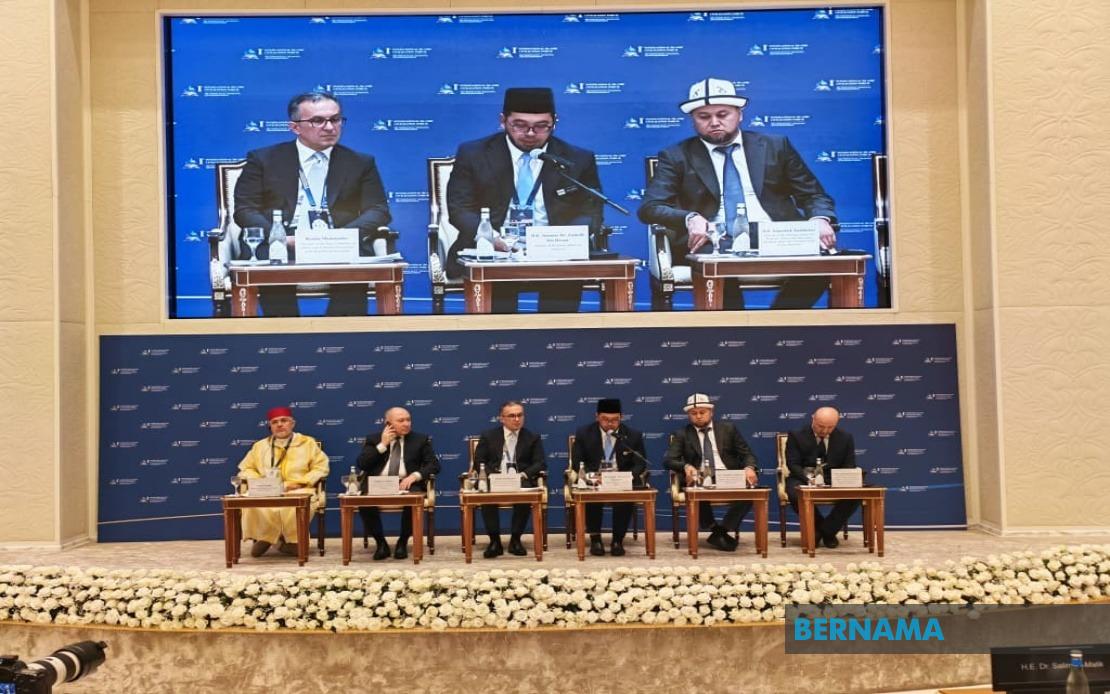
Malaysia has challenged the Islamic world to seize the humanitarian catastrophe unfolding in Gaza as a transformative moment, one that compels Muslims to recommit to foundational principles of justice, mercy, and human dignity while reimagining their civilisation's role in global affairs. Speaking at the International Islamic Civilisation Forum in Tashkent, Uzbekistan on July 8, Datuk Dr Zulkifli Hasan, Minister in the Prime Minister's Department (Religious Affairs), framed the Gaza tragedy not merely as a geopolitical crisis requiring diplomatic response, but as a watershed moment testing whether international law and justice operate with genuine impartiality across all nations and communities.
The scale of civilian suffering in Gaza, according to Zulkifli, has reverberated beyond Middle Eastern borders and struck at fundamental questions about how the global order functions. His remarks suggest growing Malaysian concern that selective application of international norms undermines the credibility of rules-based systems and erodes trust between Muslim-majority nations and Western powers. For Malaysia—a country navigating complex relationships across Islamic, Western, and Asian spheres—the statement positions Kuala Lumpur as advocate for consistency in upholding universal principles rather than accepting geopolitical double standards.
Central to Zulkifli's message was a plea for the Muslim world to escape a reactive posture. Rather than defining Islamic civilisation primarily through opposition to external pressures or grievances, he argued, Muslim societies must proactively articulate a compelling vision of their own contribution to humanity's future. This framing reflects a sophisticated understanding of soft power: that civilisations gain influence not through victimhood narratives but through demonstrating concrete solutions to shared global challenges. For Malaysian policymakers, this argument resonates with the country's own brand of constructive engagement with diverse partners.
The minister rejected nostalgia as a governing framework for Islamic renewal. While acknowledging the historical achievements of Islamic civilisation—its architectural marvels, scientific breakthroughs, and intellectual traditions—Zulkifli insisted the relevant question is not whether Muslims once excelled, but what they offer the contemporary world. This distinction carries weight in Southeast Asian context, where Malaysia competes for influence and relevance by demonstrating modern governance competence and adaptability, not by resting on historical laurels.
Zulkifli identified several domains where Islamic civilisation could exercise ethical leadership. He highlighted the urgent need for Muslim scholars and policymakers to shape frameworks governing emerging technologies including artificial intelligence, biotechnology, and quantum computing. By positioning Islam as offering moral guardrails for innovation, he presented the religion not as resistant to modernity but as essential to ensuring technological progress serves humanity rather than threatening it. This argument appeals to contemporary Muslim elites concerned about technological disruption and cultural erosion, while simultaneously offering a bridge to Western audiences seeking non-Western ethical perspectives on technological governance.
The restoration of ethics to governance represents another pillar of Zulkifli's civilisational renewal agenda. He advocated for wisdom to inform knowledge production and for development initiatives to serve broader human purposes rather than narrow economic extraction. In the Malaysian context, this emphasis on ethical governance carries domestic resonance given ongoing debates about corruption, institutional accountability, and the proper relationship between state power and citizen welfare. By universalising these concerns as Islamic civilisational values, Zulkifli elevates Malaysia's own governance challenges into a broader framework of Muslim world significance.
Historically, the minister noted, Islamic civilisation distinguished itself through intellectual openness and cross-cultural exchange. Scholars from Islamic lands engaged deeply with Greek, Persian, Indian, and Chinese knowledge traditions, synthesising insights into original contributions. Zulkifli proposed contemporary Muslim societies emulate this eclecticism by becoming active partners in global knowledge networks and ethical dialogue rather than withdrawing into cultural insularity. This historical narrative provides theological and intellectual justification for the kind of pragmatic, engagement-oriented foreign policy Malaysia itself pursues.
Environmental stewardship emerged as an underexplored dimension of Islamic renewal. Zulkifli invoked Islamic concepts of trusteeship—the idea that humans hold creation in trust—to argue that Muslims should champion sustainability and ecological responsibility. Given Southeast Asia's acute vulnerability to climate change, deforestation, and environmental degradation, this framing of environmental protection as Islamic obligation carries regional significance. It positions Muslim-majority nations as having both religious motivation and civilisational interest in leading global environmental initiatives.
Crucially, Zulkifli cautioned against portraying Islamic civilisational renewal as zero-sum competition with other cultures. Rather than a clash of civilisations narrative, he advocated dialogue, partnership, and mutual respect across religious and cultural boundaries. This emphasis reflects Malaysia's strategic position as a Muslim-majority nation deeply embedded in multicultural Southeast Asia and dependent on economic relationships with Buddhist, Christian, and secular neighbours. By rejecting civilisational rivalry in principle, Zulkifli provides diplomatic cover for Malaysia's own pragmatic relationships with partners of all faith backgrounds.
The minister specifically highlighted bilateral opportunities between Malaysia and Uzbekistan, noting complementary strengths: Uzbekistan's profound scholarly Islamic heritage paired with Malaysia's experience in Islamic finance, multicultural governance, and peaceful interfaith coexistence. Both nations, he suggested, could serve as bridges between Central Asia and Southeast Asia, advancing knowledge production and ethical innovation for the broader Muslim world. This framing elevates Malaysia's own developmental model—Islamic governance compatible with market economies and religious pluralism—as a template worthy of regional emulation.
Zulkifli's intervention at Tashkent reflects Malaysia's broader diplomatic strategy of positioning itself as a responsible voice within the Islamic world, one capable of moral clarity on issues like Gaza while simultaneously maintaining pragmatic relationships across geopolitical divides. By casting the Gaza tragedy not as an occasion for rage or isolation but as catalyst for civilisational renewal and ethical leadership, Malaysia signals that Islamic identity need not conflict with participation in globalised institutions and partnerships. For a country managing complex domestic religious dynamics and seeking regional influence, this articulation of principled engagement offers a template—one tested by Gaza's urgency but grounded in longer-term calculations about Islam's role in shaping humanity's future.

