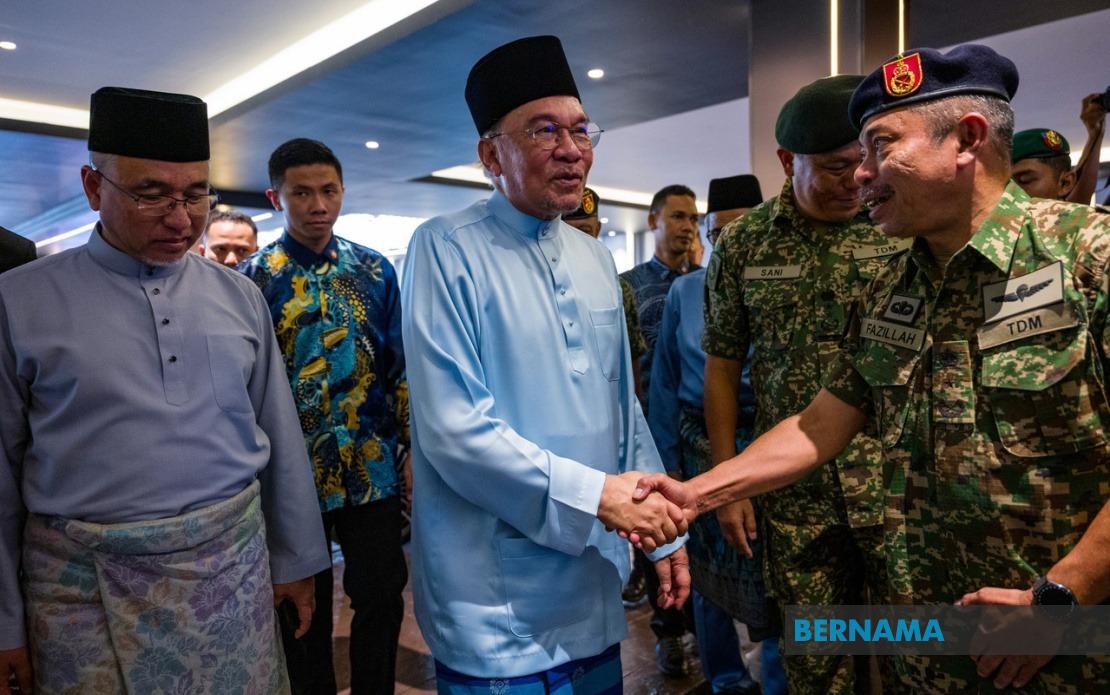
Prime Minister Datuk Seri Anwar Ibrahim's decision to boost defence spending in the upcoming Budget 2027 represents a significant policy pivot toward revitalising Malaysia's military infrastructure and capacity. The announcement, made during a government-wide engagement programme with the Armed Forces at Terendak Camp in Melaka, underscores the administration's recognition that national security and defence readiness require sustained financial investment. As both Prime Minister and Finance Minister, Anwar's dual role emphasises the economic importance attached to this military modernisation initiative, signalling that defence spending will compete favourably with other budgetary priorities in Malaysia's fiscal planning.
Chief of Defence Force General Tan Sri Malek Razak Sulaiman welcomed the commitment with visible appreciation, characterising the increased allocation as validation of the government's broader vision for the Malaysian Armed Forces. His remarks suggest that military leadership has successfully conveyed concerns about ageing equipment, operational constraints, and personnel retention challenges to the political leadership. The CDF's public endorsement transforms the budget announcement from a purely financial matter into a statement of national strategic intent, reassuring both serving personnel and defence industry stakeholders of government backing for military advancement.
The planned expenditure will serve multiple concurrent objectives within the defence sector. Beyond acquiring and maintaining advanced military assets, the budget enhancement specifically targets the Future Force strategic development plan—a comprehensive roadmap for transforming Malaysia's defence posture across the coming decade. This suggests that Malaysia's defence establishment has developed detailed modernisation proposals awaiting funding, rather than the government pursuing ad-hoc upgrades. The structured approach indicates professional military planning now receiving political endorsement and financial backing.
Personnel welfare constitutes a critical component of this defence investment, addressing long-standing grievances within the Armed Forces. Anwar explicitly referenced improvements to military housing, construction of a new medical facility, and maintenance of basic infrastructure such as water supply systems. These tangible upgrades address quality-of-life issues that directly impact recruitment, retention, and morale among service members and their families. For a professional military force, adequate accommodation, healthcare, and utilities represent foundational requirements that have reportedly deteriorated in some quarters, affecting personnel satisfaction and operational effectiveness.
The welfare dimension carries particular significance for Malaysia's defence planning, as military personnel costs and living conditions increasingly influence recruitment of skilled personnel in a competitive labour market. By coupling capital investment in equipment with investments in personnel amenities, the government signals understanding that modernisation requires both technological and human-centred approaches. This holistic strategy may improve retention of experienced personnel whose training and expertise prove valuable in operating sophisticated defence systems.
Anwar's announcement also included a commitment to streamline and expedite promotion pathways for both Armed Forces and Royal Malaysia Police personnel, bringing military advancement mechanisms into greater alignment with broader public service schemes. This administrative reform addresses procedural bottlenecks that may have frustrated career progression in security services. The simplification acknowledges that clear advancement opportunities influence job satisfaction and organisational effectiveness. By harmonising military promotion timelines with civilian public service procedures, the government seeks to modernise personnel management alongside equipment upgrades.
Regionally, Malaysia's defence budget enhancement reflects broader Southeast Asian security dynamics and regional power competition. As neighbouring countries pursue military modernisation programmes—notably Thailand, Indonesia, and Vietnam—Malaysia cannot afford to allow its defence capabilities to become outdated or inadequate. The investment decision places Malaysia within a regional context where security spending has gained political importance. Enhanced defence capability strengthens Malaysia's strategic credibility within ASEAN and supports the nation's broader foreign policy objectives.
The fiscal implications warrant consideration within Malaysia's broader economic circumstances. As a middle-income nation managing multiple developmental priorities, elevated defence spending requires balancing security imperatives against education, healthcare, and infrastructure needs. Yet Anwar's framing suggests the government views defence investment as complementary to rather than competing with economic development. Military modernisation, when coupled with transparent procurement and effective implementation, can stimulate domestic defence industries and technological development sectors.
The timing of this announcement during an official government-military engagement event, rather than through routine budget announcements, underscores the political significance attached to defence modernisation. By personalising the commitment through direct Prime Ministerial engagement at a military installation, Anwar emphasised that this represents a government priority commanding highest-level attention. This approach builds confidence among military personnel that their concerns have reached decision-makers and that promised investments will receive follow-through during budget finalisation.
Implementation challenges remain substantial. Translating budget allocations into actual equipment acquisitions, facility improvements, and personnel enhancements requires effective procurement processes, project management, and oversight mechanisms. Malaysia's defence sector has experienced project delays and cost overruns in previous modernisation attempts, suggesting that funding alone proves insufficient without attention to implementation structures. The government's success in delivering on these defence commitments will significantly influence public and military confidence in budget promises generally.
For Malaysian readers and regional observers, this defence spending increase signals governmental determination to maintain military relevance amid evolving security challenges. Whether encompassing traditional threats, maritime security concerns, or counter-terrorism requirements, the Armed Forces face expanding operational demands requiring modern capabilities. The budget commitment recognises this reality and provides institutional backing for military leadership to pursue necessary upgrades. However, sustained commitment across multiple budget cycles will ultimately determine whether this allocation represents a strategic policy shift or a cyclical adjustment.

