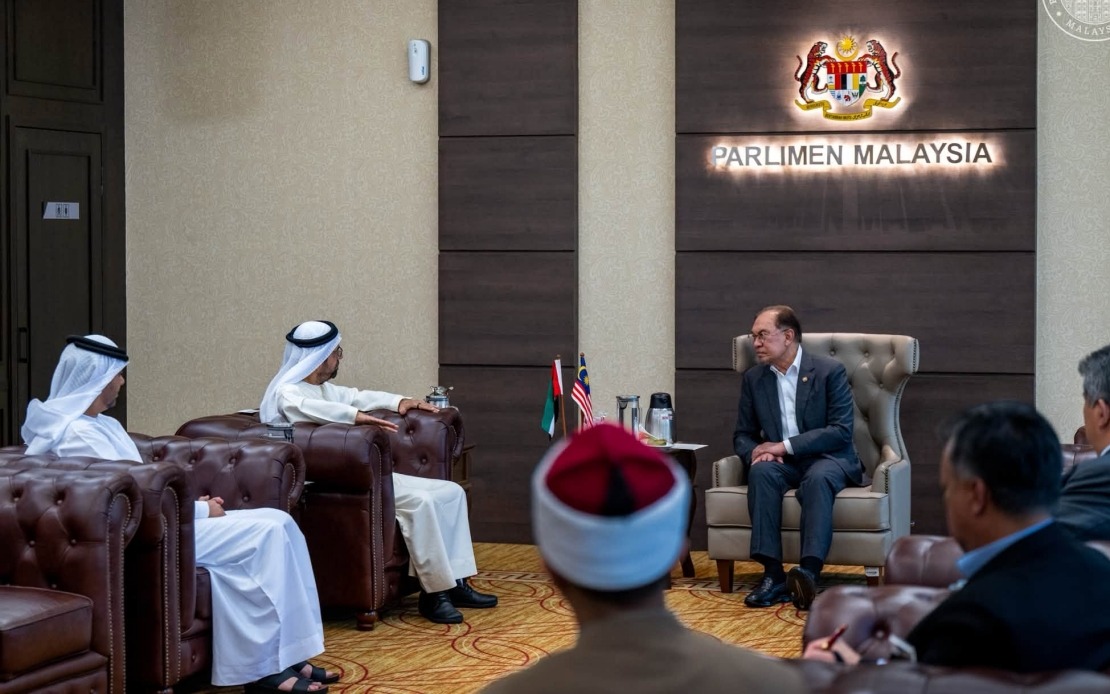
Prime Minister Datuk Seri Anwar Ibrahim has signalled Malaysia's determination to deepen its relationship with the United Arab Emirates through expanded strategic cooperation that serves the interests of both nations. The commitment emerged during a high-level engagement at Parliament House in Kuala Lumpur, where Anwar received Dr Ali Rashid Al Nuaimi, chairman of the Defence, Interior and Foreign Affairs Committee within the UAE's Federal National Council, underscoring the diplomatic weight both countries accord to their bilateral relationship.
The timing of this meeting carries particular significance given the evolving geopolitical landscape across the Middle East and Asia-Pacific regions. During their discussion, both sides examined the implications of current international tensions, particularly the escalating dynamics between the United States and Iran, which have reverberated across shipping lanes, energy markets, and security arrangements that directly affect Malaysia's interests. For a nation straddling vital maritime routes and dependent on regional stability for its economic wellbeing, Malaysia's engagement with moderate Gulf states like the UAE reflects a pragmatic foreign policy approach aimed at maintaining equilibrium amid great power competition and ideological tensions.
A striking element of the bilateral discussion centred on artificial intelligence and its transformative potential for governance structures and defence capabilities. Anwar highlighted his appreciation for the UAE's institutional approach to AI readiness, noting specifically that the Emirates has implemented mandatory AI training programmes for ministerial and senior government officials. This represents a forward-thinking recognition that technological competency among leadership cadres is no longer optional but essential for effective governance in an era of rapid digital disruption. For Malaysia, which aspires to position itself as a regional technology hub and digital economy player, such knowledge-sharing arrangements with the UAE—a nation increasingly recognised as an innovation centre in the Arab world—offers valuable lessons in implementation and institutional change management.
The discussion reflects Malaysia's broader strategic calculus in engaging Gulf Cooperation Council states. Beyond immediate bilateral concerns, Malaysia seeks to leverage partnerships with economically dynamic and technologically advancing Gulf nations to enhance its own institutional capacity and remain competitive in the global economy. The UAE, with its diversification efforts away from hydrocarbon dependence and investments in advanced sectors including aerospace, renewable energy, and financial technology, presents a model of relevance to Malaysian policymakers contemplating economic transformation.
The emphasis on defence cooperation warrants close attention, particularly as it underscores Malaysia's expanding security partnerships beyond traditional alliances. While Malaysia maintains longstanding defence relationships with Western nations and regional partners, engagement with the UAE on defence matters suggests recognition that security architecture in the Indo-Pacific must accommodate diverse stakeholders and perspectives. The UAE's military modernisation and its active role in regional security arrangements make it a natural partner for knowledge exchange on emerging threats, including maritime security challenges affecting the Strait of Malacca and surrounding waters.
From a commercial perspective, closer strategic ties with the UAE open pathways for Malaysian businesses seeking footholds in Gulf markets and for Emirati investors viewing Malaysia as an entry point to Southeast Asia. The two nations have long-standing trade relationships, but elevated strategic cooperation often catalyses increased commercial activity as governments create enabling environments and reduce friction for bilateral business activity. Malaysian companies in sectors ranging from petrochemicals to Islamic finance could benefit from enhanced access and diplomatic support within UAE markets, while the UAE's substantial sovereign wealth funds maintain interest in Southeast Asian real estate, infrastructure, and technology ventures.
Anwar's reiteration of Malaysia's commitment to regional peace and prosperity through its UAE partnership resonates against a backdrop of occasionally fractious Gulf politics and broader Middle Eastern tensions. By positioning itself as a supportive voice for stability and mutual benefit, Malaysia reinforces its standing as a responsible regional actor capable of contributing to conflict prevention and constructive dialogue. This posture proves particularly valuable given Malaysia's non-aligned foreign policy tradition and its relationships across multiple poles of influence.
The meeting also underscores the practical reality that bilateral relationships between nations increasingly transcend traditional foreign ministry channels. When parliamentary committees engage with prime ministerial offices, it signals that legislative bodies in both countries view these relationships as sufficiently important to warrant direct engagement at senior levels. For Malaysia, where parliamentary oversight of foreign policy has grown more assertive in recent years, such interactions demonstrate institutional alignment on strategic priorities.
Looking forward, the areas identified for deeper cooperation—artificial intelligence, defence technology, and governance modernisation—suggest that Malaysia-UAE relations are evolving beyond transactional trade and diplomatic courtesy toward substantive knowledge partnerships. As Southeast Asia navigates technological disruption and security challenges ranging from cyber threats to maritime incidents, access to the UAE's experience and expertise in these domains offers tangible value. Conversely, Malaysia's positioning as a stable democracy with significant influence across Islamic organisations and Southeast Asian associations provides reciprocal value to the UAE's regional engagement ambitions.

