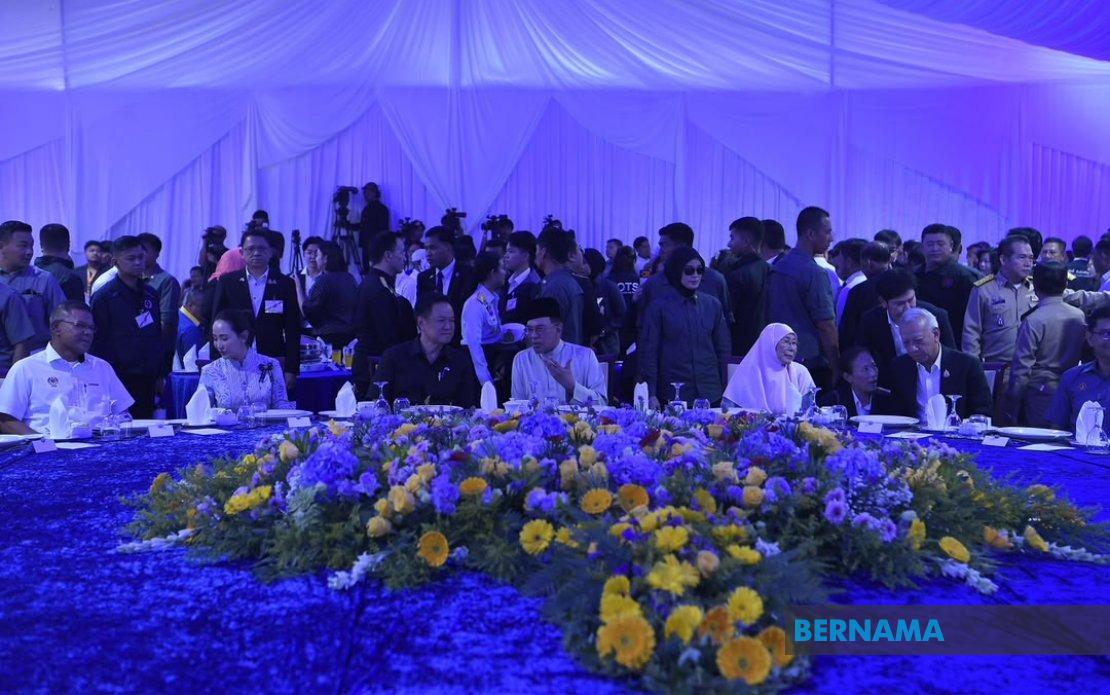
Prime Minister Datuk Seri Anwar Ibrahim and Thai Prime Minister Anutin Charnvirakul marked a significant diplomatic and infrastructural achievement on July 10 by inaugurating a new road that directly connects Malaysia's Bukit Kayu Hitam Immigration, Customs, Quarantine and Security Complex with Thailand's corresponding Sadao Customs, Immigration and Quarantine facility. The ceremonial opening represents far more than the mere unveiling of asphalt and concrete; it underscores the deepening commitment both nations have demonstrated toward modernising their shared border infrastructure and fortifying their strategic partnership across multiple dimensions.
The timing of this infrastructure project carries particular relevance for the Southeast Asian region. As cross-border movement intensifies across ASEAN nations and global supply chains continue their post-pandemic reconfiguration, efficient border infrastructure has become paramount to national competitiveness. The new Bukit Kayu Hitam-Sadao road commences operations at 6 am Malaysia time on July 11, replacing the existing Bukit Kayu Hitam-Danok crossing, which will permanently cease operations from midnight on the same date. This transition reflects careful planning to ensure continuity of trade and travel flows between the two neighbouring nations without disruption.
According to the Home Ministry, this development exemplifies the mutual resolve of Malaysia and Thailand to advance diplomatic engagement, deepen cross-border strategic collaboration, and amplify regional connectivity in pursuit of collective prosperity and enhanced security for their citizens. The project carries implications that extend well beyond the immediate border communities. By establishing a more modern and integrated border checkpoint system, both countries are signalling their intent to facilitate legitimate trade, investment, and tourism while simultaneously strengthening security protocols through contemporary infrastructure and unified control mechanisms.
The new corridor aligns strategically with the ASEAN North-South Economic Corridor, a regional initiative designed to enhance connectivity and economic integration throughout Southeast Asia. Malaysian officials emphasise that improved border infrastructure directly supports the movement of people, merchandise, capital, and travellers across ASEAN member states. For Malaysia, a nation positioned as a crucial logistics and distribution hub within the region, such enhancements translate into competitive advantages in attracting regional and international investment. Thailand, similarly reliant on cross-border trade and regional commerce, stands to benefit from accelerated and more efficient movement of goods through its southern provinces toward Malaysian markets and beyond.
The practical implications for border communities warrant particular attention. Enhanced border crossing efficiency addresses longstanding concerns about congestion, delays, and associated costs that have historically plagued traders and commuters utilising the Danok checkpoint. By consolidating immigration, customs, and quarantine functions within a unified, modern facility, both nations can process legitimate cross-border traffic more expeditiously whilst simultaneously strengthening security screening. This represents the type of practical, operational improvement that often receives insufficient recognition but substantially impacts everyday commerce and people-to-people connections that define regional integration.
From Malaysia's perspective, framed within the Malaysia MADANI development framework, this initiative demonstrates commitment to modernising institutional infrastructure and adopting contemporary technologies in border management. The Home Ministry explicitly references this alignment, pledging continued investment in border facilities through technological advancement and international strategic partnerships. Such commitments matter because they signal to international investors and regional partners that Malaysia is serious about maintaining competitive, secure, and transparent border operations that facilitate legitimate economic activity whilst protecting national interests.
The bilateral cooperation exemplified by this project also extends to security considerations that frequently dominate border management discussions. Modern, integrated border infrastructure enables both nations to implement more sophisticated screening protocols, share real-time intelligence, and coordinate enforcement activities more effectively. This capacity for enhanced security cooperation assumes heightened importance given transnational challenges including human trafficking, smuggling operations, and organised crime that do not respect administrative boundaries. By creating a framework for technological integration and operational coordination, both countries strengthen their capacity to address these shared threats.
The economic spillover effects warrant consideration across multiple sectors. Border areas in Kedah and the adjoining Thai provinces have historically functioned as limited economic engines, partly constrained by infrastructure limitations and crossing inefficiencies. Modern checkpoint facilities, combined with simplified procedural requirements, can catalyse increased cross-border shopping, tourism, and investment activities in these regional peripheries. Malaysian traders and entrepreneurs positioned near the border now enjoy improved market access to Thai consumers and logistics networks, whilst Thai businesses similarly gain enhanced connectivity to Malaysian distribution channels and the broader ASEAN market.
The symbolic dimension of this cooperation merits reflection as well. The joint inauguration by both prime ministers publicly demonstrates that Malaysia-Thailand relations remain robust across successive government transitions. Regional stability depends substantially on such demonstrations of continuity and commitment in bilateral relationships. In a geopolitical environment where external powers increasingly seek influence throughout Southeast Asia, visible affirmations of strong intra-regional partnerships reinforce ASEAN solidarity and collective agency in determining regional trajectories.
Looking forward, officials from both nations expressed confidence that this modern border infrastructure will catalyse a fresh era of Malaysia-Thailand cooperation, support economic dynamism in peripheral border regions, and enhance entry point management through safer, more efficient, and more transparent operational frameworks. The project required coordination across multiple Malaysian and Thai governmental agencies, enforcement bodies, and strategic partners, underscoring the institutional capacity both nations demonstrated in executing complex cross-border infrastructure initiatives. Such successful collaboration provides a blueprint for additional joint ventures addressing regional challenges from transport connectivity to environmental management to public health coordination.
The closure of the Danok crossing, whilst representing discontinuity for some established patterns of cross-border movement, ultimately reflects progress toward consolidated, more sophisticated border infrastructure. Bukit Kayu Hitam and its Thai counterpart in Sadao now constitute the primary international land crossing point in this segment of the Malaysia-Thailand border. This consolidation enables both nations to concentrate resources on maintaining world-class facilities and implementing best-practice border management protocols at a single, optimised location rather than distributing resources across multiple checkpoints with varying infrastructure standards.
For Malaysian policymakers and regional observers, this project encapsulates broader trends toward infrastructure modernisation and deepened intra-ASEAN cooperation that define Southeast Asian development trajectories in the 2020s. As nations throughout the region invest in border infrastructure, logistics networks, and digital connectivity frameworks, they implicitly acknowledge that regional prosperity depends on facilitating legitimate cross-border flows whilst maintaining security vigilance. The Bukit Kayu Hitam-Sadao corridor represents a tangible manifestation of this strategic calculus, promising enhanced prosperity and security for both Malaysian and Thai citizens whilst contributing to broader ASEAN integration objectives.

