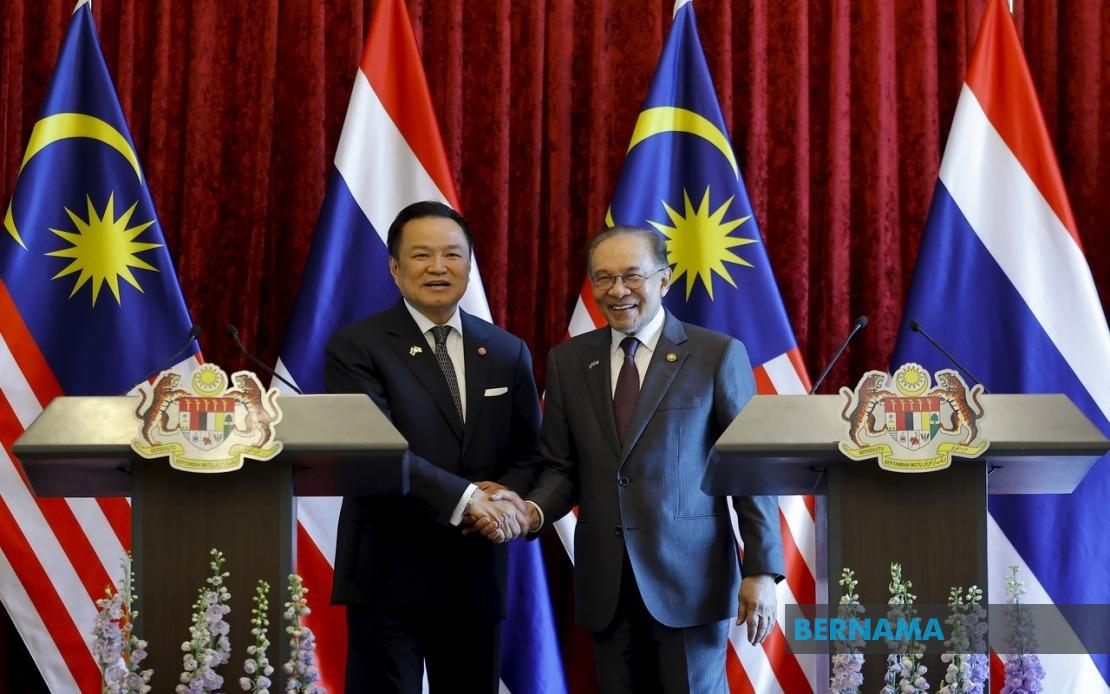
Prime Minister Datuk Seri Anwar Ibrahim and Thailand's Premier Anutin Charnvirakul have charted an ambitious roadmap for closer bilateral cooperation, cementing a commitment to accelerate multiple cross-border development schemes and reshape the economic landscape along their shared frontier. The two leaders, meeting in Putrajaya on July 9, endorsed a strategic framework designed to unlock substantial trade gains and deepen integration across their respective economies within the next three years.
The centrepiece of the partnership is an audacious target of achieving USD30 billion in bilateral trade by 2027, a significant step-up from current levels that underscores both nations' confidence in the potential of their complementary economies. To realise this objective, the governments have committed to expediting a portfolio of border connectivity infrastructure, recognising that physical links remain fundamental to seamless commerce. This initiative extends beyond conventional highway and rail development to encompass digital connectivity and logistics hubs that would position the Malaysia-Thailand frontier as a thriving commercial corridor rather than a mere administrative boundary.
Central to the bilateral strategy is the establishment of special border economic zones, a mechanism increasingly deployed across Southeast Asia to stimulate targeted growth in designated regions. These zones would permit participating businesses to operate under streamlined regulatory environments, offering tax incentives and customs flexibility to encourage investment and entrepreneurship. For Malaysia, such zones could catalyse economic activity in northern states such as Perlis, Kedah, and Perak, regions that have historically lagged behind more developed parts of the country. Thailand stands to gain similarly in its border provinces, creating reciprocal benefits that bind both economies more tightly together.
Anwar emphasised that the bilateral relationship, rooted in shared history and cultural affinity, possesses far greater untapped potential than currently realised. His characterisation of the meeting as substantive and fruitful reflected the concrete outcomes achieved, though both leaders acknowledged that sustained effort across multiple policy domains would be required to translate ambition into results. The Prime Minister's remarks underscored Malaysia's philosophical approach to regional engagement: recognising that prosperity is interdependent and that neighbouring economies thrive or struggle together, a perspective increasingly vital as the region navigates post-pandemic recovery and geopolitical shifts.
Simplification of immigration and customs procedures represents another pillar of the agreement, addressing a persistent friction point for businesses operating in border areas. Harmonising documentation requirements, streamlining documentation processing, and establishing trusted trader programmes can substantially reduce transaction costs and transit times. For Malaysian exporters accessing Thai markets and Thai investors eyeing Malaysian opportunities, such facilitation measures translate directly into enhanced competitiveness and margin improvement. Regional patterns suggest that nations prioritising border efficiency gain disproportionate advantages in attracting supply chain investment from multinational corporations seeking to optimise operations across Southeast Asia.
The planned visit to Bukit Kayu Hitam and Sadao, the border towns respectively in Kedah and Songkhla provinces, signals the tangible nature of the partnership. This deliberate extension of high-level engagement beyond capital cities carries symbolic weight, demonstrating that the collaboration is designed to benefit frontier communities rather than remaining confined to ministerial discourse in national capitals. Anutin's participation in border area visits reflects personal commitment to the agenda and provides platforms for local stakeholders to articulate specific challenges and opportunities that might otherwise remain invisible to policymakers in Bangkok and Kuala Lumpur.
The timing of this bilateral push merits consideration within the broader Southeast Asian context. Regional trade growth has decelerated from pre-pandemic trends, and individual economies face headwinds from elevated global interest rates and uncertain external demand. Bilateral and sub-regional arrangements offer nations some insulation against these macroeconomic currents by deepening specialisation and creating integrated production networks. A reinvigorated Malaysia-Thailand partnership could serve as a template for other ASEAN pairs seeking to maximise mutual benefit through coordinated infrastructure investment and regulatory alignment.
Historically, Malaysia-Thailand relations have experienced periodic strains rooted in maritime boundary disputes and immigration issues, though both governments have generally maintained pragmatic engagement. This fresh commitment to collaborative projects builds upon decades of diplomatic groundwork and represents a maturation of bilateral ties toward a relationship founded increasingly on economic interdependence rather than political necessity. The willingness of both leaderships to address outstanding issues, as referenced by Anwar, suggests a recognition that unresolved tensions, if left to fester, risk undermining the very partnership being constructed.
For Malaysian businesses, particularly small and medium enterprises, the bilateral framework offers avenues for market expansion previously constrained by tariff barriers and logistical friction. Access to Thailand's 70-million-person consumer base, combined with opportunities to participate in Thai-based manufacturing networks serving regional and global markets, represents tangible commercial opportunity. Conversely, Thai firms gain access to Malaysia's strategic position in global semiconductor and petrochemical supply chains, positioning themselves advantageously for future growth in those sectors.
Achieving the USD30 billion trade target by 2027 will require sustained implementation commitment from both governments, particularly in completing infrastructure projects on schedule and maintaining political momentum across electoral cycles and leadership transitions. The specific mechanisms for monitoring progress, resolving implementation bottlenecks, and adjusting strategy as circumstances evolve remain to be detailed, though the establishment of bilateral working groups and coordinating committees typically follows such high-level agreements. Success will ultimately hinge on whether private sector participants view the enabling environment created by government as sufficiently predictable and rewarding to justify investment and operational restructuring required to deepen cross-border economic linkages.

