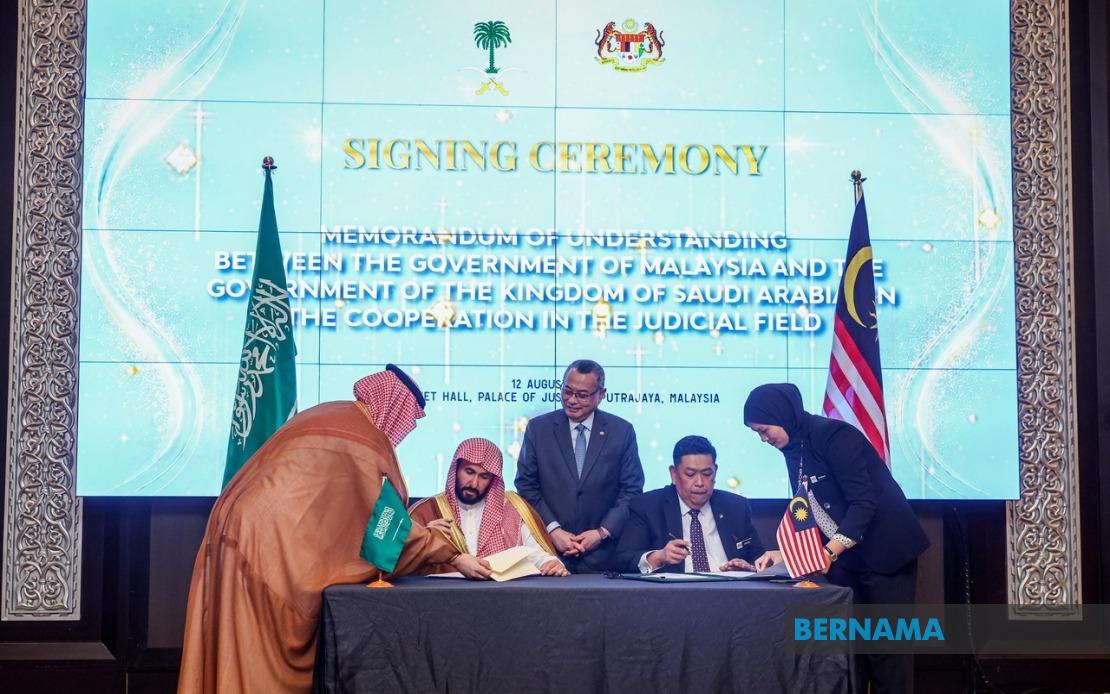
Malaysia and Saudi Arabia have taken a significant step forward in strengthening their bilateral relations by formalising judicial cooperation through a comprehensive memorandum of understanding signed at the Palace of Justice in Putrajaya. The agreement, inked by Chief Registrar of the Federal Court Azhaniz Teh Azman Teh and Saudi Arabian Minister of Justice Sheikh Dr Waleed Mohammed Alsmani, signals deepening institutional ties between the two nations' court systems and reflects their commitment to modernizing judicial administration across the Islamic world.
The signing ceremony, conducted under the witness of Chief Justice Tun Wan Ahmad Farid Wan Salleh, occurred during the Saudi minister's official state visit to Malaysia. This timing underscores the diplomatic importance both countries attach to the judicial partnership, positioning it as a cornerstone of their broader engagement strategy. The presence of Malaysia's highest judicial officer at the ceremony demonstrated the significance afforded to this agreement within the Malaysian legal establishment and signalled readiness at the most senior levels to implement its provisions.
The MoU establishes a structured institutional framework covering multiple dimensions of judicial practice and administration. Most significantly, the agreement encompasses cooperation in civil case management methodologies, allowing both nations to learn from each other's approaches to handling complex litigation. This exchange of best practices holds particular relevance for Malaysia, which has increasingly sought to reduce case backlogs and improve judicial efficiency through process innovation.
Judicial technology and digitalisation form a cornerstone of the partnership, with both countries recognising that court modernisation is essential for delivering justice effectively in the digital age. Malaysia's experience with its e-Court system, which has substantially streamlined proceedings and improved access to judicial information, provides valuable lessons that Saudi Arabia's judiciary may adapt to its own context. The emphasis on technology transfer reflects how developing nations can collaborate to reduce the costs and complexities associated with independent system development.
Beyond procedural cooperation, the agreement facilitates the systematic exchange of publicly available judicial information and practical experience between institutions. This transparency-focused approach creates opportunities for comparative legal analysis and helps both judiciaries understand contemporary approaches to common challenges. Regular institutional visits are envisioned, enabling judicial officers and court administrators from each nation to observe operations firsthand and build professional networks that transcend formal diplomatic channels.
A particularly noteworthy aspect of the cooperation programme centres on Malaysia's judicial handling of sexual offences against children. During the formal visit, Saudi officials participated in dialogue sessions exploring Malaysia's specialised approaches to these sensitive cases, including victim protection measures and evidence-gathering protocols. This knowledge-sharing addresses a universal challenge facing judicial systems and demonstrates how nations with different legal traditions can collaborate on issues affecting vulnerable populations.
The Malaysian judiciary has explicitly framed this agreement as foundational to deepening long-established ties between the two countries. For Malaysia, engagement with Saudi Arabia carries strategic significance given the kingdom's influential role in the Islamic world and its position as a major source of foreign investment and technology transfer. Strengthening judicial cooperation can facilitate commercial partnerships by building confidence in dispute resolution mechanisms and demonstrating the robustness of Malaysian legal institutions to potential investors from the Gulf.
The MoU's emphasis on civil case management carries implications beyond bilateral relations. As a regional hub for Islamic finance and Shariah law development, Malaysia's innovations in court administration and case handling may find wider adoption throughout Southeast Asia and the Middle East. Saudi Arabia's interest in these systems suggests that Malaysian judicial expertise is increasingly recognised as globally competitive and worthy of emulation.
For Malaysian legal practitioners, this agreement opens pathways for professional development through exposure to different judicial systems and procedures. The promise of regular exchanges and institutional visits creates opportunities for judges, legal researchers, and court administrators to enhance their skills and understanding of comparative law. Such professional enrichment ultimately benefits Malaysia's own legal system through the infusion of international perspectives and contemporary practices.
The timing of this partnership also reflects broader strategic positioning by Malaysia within regional geopolitics. By cementing ties with Saudi Arabia's judiciary, Malaysia strengthens its credentials as a bridge between Southeast Asian and Middle Eastern legal traditions. This positioning becomes increasingly valuable as regional disputes increasingly involve cross-border commercial and family law matters requiring mutual legal recognition and cooperation.
Looking forward, the success of this MoU will depend on meaningful implementation and sustained political will from both sides. The appointment of focal points within each judiciary, the scheduling of exchange programmes, and the actual transfer of technological expertise will determine whether the agreement remains symbolic or generates tangible improvements in judicial practice. Malaysian court officials have committed to actively advancing the partnership's objectives, suggesting genuine institutional investment rather than merely ceremonial engagement.
The broader implications for Malaysia's regional standing should not be underestimated. As this country positions itself as a centre of excellence in Islamic jurisprudence and modern judicial administration, international partnerships with major powers like Saudi Arabia reinforce this narrative. The agreement demonstrates that Malaysian institutions are sufficiently sophisticated to attract the interest of wealthier, more established systems and that our judicial expertise commands respect beyond our borders.
Ultimately, this MoU represents more than a technical agreement between two court systems. It embodies a strategic understanding that judicial cooperation strengthens bilateral relations, facilitates commerce and investment, and contributes to regional stability through improved legal certainty and dispute resolution mechanisms. For Malaysia, leveraging this partnership effectively could enhance its profile as a jurisdiction of choice for international dispute resolution while simultaneously building institutional capacity through exposure to global best practices.

