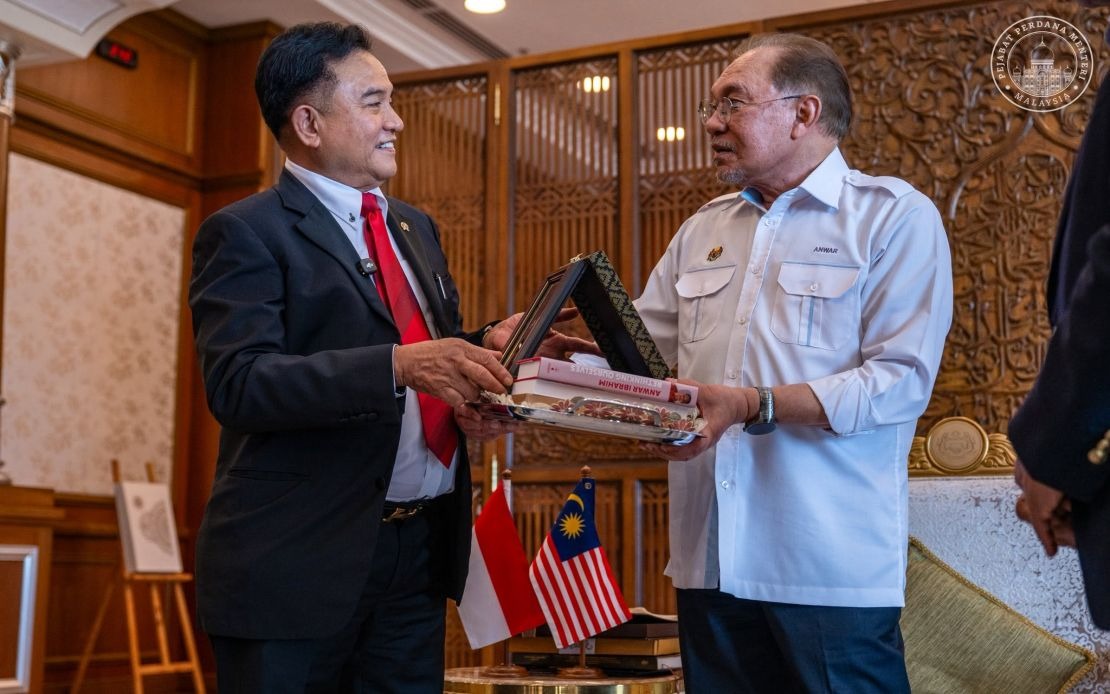
Prime Minister Datuk Seri Anwar Ibrahim has reaffirmed Malaysia's commitment to broadening cooperation with Indonesia across legislative reform, governance structures and other areas of shared strategic interest. The commitment emerged during a bilateral engagement at Putrajaya, where Anwar received a courtesy visit from Indonesia's Coordinating Minister for Legal, Human Rights, Immigration and Correction, Prof Dr Yusril Ihza Mahendra. The meeting underscores the ongoing momentum in diplomatic relations between Southeast Asia's two largest economies and reflects their determination to address mutual challenges through institutional strengthening.
The discussions centred on mechanisms to deepen partnership in legislative harmonisation and governance frameworks—domains where Malaysia and Indonesia have historically found considerable common ground given their shared legal traditions and constitutional structures. Both nations recognise that aligning legislative approaches and governance practices can facilitate smoother cross-border transactions, enhance regulatory certainty, and create more efficient channels for addressing transnational issues ranging from immigration and border management to human rights standards. The scope of cooperation extends beyond formal legal architecture to encompass broader institutional capacity-building initiatives.
Anwar, who holds dual responsibility as Prime Minister and Finance Minister, highlighted the importance of exchanging perspectives on how each country's legislative and administrative systems can evolve in ways that benefit both populations. This dual focus on governance efficiency and legal modernisation reflects a pragmatic approach to bilateral engagement—moving beyond symbolic gestures toward substantive policy coordination. The Malaysian leader's emphasis on strengthening frameworks suggests recognition that institutional cooperation, while less visible than trade or defence partnerships, forms the bedrock of sustainable regional integration.
Indonesia's delegation, led by Prof Dr Yusril Ihza Mahendra, brings particular significance given his portfolio encompassing legal affairs and human rights. His involvement signals that Jakarta views these discussions as integral to its broader governance agenda and its commitment to rule-of-law advancement across the region. The coordination ministry's mandate spans multiple critical areas, indicating that the bilateral partnership discussion encompasses not merely legislative mechanics but also human rights compliance, correctional system standards, and immigration protocols—all areas where regional harmonisation can produce tangible improvements.
For Malaysia, deepening legislative cooperation with Indonesia addresses several strategic imperatives. Regional disparities in legal frameworks and governance standards can create friction points in bilateral relations and complicate commerce. By establishing stronger foundations for legislative dialogue and institutional exchange, both countries position themselves to address emerging challenges more effectively. Climate policy, digital governance, and cross-border labour mobility represent contemporary issues where coordinated legislative responses generate superior outcomes compared to unilateral action.
The emphasis on "close fraternal relations" in Anwar's remarks carries particular weight given the historical texture of Malaysia-Indonesia ties. While the two nations share linguistic, cultural and religious heritage, their relationship has occasionally been marked by territorial disputes and policy divergences. Positioning cooperation in governance and legislation as a cornerstone of the relationship reflects confidence that institutional frameworks and rule-based approaches can transcend historical sensitivities and channel bilateral engagement toward constructive ends.
From a Southeast Asian perspective, stronger Malaysia-Indonesia cooperation in governance matters has multiplicative effects. As ASEAN's two largest members by population and economy, initiatives they jointly pursue often set patterns that influence regional standards and practices. Enhanced legislative cooperation between them could catalyse broader ASEAN efforts toward regulatory harmonisation, particularly in areas affecting intra-regional commerce and people-to-people movement. The bilateral partnership thus functions as a potential engine for deepening the broader regional integration architecture.
The timing of this engagement, in late June, places it within an ongoing cycle of bilateral high-level visits that have characterised recent Malaysia-Indonesia relations. These regular contacts reflect both capitals' interest in maintaining momentum in ties and ensuring that cooperation initiatives at the ministerial level translate into concrete policy outcomes. The courtesy call format, while seemingly ceremonial, provides structured space for substantive discussion and signals that both governments treat the relationship as a priority warranting regular diplomatic attention at senior levels.
Looking forward, the commitment articulated during this meeting will likely translate into follow-up mechanisms at the technical level, with officials from both justice and governance ministries tasked with developing specific areas of legislative collaboration. Such implementation structures often prove more consequential than the public diplomatic statements that accompany bilateral engagements. The real test of this renewed commitment will emerge through measurable outcomes—whether in harmonised standards, joint policy initiatives, or expanded institutional exchange mechanisms that benefit officials, legal professionals and ultimately citizens of both nations.
The broader context for this cooperation involves both countries navigating evolving global governance standards and regional integration pressures. Digital governance, data protection, and cybersecurity legislation increasingly demand cross-border coordination. Malaysia and Indonesia, both grappling with rapid digitalisation and its governance implications, have clear incentives to learn from each other's legislative and regulatory approaches. Similarly, transnational issues including human trafficking, organised crime and irregular migration require the institutional coordination and legislative alignment that this partnership framework promises to facilitate.
For Malaysian stakeholders across business, civil society and government, the practical implications involve potential changes in how legislation evolves domestically. Where Indonesia develops innovative governance solutions—whether in digital administration, human rights protections or administrative efficiency—Malaysia gains opportunities to adapt successful models for local application. Reciprocally, Indonesian policymakers can access Malaysian legislative experience and institutional practices. This horizontal learning across comparable democracies and institutional systems generates more contextually appropriate solutions than importing governance frameworks from distant developed economies.

