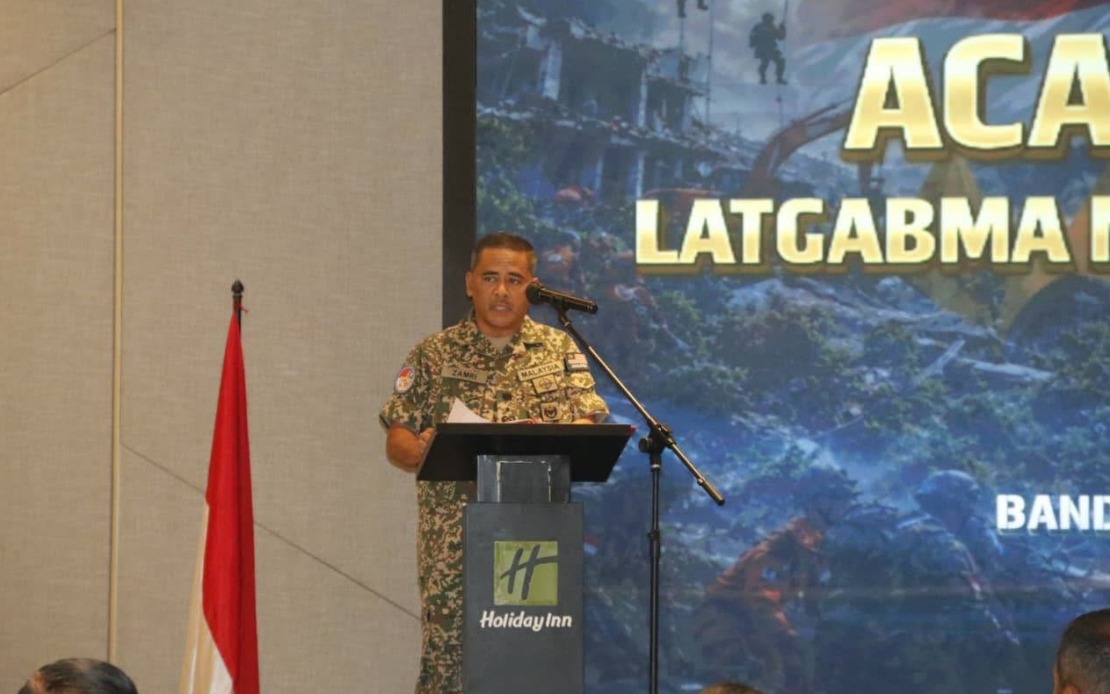
The Malaysian Armed Forces and their Indonesian counterparts have moved to reinforce bilateral defence relationships through a comprehensive 13-day joint military exercise conducted in Lampung, Sumatra. The LATGABMA MALINDO DARSASA 12AB/2026 exercise, now underway in the Indonesian province, brings together 719 personnel across various military and civilian agencies from both countries in what represents a significant step in regional security cooperation. According to the Joint Forces Headquarters statement, this exercise transcends routine training operations to embody the deeper strategic partnership and mutual confidence that has developed between Kuala Lumpur and Jakarta over decades of defence collaboration.
The exercise framework extends beyond traditional military drills, addressing the evolving security landscape that confronts Southeast Asia. Brigadier General Datuk Zamri Othman, Commander of the 1st Infantry Brigade and Chief of the MAF Exercise Planning Group, emphasised that contemporary threats have fundamentally altered the nature of defence readiness. Maritime piracy, transnational smuggling networks, terrorism financing, sophisticated cyber intrusions, and the increasing frequency of natural disasters all demand that neighbouring nations develop coordinated response mechanisms. For Malaysia and Indonesia, which share maritime boundaries and face common vulnerabilities, such integration of operational planning and personnel training represents a practical acknowledgment of interdependence in an uncertain regional environment.
The selection of Lampung as the exercise location carries particular strategic significance. The province sits along the convergence of three active tectonic plate systems, subjecting it to regular earthquake and tsunami threats. By conducting the training scenario in this geologically dynamic area, both armed forces gain exposure to realistic disaster conditions rather than theoretical simulations. The exercise curriculum explicitly incorporates lessons drawn from Indonesia's bitter experiences with major seismic events and subsequent humanitarian catastrophes. This grounding in authentic environmental challenges ensures that participating personnel develop competencies transferable to actual emergency situations across the broader region.
The exercise structure comprises two interconnected phases designed to build understanding progressively. The initial Staff Exercise phase focuses on ten critical operational scenarios: Initial Disaster Response, Mass Casualty Incident, Infrastructure Collapse, Medical Emergency, International Assistance, Cyber Attack, Information Warfare, Mass Evacuation, Stabilisation Phase, and Transition Phase. This academic foundation allows commanders and planning staff to examine complex decision-making processes and coordination challenges before moving to practical implementation. By working through these scenarios jointly, Malaysian and Indonesian military leaders develop shared understanding of each other's operational doctrines, communication protocols, and institutional constraints, reducing friction during actual combined operations.
The Field Training Exercise component integrates personnel from multiple agencies beyond the armed forces. The Indonesian National Search and Rescue Agency, disaster preparedness volunteer units, the Indonesian Red Cross, and regional disaster management authorities participate alongside MAF and TNI personnel. This inter-agency approach reflects how modern humanitarian and disaster response operations demand seamless coordination across civilian and military hierarchies. Malaysian observers gain insight into how Indonesian civilian institutions function during emergencies, while Indonesian counterparts witness Malaysian approaches to command structure and resource allocation. Such exposure builds the informal networks and personal relationships that facilitate rapid cooperation when actual disasters strike.
The Force Integration Training component emphasises practical competencies critical to field operations. Participants engage in rope and rappelling techniques, emergency medical response procedures, and field hospital establishment protocols. These seemingly mundane skills prove essential when infrastructure collapses and conventional medical facilities become inaccessible. The training recognises that effective disaster response often depends less on sophisticated technology than on trained personnel capable of functioning under resource constraints and physical danger. By practising these skills alongside Indonesian counterparts, Malaysian service members develop confidence in their ability to work effectively within unfamiliar organisational contexts and with personnel trained under different doctrinal frameworks.
Beyond the humanitarian focus, the exercise incorporates a significant cyber security component that addresses non-physical threats. The cyber training module covers technical attack methodologies including reconnaissance activities, enumeration processes, credential compromise attacks, man-in-the-middle interception, spoofing techniques, and data feed manipulation. As both Malaysia and Indonesia develop increased dependence on digital systems for critical infrastructure management, developing joint capacity to defend against cyber threats becomes strategically essential. Military personnel from both nations gain understanding of how their counterparts approach cyber defence, enabling better coordination should cyberattacks target shared regional interests or cross-border infrastructure.
The exercise maintains continuity with a longer institutional history. LATGABMA MALINDO DARSASA exercises trace their origins to 1984, conducted triannually on a rotational basis through the General Border Committee and the Malaysia-Indonesia Joint Training Committee. This four-decade trajectory of regular interaction has created deeply embedded institutional relationships and shared understanding of operational norms. The previous iteration in 2023 in Pekan, Pahang employed an anti-terrorism focus, while the current edition emphasises disaster preparedness. This rotation between different threat scenarios ensures both nations maintain versatility in responding to the multiple security challenges they confront.
The exercise composition reflects careful calibration of force structure. The 463 TNI personnel substantially outnumber the 150 Malaysian service members, appropriate given the exercise occurs on Indonesian territory and employs Indonesian civilian agencies as training partners. The inclusion of 25 Indonesian National Police officers, two Malaysian National Disaster Management Agency representatives, and 79 additional Indonesian agency personnel demonstrates how modern security challenges cut across traditional military-police-civilian boundaries. Effective response requires institutional actors from multiple sectors developing common understanding of objectives, protocols, and command relationships.
The humanitarian projects embedded within the exercise translate training into tangible community benefit. Engineering civil action programmes involve renovation of uninhabitable housing units in Kampung Sukamaju and construction of concrete roadway infrastructure in Kampung Keteguhan. Medical civic action components provide general health screenings, optical services, and blood donation drives through local community health centres. These activities build goodwill with Indonesian civilian populations while providing training value for Malaysian military medical personnel. The combination of operational training with community benefit creates a framework where military cooperation simultaneously serves humanitarian objectives.
For Malaysia, participation in this exercise reinforces several strategic interests. The training exposure strengthens the MAF's capacity to respond to potential cross-border disasters affecting both nations. The cyber security training addresses growing concerns about digital infrastructure vulnerability as Malaysia develops smart city initiatives and digital economic frameworks. The exercise also demonstrates Malaysia's commitment to regional security partnerships at a time when geopolitical competition from major powers intensifies. By maintaining robust bilateral military cooperation with Indonesia, Malaysia signals that Southeast Asian states intend to shape their own security environment rather than becoming passive spectators to great power competition.
The broader significance extends beyond the immediate bilateral relationship. Indonesia and Malaysia represent the two largest military establishments in Southeast Asia. Their capacity to cooperate effectively on shared threats influences regional stability more broadly. As maritime security challenges, transnational crime networks, and cyber threats increasingly transcend national boundaries, the development of coordinated response frameworks becomes essential. The LATGABMA MALINDO DARSASA exercise, through its focus on realistic disaster scenarios and cyber defence, signals that both nations understand their security futures as fundamentally interconnected. This recognition provides a foundation for continued institutional development and operational integration across multiple threat domains.