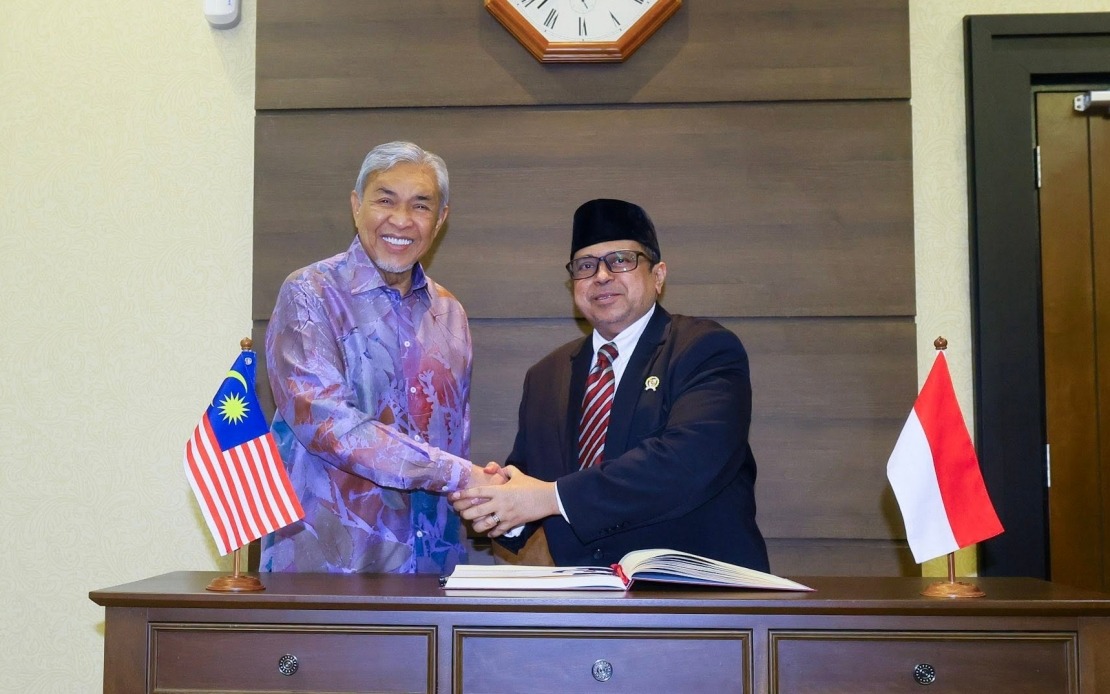
Malaysia and Indonesia are poised to deepen their partnership across critical economic sectors, with Deputy Prime Minister Datuk Seri Dr Ahmad Zahid Hamidi emphasising the two nations' shared commitment to fortifying the halal industry as a cornerstone of mutual prosperity. The commitment emerged during discussions at Parliament between Malaysian officials and a high-level Indonesian delegation comprising Ambassador Raden Datuk Mohammad Iman Hascarya Kusumo and Dr Ahmad Haikal Hassan, head of Indonesia's Halal Product Assurance Organising Body (BPJPH).
Beyond the halal sector, the bilateral dialogue revealed ambitions to expand cooperation into trade facilitation, rural development initiatives, and capacity building in human resources—sectors where both nations share complementary strengths and comparable development priorities. The breadth of these discussions underscores a strategic recognition that sustained economic growth requires coordinated advancement across multiple domains rather than siloed efforts.
The most substantive outcome centres on the proposed establishment of three interconnected halal governance structures. The Malaysia-Indonesia Halal Council (MIHC) would serve as the primary mechanism through which both nations align regulatory frameworks, certification standards, and investment protocols. This bilateral body would be flanked by the ASEAN Halal Council, expanding the standardisation mandate across Southeast Asia's ten member states, and the World Halal Development Council, positioning the region at the forefront of global halal commerce and Islamic finance.
The significance of these institutions lies in their potential to eliminate fragmented standards that currently complicate cross-border trade and investment. Currently, halal certification remains inconsistent across jurisdictions, creating friction for manufacturers and exporters seeking to serve multiple Muslim-majority markets simultaneously. By harmonising these requirements, Malaysia and Indonesia would reduce compliance costs for businesses and accelerate the movement of halal-certified goods throughout the region and beyond.
Malaysia's position as a global halal hub is already well-established through its governance infrastructure, certification expertise, and accumulated brand equity in the sector. Indonesia, conversely, possesses the largest Muslim population globally and substantial manufacturing capacity, positioning it as both a major producer and consumer of halal products. The complementarity is striking: Malaysia provides regulatory sophistication and international credibility, while Indonesia offers scale and market access to over 270 million consumers. When combined through formal institutional arrangements, this pairing could reshape global halal commerce patterns.
The halal industry represents one of Southeast Asia's most underexploited economic opportunities. Current global halal food and beverage markets exceed $2 trillion annually, with Muslim consumers representing roughly a quarter of the world's population. Yet the region's share of this market remains disproportionately modest relative to its Muslim demographic weight and production capabilities. Structural barriers—including inconsistent standards, fragmented supply chains, and limited international marketing coordination—have constrained regional actors' ability to capture value that currently accrues to established players in Europe, Australia, and East Asia.
Ahmad Zahid, who chairs the Malaysia Halal Industry Development Council, framed the initiative within the context of Malaysia and Indonesia's historical partnership, suggesting that strengthened institutional ties would catalyse broader economic cooperation. This rhetorical framing matters, as it positions halal standardisation not as a technical compliance exercise but as an expression of bilateral commitment and shared regional leadership.
For Malaysian businesses, these arrangements offer tangible benefits. Manufacturers and exporters could access Indonesian distribution networks and consumer markets with reduced friction, provided their products meet harmonised standards. Similarly, Indonesian producers gain validation from Malaysia's internationally recognised halal certification, facilitating entry into premium markets in the Middle East, Europe, and North America where Malaysian halal credentials carry substantial weight.
The proposed councils also address a strategic vulnerability: the global halal sector currently lacks cohesive representation and standard-setting authority comparable to conventional trade governance bodies. By establishing these platforms, Malaysia and Indonesia position themselves to influence emerging international frameworks, particularly as major importing nations increasingly codify halal requirements into their procurement and food safety regulations. Early institutional dominance could yield outsized influence over standards that eventually become globally binding.
Indonesia's recent establishment of the BPJPH itself represents a maturation of its halal governance capacity, creating a credible counterpart for Malaysian institutional bodies. This development removes a previous asymmetry in regulatory sophistication and enables more equitable negotiation of standards and cooperative arrangements. The presence of the BPJPH head in these discussions signals Jakarta's determination to match Kuala Lumpur's halal sector leadership ambitions.
For the broader Southeast Asian region, Malaysia-Indonesia coordination on halal standards creates beneficial spillovers. If these two largest Muslim-majority economies establish harmonised requirements, other ASEAN members face incentives to align with that emerging standard rather than developing divergent frameworks. This could catalyse a race to the top in halal governance rather than a fragmented regulatory landscape.
The timing of this initiative also reflects economic pragmatism. Both nations face pressures to diversify revenue sources amid global energy transition uncertainties. The halal sector, characterised by growing consumer demand and relatively insulation from fossil fuel dependencies, represents a defensible pillar for future growth. Investment in institutional infrastructure now positions both countries to capture disproportionate share of this expanding market as global wealth among Muslim consumers continues rising.

