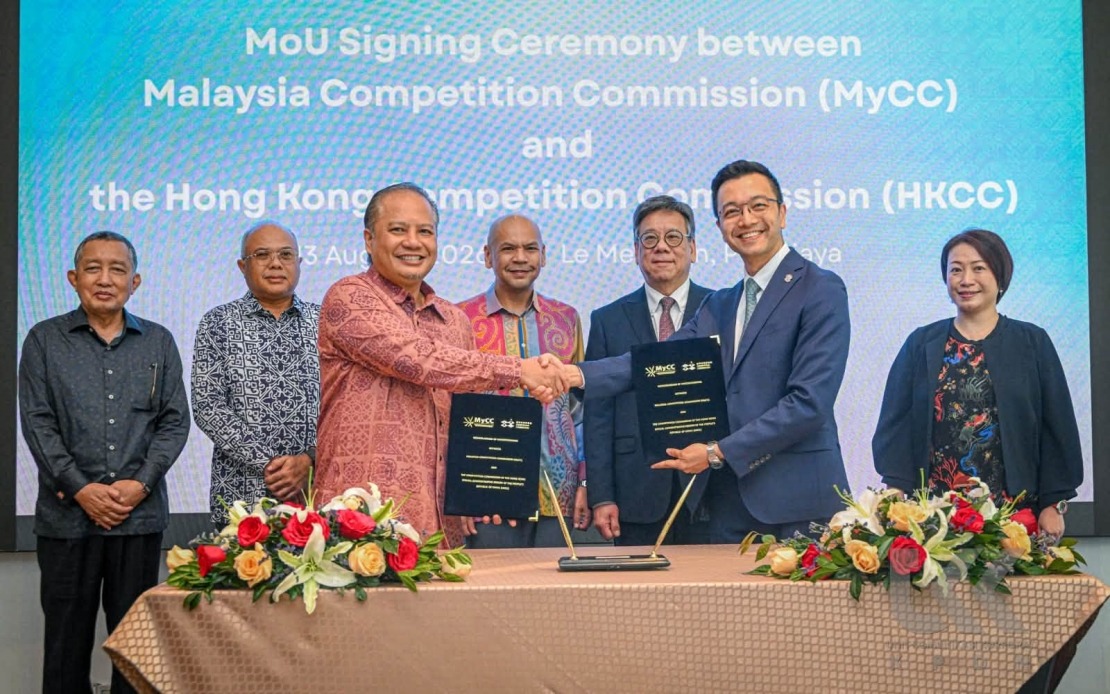
The Malaysia Competition Commission and the Hong Kong Competition Commission have formalized their partnership through a Memorandum of Understanding aimed at deepening collaboration on competition policy enforcement and regulatory frameworks. Signed today, the agreement represents a significant step in addressing the complex realities of modern regional commerce where anti-competitive practices frequently transcend national boundaries and require coordinated investigative responses.
Domestic Trade and Cost of Living Minister Datuk Armizan Mohd Ali emphasized that this partnership reflects Malaysia's broader commitment to aligning with international best practices in competition regulation. The MoU joins three predecessors involving cooperation frameworks with the Türkiye Competition Authority, Korea Fair Trade Commission, and the Philippine Competition Commission, positioning MyCC as an increasingly active participant in the global competition enforcement network. For Malaysian consumers and businesses, this web of international agreements creates the potential for more effective policing of monopolistic behaviour that crosses regional lines.
The minister articulated a critical rationale underpinning the agreement: today's businesses operate within supply chains and markets that are fundamentally transnational in character. When companies engage in cartels, abuse dominant positions, or implement exclusionary practices, the impacts ripple across multiple jurisdictions simultaneously. Without formal channels for information-sharing and coordinated investigation between regulators, enforcement becomes fragmented and ineffective. The MoU addresses this structural gap by establishing formal pathways for Malaysia and Hong Kong authorities to work in tandem on these cross-border matters.
Practically, the cooperation framework envisions regular exchange of intelligence on significant developments in competition law, including legislative changes that each jurisdiction implements. This knowledge transfer allows regulators to learn from each other's approaches and adapt successful enforcement strategies to their own legal contexts. For Malaysia, understanding how Hong Kong's advanced financial services sector manages competition concerns could prove particularly valuable given the growing interconnectedness of Malaysian and Hong Kong capital markets and the increasing complexity of regional commercial disputes.
The agreement also establishes concrete mechanisms for building institutional capacity within both competition commissions. Training programmes, joint workshops, and officer secondment arrangements will facilitate the direct transfer of enforcement expertise. MyCC staff may spend time embedded within HKCC operations to observe investigative techniques, while Hong Kong investigators could reciprocate by learning how MyCC navigates Malaysia's unique market structures and regulatory environment. Such direct professional exchange often proves more valuable than theoretical training, as it exposes competition officials to real-world problem-solving approaches.
Research collaboration constitutes another pillar of the partnership. By pooling intellectual resources, the two commissions can undertake deeper analytical work on emerging competition issues that affect both jurisdictions. Technology-driven markets, e-commerce platforms, and digital services present novel competition challenges that traditional regulatory frameworks sometimes struggle to address. Collaborative research allows Malaysia and Hong Kong to develop evidence-based approaches to these frontier issues rather than proceeding in isolation.
The minister's emphasis on bilateral and multilateral coordination reflects an important strategic insight: competition enforcement increasingly requires networks rather than isolated national actions. When MyCC identifies a cartelist operating simultaneously in Malaysia and Hong Kong, the ability to share investigative findings and coordinate enforcement actions dramatically increases the likelihood of meaningful penalties and deterrence. This matters enormously for Malaysian consumers, who benefit when regional monopolies and price-fixing schemes are effectively disrupted through coordinated enforcement.
For Malaysia's broader economic positioning within Southeast Asia and beyond, the competition law partnership signals institutional maturity and commitment to transparent, rules-based commerce. International investors assess regulatory quality partly by observing how seriously a jurisdiction takes competition enforcement. By demonstrating that MyCC operates within a sophisticated international enforcement network, Malaysia enhances its reputation as a place where fair competition is protected and crony capitalism is actively challenged. This can attract investment from companies that value competitive markets and transparent business environments.
The KPDN ministry's statement that it will continue strengthening ties with regional and international competition authorities suggests this MoU is not an endpoint but rather part of a continuous expansion of Malaysia's competition diplomacy. In Southeast Asia, where ASEAN integration continues accelerating, such bilateral frameworks lay groundwork for potential multilateral competition arrangements that could eventually coordinate enforcement across the entire region. The Philippines agreement mentioned in the minister's statement already represents a crucial step in this direction.
Consumers stand to gain tangible benefits from this enforcement cooperation. Price-fixing conspiracies, market allocation schemes, and other cartel activity often involve participants across multiple countries. When regulators can efficiently share evidence and coordinate investigations, they disrupt these cartels more effectively and secure larger penalties, which theoretically translates into lower prices and better choices for end consumers. The telecommunications, aviation, maritime shipping, and automotive industries frequently feature cross-border competition concerns that directly affect Malaysian households and businesses.
The agreement also addresses a practical enforcement challenge: determining whether a particular behaviour constitutes a violation sometimes depends on understanding market conditions and competitive dynamics in another jurisdiction. By fostering ongoing dialogue with HKCC, MyCC gains insight into how certain practices function in Hong Kong's sophisticated market and can better assess whether similar behaviour in Malaysia warrants investigation or enforcement action. This comparative analysis strengthens the intellectual foundation for Malaysia's enforcement decisions.
Looking forward, the MoU creates infrastructure that could facilitate more ambitious cooperation projects. Joint task forces investigating specific cartels, coordinated raids across borders, and shared prosecution resources represent possibilities once the foundational relationship deepens. Such arrangements currently exist in other regions, notably the European Union and North America, and demonstrate how serious competition enforcement requires institutional mechanisms that transcend national sovereignty. Malaysia's entry into such arrangements, however modest the current steps, positions the country as part of an emerging Southeast Asian competition enforcement architecture.
Ultimately, the Malaysia-Hong Kong competition cooperation agreement reflects a broader global trend: regulators increasingly recognize that enforcing competition law in a borderless digital economy demands cross-jurisdictional collaboration. For Malaysia, this partnership with Hong Kong, building on existing relationships with Turkey, South Korea, and the Philippines, demonstrates that MyCC has graduated from a purely domestic watchdog into a meaningful participant in international competition governance. This evolution serves Malaysian economic interests by ensuring that the country's markets remain contestable, dynamic, and resistant to the monopolistic practices that ultimately harm consumers and stifle entrepreneurship.

