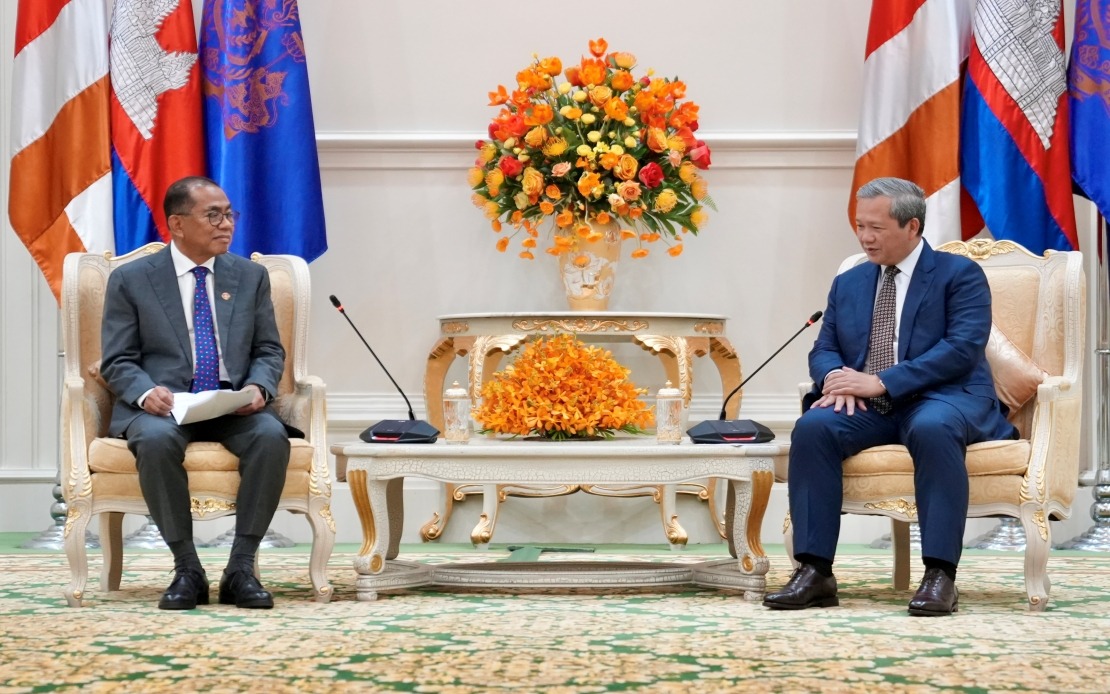
Malaysia's Defence Minister Datuk Seri Mohamed Khaled Nordin has elevated defence partnerships with Cambodia through strategic engagements in Phnom Penh, underscoring both nations' determination to broaden security collaboration and contribute to ASEAN's collective resilience during an increasingly complex regional environment. The visit, which included a courtesy call on Cambodian Prime Minister Samdech Thipadei Hun Manet at the Peace Palace, reflects the deeper institutional commitment Malaysia maintains toward Southeast Asian stability even as its chairmanship of the regional bloc concludes this year.
At the heart of these discussions lies the finalisation of the Malaysia-Cambodia Defence Cooperation Memorandum of Understanding, a framework designed to systematically expand security coordination across multiple domains. This agreement represents more than ceremonial diplomacy; it provides a structured mechanism through which both countries can operationalise shared interests in regional security, moving bilateral relations beyond ad-hoc engagements toward sustained institutional cooperation. The timing of pushing this accord toward completion signals recognition among ASEAN states that formalised defence ties are essential infrastructure for addressing transnational security threats.
The two defence ministers identified several contemporary security challenges requiring coordinated responses. Border stability along the Cambodia-Thailand frontier emerged as a significant concern, with both Malaysia and Cambodia emphasising dialogue and negotiation as pathways to sustainable peace. Malaysia's continued backing for the ASEAN Observer Team mechanism demonstrates how regional countries are institutionalising conflict prevention and monitoring, moving beyond traditional bilateral approaches to collective problem-solving that reflects ASEAN's foundational principles of centrality and dialogue-based diplomacy.
Arguably the most consequential agenda item centred on the South China Sea Code of Conduct, which remains one of the region's most consequential unresolved issues. By reaffirming their commitment to finalising this framework, Malaysia and Cambodia signal that rules-based maritime order matters to mid-sized powers seeking to insulate the region from great power domination. The COC represents a delicate calibration—accommodating Chinese interests while protecting the navigation rights and economic interests of Southeast Asian states. Malaysia's position as a country with significant maritime claims and trade dependencies makes this commitment particularly meaningful.
Defence cooperation is expanding into domains that reflect 21st-century security priorities rather than Cold War-era concerns. Jungle warfare training capabilities address genuine regional requirements, given the persistent challenges of internal security operations and cross-border threats that still characterise parts of Southeast Asia. However, the inclusion of artificial intelligence and drone technology development signals that Malaysia and Cambodia recognise military modernisation as essential for credible deterrence and effective operations in the digital age. Malaysia's defence industry, while smaller than those of Thailand or Vietnam, possesses niche capabilities that can create mutual learning opportunities with regional partners.
The broader strategic framework guiding these initiatives stems from Malaysia's National Defence Strategy, specifically its Third Pillar on Credible Partnerships. This doctrine acknowledges that Malaysia's security cannot be assured through military capacity alone; instead, it depends on building reciprocal relationships with neighbouring states and regional institutions that create networks of mutual assurance and coordinated responses. Datuk Seri Mohamed Khaled's sequential visits to Vietnam and Cambodia, involving senior military leaders including Chief of the Royal Malaysian Navy Admiral Tan Sri Zulhelmy Ithnain, demonstrate that defence diplomacy operates through high-level engagement and personal relationships alongside institutional mechanisms.
Cambodia's perspective in these discussions reflects its own security preoccupations, particularly regarding border stability and the complex relationships it navigates with larger regional powers. By formalising cooperation with Malaysia, Cambodia gains an additional security partner and access to Malaysia's expertise in areas such as maritime security and modern defence technologies. Simultaneously, Malaysia gains a more structured platform to influence regional security architecture and demonstrate active involvement in ASEAN cooperation beyond its formal chair responsibilities.
The anticipated signing of the Malaysia-Cambodia Defence Cooperation MoU during the ASEAN Defence Ministers' Meeting in the Philippines carries symbolic weight beyond the bilateral relationship. It signals to the region and beyond that ASEAN states continue deepening institutionalised cooperation despite external pressures and divergent economic interests. The multilateral Defence Ministers' forum provides visibility and legitimacy to bilateral achievements while embedding them within broader ASEAN security architecture, creating reinforcing cycles of commitment and demonstration effects that encourage other states to pursue similar formalisation.
Looking forward, the commemoration of 70 years of Malaysia-Cambodia diplomatic ties in 2027 provides a temporal anchor for expanded cooperation. Defence partnerships typically mature over decades rather than months, requiring sustained investment in training exchanges, joint exercises, and institutional learning. The explicit confidence expressed in strengthened cooperation reflects expectations that this MoU will establish patterns of interaction that extend across multiple government administrations and persist regardless of shifting political circumstances.
Malaysia's continued emphasis on regional peace and stability despite concluding its ASEAN chair term addresses a fundamental vulnerability facing small and medium-sized Southeast Asian states: their security depends on institutional structures and norms that transcend any single country's leadership tenure. By demonstrating commitment to partnership deepening after relinquishing the chair, Malaysia reinforces ASEAN's collective understanding that security cooperation represents a permanent organisational feature rather than a rhetorical priority that fluctuates with formal roles.
The convergence of Malaysia-Cambodia engagement with broader regional mechanisms like the Code of Conduct and ASEAN Observer Team illustrates how bilateral relationships and multilateral frameworks create mutually reinforcing architectures. Neither operates effectively in isolation; rather, they function as interconnected components of a security ecosystem. Malaysia's diplomatic investments in this ecosystem reflect strategic calculation that regional stability directly correlates with national prosperity and security, particularly for a nation dependent on regional trade routes and vulnerable to spillover effects from neighbouring conflicts.
The inclusion of defence industry and emerging technology cooperation signals awareness among Southeast Asian states that military modernity and technological capacity increasingly determine strategic relevance. As great powers compete for influence through technological access and transfer, Malaysia and Cambodia's joint focus on AI and drone capabilities represents efforts to develop autonomous capacity rather than remaining perpetually dependent on external suppliers. This dimension of the cooperation framework addresses long-term developmental ambitions alongside immediate security requirements.

