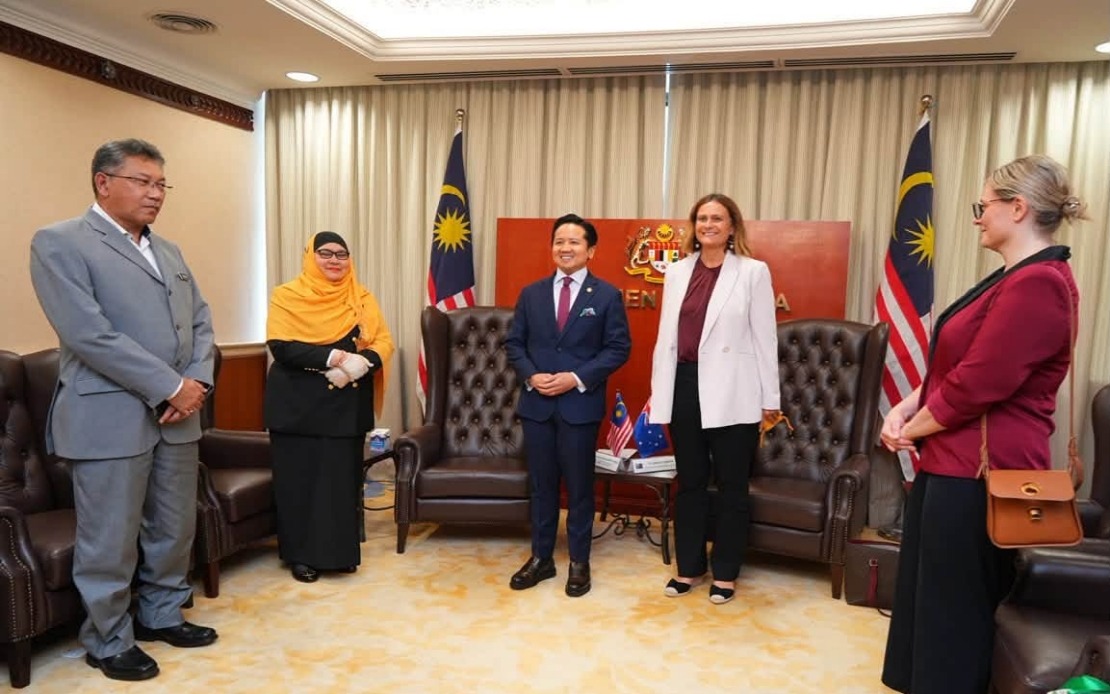
Malaysia and Australia are charting a new course in critical minerals collaboration, with high-level discussions in Putrajaya signalling both countries' commitment to building resilient supply chains for technologies essential to the global energy transition. The Natural Resources and Environmental Sustainability Ministry confirmed that Minister Datuk Seri Arthur Joseph Kurup and Australian High Commissioner to Malaysia Danielle Heinecke held talks at Parliament, where rare earth elements and advanced manufacturing emerged as priority areas for deeper bilateral engagement.
The strategic importance of this partnership cannot be overstated for Malaysia's position within regional supply chains. Australia is a global leader in extracting critical minerals, while Malaysia has established itself as a key processor of rare earth elements in Southeast Asia. By combining Australia's technical expertise with Malaysia's existing downstream capabilities, both nations aim to create a more integrated and competitive value chain that reduces dependency on other global players, particularly China, which currently dominates neodymium magnet production.
Central to Malaysia's ambitions is the National Mineral Policy 3, which explicitly targets the development of a comprehensive domestic rare earth value chain extending from midstream processing through to downstream manufacturing. Neodymium magnets, which are critical components in wind turbines, electric vehicle motors, and various defence applications, represent a high-value manufacturing opportunity that could anchor Malaysia's position in the global clean energy economy. Current discussions between the two countries suggest concrete pathways toward establishing production facilities locally, a development that would mark significant industrial progression for the region.
One particularly technical dimension of the cooperation involves the management of rare earth processing residues, specifically neutralisation underflow residue, or NUF. Handling NUF presents both environmental and economic challenges, as improper management can contaminate soil and water systems, while effective processing can recover valuable materials and reduce waste volumes. The exchange of best practices in this area demonstrates that both Malaysia and Australia are approaching rare earth development with environmental responsibility as a cornerstone principle, not an afterthought.
The partnership also reflects broader strategic calculations within the Indo-Pacific region. As supply chain security becomes increasingly critical to developed economies seeking alternatives to Chinese dominance, Malaysia's geographic location and existing industrial infrastructure position it as an attractive hub for downstream critical minerals processing. Australia's role as a primary supplier of raw materials, combined with its technical knowledge and regulatory frameworks, creates natural complementarities that benefit both economies and strengthen regional economic integration.
Beyond minerals, the ministerial discussions encompassed environmental sustainability and climate action, underscoring how modern trade relationships increasingly intertwine resource extraction with climate commitments. Both countries discussed hazardous waste management frameworks and marine ecosystem conservation, suggesting that any expanded minerals cooperation will be embedded within comprehensive environmental governance structures. This integration of resource development with environmental stewardship reflects international expectations and consumer demand for responsibly sourced critical minerals.
Climate financing and Malaysia's engagement with the United Nations Climate Change Conference represent another layer of this partnership. As nations prepare for COP31, collaborative frameworks for clean technology manufacturing become increasingly valuable. Domestic neodymium magnet production in Malaysia would directly support the deployment of renewable energy systems, electric vehicles, and other climate mitigation technologies throughout Southeast Asia, creating tangible links between resource partnership and climate outcomes.
The Malaysia-Australia Comprehensive Strategic Partnership, established in 2021, provides the institutional framework within which these critical minerals discussions are occurring. This arrangement has evolved beyond traditional bilateral cooperation to encompass strategic economic priorities that reflect shifting global power dynamics and supply chain vulnerabilities exposed by recent geopolitical tensions. The critical minerals initiative represents perhaps the most substantive expression of this partnership's economic dimension.
For Malaysian stakeholders, the implications extend across multiple sectors. Local manufacturers, technology companies, and industrial clusters stand to benefit from knowledge transfer and technological partnerships arising from this cooperation. The development of neodymium magnet manufacturing capacity would require investment in infrastructure, workforce training, and research facilities, potentially stimulating broader industrial development in regions designated for critical minerals processing. Additionally, establishing Malaysia as a trusted supplier of responsibly sourced magnets could unlock premium market positioning in regions like Europe, where sourcing ethics increasingly influence procurement decisions.
The Australian perspective complements Malaysia's strategic interests. By developing downstream processing partnerships rather than simply exporting raw minerals, Australia can capture greater value from its resource endowments while diversifying its economic relationships beyond traditional markets. This approach also addresses international concerns about whether critical minerals are being processed sustainably, allowing Australian companies to participate in supply chains certified for environmental and social responsibility.
Regional implications merit consideration as well. Southeast Asia's industrialisation depends substantially on access to critical minerals and advanced manufacturing capabilities. A Malaysia-Australia partnership that produces neodymium magnets locally creates opportunities for downstream manufacturers throughout the region to source these essential components with greater certainty and potentially lower costs than current arrangements. This could accelerate the region's transition toward manufacturing higher-value technologies.
The pathway forward involves translating the high-level commitments into concrete investment and infrastructure development. Establishing domestic neodymium magnet manufacturing will require capital injection, technology transfer agreements, and aligned regulatory environments. Both countries have signalled their commitment to navigating these complexities, but execution will ultimately determine whether these discussions yield tangible industrial development or remain aspirational dialogue.
Moving forward, the success of this partnership will hinge on maintaining momentum beyond political statements. Joint working groups, investment frameworks, and explicit timelines for facility development will be necessary to translate cooperation into functioning manufacturing capacity. For Malaysia, this represents a genuine opportunity to diversify its economy and strengthen its role within regional supply chains for technologies central to the global clean energy transition.

