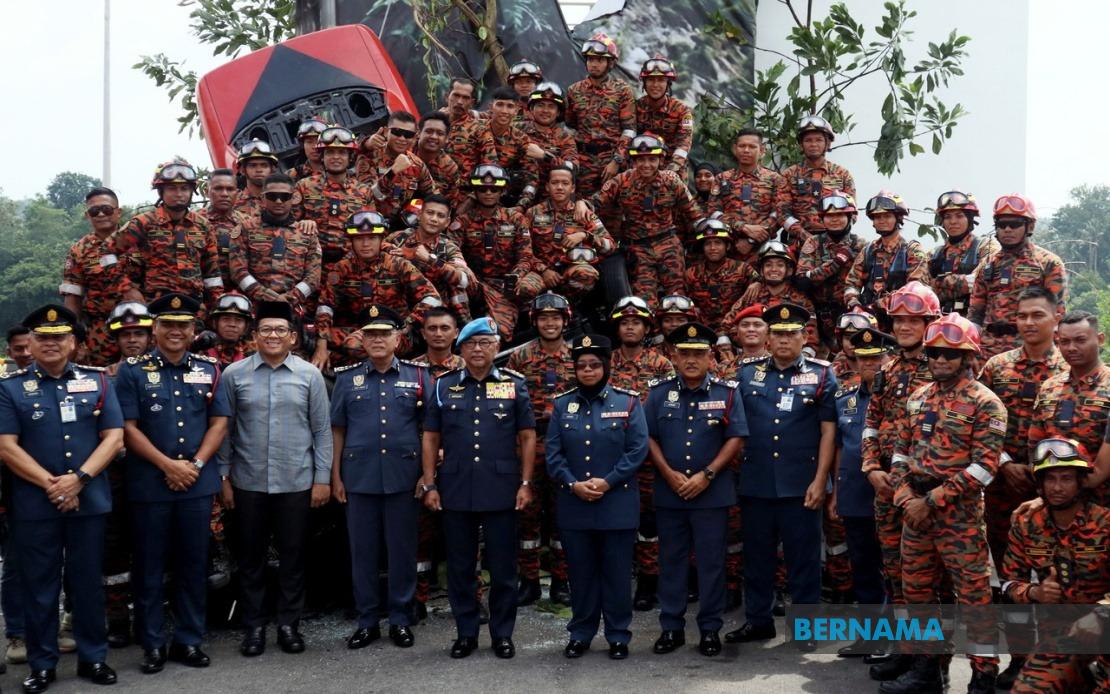
The Malaysian federal government has committed RM278.9 million in annual development funding for the Malaysian Fire and Rescue Department (JBPM) to advance 86 projects under the 13th Malaysia Plan's initial rolling plan phase. Housing and Local Government Deputy Minister Datuk Aiman Athirah Sabu unveiled this investment framework at the opening of Sungai Lembing Fire and Rescue Station in Pahang, emphasising the government's determination to strengthen emergency response infrastructure across the nation.
The approved annual ceiling encompasses both fresh initiatives and sustained programmes spanning the entire country. Of the 86 projects, 27 represent newly launched undertakings whilst 59 are established initiatives entering new phases of implementation. This balanced portfolio signals a strategic approach to emergency services development, blending expansion into underserved regions with deepening capacity in existing operational areas. The allocation reflects recognition that fire and rescue capabilities must evolve alongside population growth and urbanisation patterns across Malaysia's varied geography.
Pahang state exemplifies the breadth of this infrastructure programme. Seven facility development ventures are progressing across the eastern peninsula state under both the 12th Malaysia Plan and the 13MP's inaugural rolling plan. These encompass acquisition of the Gohtong Jaya station building and associated residential quarters, construction of entirely new facilities at Benta and Tioman with their own accommodation complexes, and major renovation initiatives. The Bentong and Kuantan stations are simultaneously undergoing comprehensive upgrading, whilst Triang station is being fully reconstructed. Preliminary groundwork has commenced for establishing Tanjung Lumpur station, demonstrating a multi-stage developmental pipeline designed to ensure systematic, sustainable expansion.
The newly inaugurated Sungai Lembing station represents a tangible manifestation of this investment philosophy. Constructed at a cost of RM6 million on a seven-acre parcel, the facility stands as Pahang's 29th fire and rescue station since the systematic expansion programme commenced. The station commenced operational duties on February 15, positioning itself to serve approximately 15,000 residents across Sungai Lembing township and neighbouring communities. Its positioning within the state's network fills a previously underserved zone, enhancing response capabilities for what was once a gap in coverage.
Beyond conventional firefighting and emergency response, the facility is envisioned as a multifunctional community asset. Deputy Minister Aiman Athirah articulated aspirations for the station to evolve into an integrated community learning hub, providing structured training, skills development programmes, and public awareness initiatives aimed at cultivating civilian-led lifesaving capabilities. This reframing of fire stations as knowledge centres reflects evolving international practice, positioning emergency services infrastructure within broader community resilience frameworks rather than as purely operational entities.
Sungai Lembing occupies particular strategic significance within Pahang's broader developmental narrative. Deputy Economy Minister and Paya Besar Member of Parliament Datuk Mohd Shahar Abdullah contextualised the fire station within an expansive heritage town revitalisation strategy. The township has emerged as a focal point for experiential tourism development, with simultaneous initiatives addressing cultural restoration, environmental conservation, and international recognition. The PCCL Cinema undergoes heritage restoration, ecotourism product development creates sustainable revenue streams, a digital museum establishment preserves local historical knowledge, and the historic Sungai Lembing Tunnel receives major upgrading investment. These complementary projects position the former mining community for reimagining as a modern heritage destination.
Crucially, Deputy Minister Shahar Abdullah emphasised that ambitious heritage and tourism development cannot succeed without corresponding investment in essential public services infrastructure. Fire and rescue capability represents a foundational prerequisite for attracting visitors and ensuring resident safety in a community embarking on transformation. The Sungai Lembing station therefore functions simultaneously as emergency preparedness infrastructure and as a confidence signal to potential tourists and investors that the township operates with contemporary safety standards. This integrated approach treats emergency services not as peripheral infrastructure but as central to place-making strategy.
The investment framework also carries significance for regional emergency management policy. Malaysia's archipelagic and geographically dispersed population presents distinct challenges compared to more densely concentrated nations. Rural and semi-rural communities like Sungai Lembing historically experienced extended emergency response times due to distance and resource limitations. Systematic expansion of station networks, coupled with facility modernisation, directly addresses these disparities. The strategic positioning of new facilities considers geographic coverage gaps identified through operational data analysis, ensuring that response protocols progressively converge toward urban standards across diverse terrain.
For Malaysian policymakers, the RM278.9 million allocation carries implications extending beyond immediate emergency services provision. It demonstrates commitment to equitable infrastructure distribution, particularly in states undergoing economic diversification beyond traditional primary industries. Pahang's evolution toward heritage tourism, as exemplified by Sungai Lembing's repositioning, requires enabling infrastructure investments across multiple sectors. The fire and rescue department's expansion participates in this broader ecosystem development, signalling that transformation toward tourism-oriented economies includes essential public service modernisation.
The involvement of Sultan Al-Sultan Abdullah Ri'ayatuddin Al-Mustafa Billah Shah in the Sungai Lembing station inauguration underscores the cultural and political importance attached to this infrastructure investment. Royal patronage of emergency services development reflects recognition that public safety represents a fundamental governmental responsibility transcending routine bureaucratic administration. This ceremonial emphasis likely presages increased political attention to emergency services modernisation across the east coast, potentially generating momentum for accelerated implementation of pending projects throughout Pahang's network expansion programme.

