Malaysia's renewable energy sector is gaining momentum, with installed capacity reaching nearly 32 per cent as of June this year, according to Deputy Prime Minister Datuk Seri Fadillah Yusof. The figure represents a significant stride toward the government's commitment to achieve 35 per cent renewable energy capacity by 2030, part of an even more ambitious vision to reach 70 per cent by 2050. This milestone underscores Malaysia's serious engagement with energy transition, a shift that extends far beyond environmental responsibility and instead reflects hard-nosed economic necessity in an increasingly competitive global energy landscape.
Fadillah, who doubles as Minister of Energy Transition and Water Transformation (PETRA), framed the energy transition not as aspirational policy but as strategic imperative. Ensuring reliable domestic energy supply, bolstering Malaysia's attractiveness to international investors concerned with sustainability credentials, and honouring global climate commitments all hang on successful execution of the National Energy Transition Roadmap (NETR). The framework balances three critical pillars: energy security to guarantee uninterrupted supply, affordability to protect household and industrial competitiveness, and environmental sustainability. This equilibrium matters acutely in Malaysia's context, where energy costs influence manufacturing competitiveness and where energy-intensive industries remain crucial to economic growth.
The backdrop to this progress is institutional. The government has constructed a coherent policy architecture under NETR that coordinates between federal bodies, state authorities, and the private sector. This alignment reduces investor uncertainty and creates predictable conditions for long-term project development. The earlier achievement of 31 per cent renewable capacity by December 2025 demonstrates the roadmap's operational effectiveness, though maintaining momentum toward 35 per cent by 2030 requires sustained regulatory consistency and continued capital flow into solar, wind, and other renewable technologies.
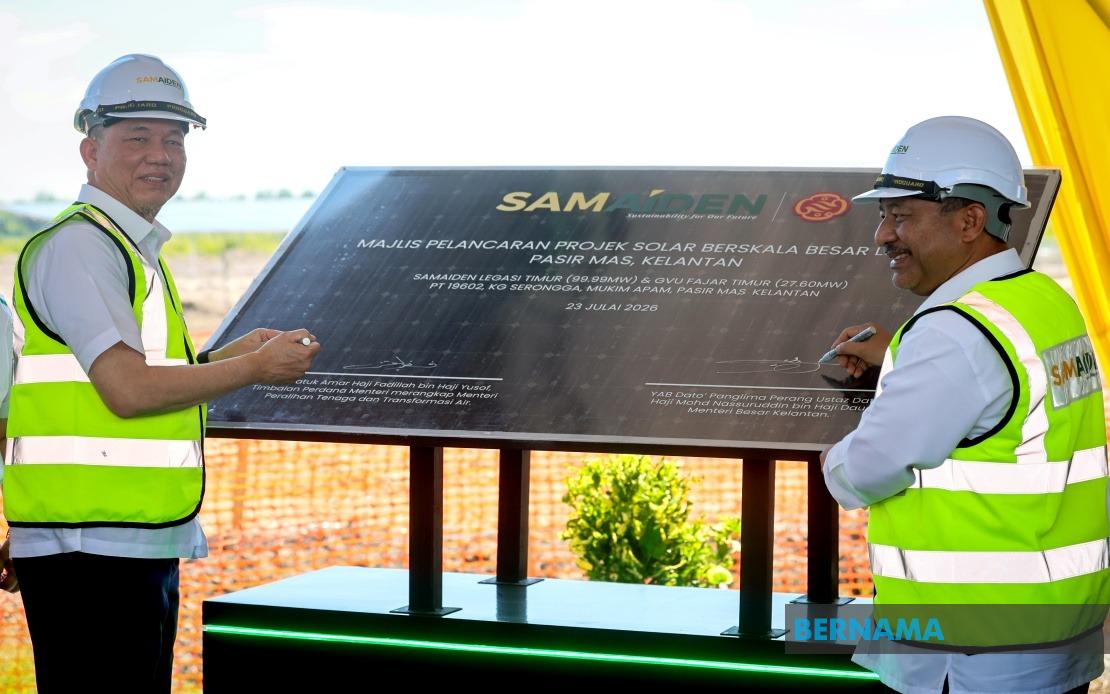
Kelantan's experience illuminates the localized opportunity within Malaysia's broader energy transition. The state launched the Large-Scale Solar Project (LSS5) in Pasir Mas, which Fadillah highlighted as validation of investor confidence in Malaysian energy policy. The project signals that private capital sees profitable and stable conditions for solar deployment in Malaysia, a perception that feeds further investment appetite. For Kelantan specifically, the implications are substantial: employment opportunities in construction and operations, spin-off demand for supporting industries, and potential infrastructure improvements serving the renewable energy sector. Menteri Besar Datuk Mohd Nassuruddin Daud positioned LSS5 as a demonstration project that could attract higher-value investments downstream, establishing Kelantan as a renewable energy hub rather than merely a recipient state.
The solar sector's expansion across Malaysia reflects broader regional trends. Southeast Asia, with its abundant sunshine and rapid electricity demand growth, possesses natural advantages for solar development. Within this context, Malaysia competes with regional peers in Thailand, Vietnam, and Indonesia for renewable energy investment and expertise. Success in deploying large-scale projects like LSS5 enhances Malaysia's positioning as a reliable investment destination in the region's energy transition. The competitive dimension matters for policymakers: countries that lag risk losing capital flows and technological expertise to faster-moving neighbours.
Fadillah's emphasis on balanced energy transition carries particular weight given public sensitivities around electricity costs. Malaysia's electricity tariff structure has long been contested politically, with industrial users subsidizing residential consumers. Energy transition funded through higher grid investments must not translate into sharp consumer bill increases, or public support erodes. The message of cost affordability within the NETR framework responds to this political reality. Demonstrating that renewable energy deployment can occur without punitive price spikes is essential to maintaining social license for the energy transition agenda.
The Solar ATAP Programme, which Fadillah referenced, exemplifies the government's distributed approach to renewable expansion. Rather than concentrating solar capacity in large utility-scale projects, encouraging rooftop installations on residences, commercial buildings, and places of worship spreads benefits across communities and reduces transmission losses. This two-track strategy—combining utility-scale and distributed solar—diversifies the renewable energy deployment portfolio and builds grassroots engagement with energy transition. For households and small businesses able to generate their own electricity, the economic calculus can prove compelling, particularly if regulatory frameworks permit excess generation to feed into the grid at favourable rates.
Kelantan's geographic and administrative characteristics position it as a test bed for Malaysia's energy transition. The state possesses suitable land for solar deployment, active state government backing, and private sector appetite for investment. These conditions rarely align perfectly, making Kelantan's receptiveness valuable for demonstrating scalability elsewhere. If LSS5 and subsequent projects execute successfully, generate promised economic benefits, and maintain community support, the model becomes replicable across other Malaysian states. Conversely, project stumbles would send cautionary signals that impede deployment in less favourable political environments.
The 2030 and 2050 targets acquire urgency in the context of Malaysia's international commitments. The country has pledged emissions reductions on the global stage and positioned itself as a developing nation serious about climate action. Meeting renewable energy targets helps fulfill these pledges and strengthens Malaysia's negotiating position in climate forums. Additionally, major multinational corporations increasingly condition investment and supply chain decisions on partner countries' environmental performance. Achieving renewable energy milestones directly supports Malaysia's ability to attract capital from firms bound by environmental, social, and governance criteria.
Investor confidence, as both Fadillah and Mohd Nassuruddin emphasized, forms the bedrock enabling further acceleration. When large-scale projects like LSS5 achieve financial close and begin operations, they generate positive case studies that de-risk subsequent projects in investor perception. Project developers can point to comparable Malaysian examples when assessing feasibility. Lenders gain confidence in the regulatory environment's stability. This virtuous cycle—successful projects breeding further investment—depends crucially on governments maintaining policy consistency and following through on commitments.
The challenge ahead involves sustaining deployment velocity while managing grid integration complexities. As renewable energy penetration rises, integrating variable solar and wind generation into electricity networks becomes increasingly sophisticated technically. Battery storage, demand response, and grid modernization investments will consume capital and require regulatory innovation. Malaysia's stated pathway to 70 per cent renewable capacity by 2050 implicitly commits to solving these integration challenges, an undertaking that extends beyond current Large-Scale Solar projects into systemic electricity infrastructure evolution.
Beyond the energy sector itself, Malaysia's renewable energy progress influences broader economic positioning. Nations leading renewable energy deployment cultivate expertise, attract specialized manufacturing and services sectors, and build export capabilities around clean energy technologies. As Malaysia ramps solar capacity, opportunities emerge for local companies in installation, maintenance, and supply chain activities. Over time, successful renewable energy deployment can evolve into a competitive advantage in green technology sectors, supplementing Malaysia's traditional strengths in resource extraction and manufacturing.
The pathway to 2030 remains achievable but not automatic. Maintaining the pace of deployment demonstrated thus far requires continued policy support, sustained private sector engagement, and effective coordination across government levels. Projects like LSS5 serve not merely as incremental capacity additions but as proof points validating the entire energy transition framework. As Malaysia progresses toward its renewable energy targets, the stakes encompass energy security, economic competitiveness, climate responsibility, and regional standing in Southeast Asia's energy future.

