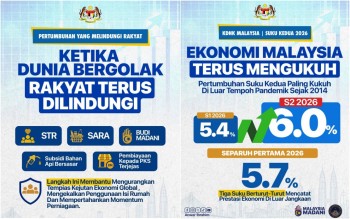
Malaysia's economy has demonstrated remarkable resilience in the second quarter of 2026, expanding at a six per cent rate that has surprised market analysts and positioned the nation among the region's stronger performers despite deteriorating global conditions. Prime Minister Datuk Seri Anwar Ibrahim highlighted the achievement as a significant milestone, representing the most robust second-quarter expansion the country has recorded in over a decade when excluding the pandemic-distorted figures of 2020 and 2021.
The acceleration comes at a time when the international economic landscape remains fragile, with major trading partners grappling with supply-chain disruptions stemming from ongoing regional tensions in West Asia and a broader deceleration in global demand. That Malaysia has managed to buck this headwind suggests the domestic economy possesses genuine underlying momentum rather than merely riding temporary external tailwinds. The six per cent figure notably exceeds what market watchers had anticipated, indicating that sectors beyond traditional growth drivers may be contributing to the expansion.
Anwar attributed the strong performance to deliberate policy interventions by the MADANI Government aimed at insulating Malaysian households from the inflationary pressures that have squeezed consumer spending elsewhere in the world. The Prime Minister specifically referenced targeted support schemes including BUDI MADANI, Sumbangan Tunai Rahmah (STR), and Sumbangan Asas Rahmah (SARA), which have provided direct financial assistance to vulnerable populations during a period of elevated price pressures across energy, food, and essential commodities. Beyond these visible relief measures, the government has undertaken less publicised efforts to manage price stability and ensure supply chain continuity across critical sectors.
The ability to maintain purchasing power among lower and middle-income groups has proven crucial for sustaining domestic consumption, which typically accounts for roughly 55 to 60 per cent of Malaysia's economic activity. By preventing a sharp erosion of household incomes through inflation, the administration has succeeded in keeping the domestic engine of growth running even as external demand has softened. This contrasts with several neighbouring economies where more pronounced price inflation has dampened consumer confidence and spending patterns, resulting in slower overall growth trajectories.
However, Anwar's remarks suggest the government recognises that a single quarter of strong performance, however impressive, does not guarantee continued momentum. He emphasised that sustaining this growth trajectory requires further structural reforms and initiatives beyond the emergency relief measures already implemented. The Prime Minister indicated that the MADANI administration intends to broaden the foundation of economic advancement, moving beyond crisis management toward more permanent improvements in living standards through policies that generate meaningful income growth and employment opportunities.
The emphasis on quality job creation reflects an understanding among policymakers that headline GDP figures alone do not capture the full picture of economic health. Rapid growth achieved through unsustainable measures or concentrated among a narrow segment of the population may prove ephemeral and insufficient to address underlying structural challenges. Malaysia's experience over past decades has shown that sustainable development requires inclusive participation, where the benefits of expansion reach workers across different skill and income levels through better-remunerated positions rather than simply increasing the number of jobs available.
Support for vulnerable groups also featured prominently in Anwar's vision for ensuring broader-based prosperity. This signals recognition that economic growth divorced from distributional equity can create social tensions and undermine long-term stability. As Malaysia navigates a complex global environment characterised by geopolitical uncertainties and shifting trade patterns, policymakers appear conscious that maintaining social cohesion and public confidence in the economic system ranks equally with macroeconomic indicators.
The Q2 2026 result arrives amid intensifying regional competition for investment and trade flows, with several Southeast Asian nations pursuing their own economic transformation agendas. Malaysia's demonstrated ability to achieve above-trend growth while managing inflation and maintaining social support systems positions the country favourably within this competitive context, potentially attracting investor interest and reinforcing its reputation as a stable regional economic centre. The strong quarter may enhance confidence among both domestic and foreign entrepreneurs regarding the medium-term outlook.
Looking ahead, several factors will determine whether the current momentum can be sustained through the remainder of 2026 and into 2027. Global commodity prices, particularly for petroleum and liquified natural gas in which Malaysia has significant production stakes, will influence export revenues and government resources available for continued policy support. Additionally, any escalation of geopolitical tensions in West Asia could disrupt supply chains or reduce demand from affected trading partners, creating downside risks to the current trajectory. Domestically, the government faces the challenge of transitioning from emergency support measures to structural reforms that enhance productivity and competitiveness without triggering demand destruction.
The MADANI Government's framing of strong growth as a stepping stone toward more comprehensive economic transformation suggests policymakers view the current favourable conditions as a window of opportunity rather than a destination. By emphasising the need for reform, job quality, and inclusive development, the administration appears to be building intellectual and political groundwork for potentially more ambitious structural changes that might involve adjustments to subsidy systems, labour market policies, or investment allocation mechanisms. How successfully these broader reforms are executed in coming years will largely determine whether the robust Q2 2026 performance represents the beginning of a sustained upswing or a temporary peak before emerging challenges reassert themselves.

