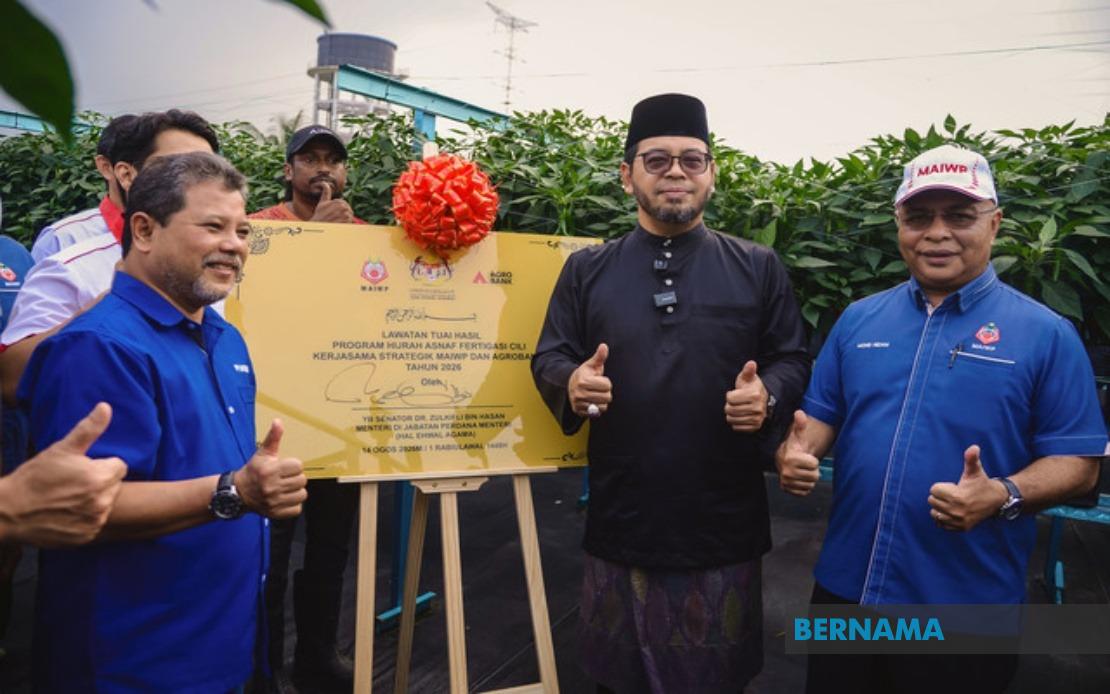
The Malaysian Islamic Welfare Organisation (MAIWP) is scaling up its flagship asnaf chilli fertigation project to encompass five acres of cultivated land, capitalising on the remarkable success of its initial implementation phases. The expansion comes as the programme continues to demonstrate its capacity to generate substantial income for economically disadvantaged Muslim communities while advancing agricultural innovation in the country.
Dr Zulkifli Hasan, the Minister in the Prime Minister's Department (Religious Affairs), highlighted the project's transformative impact during recent remarks on the expansion. He underscored how equipping asnaf participants—classified as those eligible for zakat assistance—with contemporary farming knowledge and technology has yielded tangible economic returns. The first harvest alone produced more than 16.7 tonnes of chillies, generating revenues exceeding RM207,000 for participating families. This productivity represents a significant achievement for a community-development initiative, particularly given the relatively nascent stage of the programme's implementation.
The initiative addresses a critical gap in Malaysia's approach to poverty alleviation by moving beyond conventional welfare provision towards income-generating activities anchored in productive capacity-building. Rather than treating asnaf communities as perpetual beneficiaries of charity, the MAIWP model positions them as agricultural entrepreneurs capable of sustaining themselves through modern cultivation techniques. The fertigation system—a method combining fertiliser application with irrigation—has proven particularly effective in boosting yields whilst reducing water consumption, a crucial consideration in Malaysia's tropical climate where water efficiency increasingly matters.
Beyond primary production, MAIWP is actively encouraging participants to engage in value-added processing and marketing activities. The programme structure now facilitates downstream opportunities, enabling farmers to transform raw chilli harvests into packaged products, chilli pastes, dried varieties, and other processed goods with significantly higher profit margins. This vertical integration strategy expands market accessibility and builds entrepreneurial capacity within participating families, moving them progressively from farm-gate sales towards branded product development.
Alinda Rosely, a 49-year-old single mother participating in the scheme, exemplifies the programme's personal impact. She credits the fertigation knowledge and ongoing technical support with enabling her economic recovery after facing significant hardship. During a particularly favourable market period last year, she earned RM40,000 within just six months through chilli cultivation. Her testimony illustrates how targeted skill development, combined with access to improved agricultural technology, can catalyse genuine household income transformation for vulnerable demographics.
The five-acre expansion reflects MAIWP's broader institutional mission to cultivate self-reliance and competitive capacity within the asnaf community. Rather than perpetuating dependency, the organisation views skills transfer and income-generating asset creation as pathways to sustainable dignity and economic participation. This philosophical orientation distinguishes the initiative from traditional zakat distribution schemes, which, while essential for immediate welfare needs, do not inherently build long-term earning potential.
MAIWP's financial commitment to community welfare extends considerably beyond this single agricultural project. As of August 2026, the organisation had disbursed RM699.57 million in zakat assistance through 38 distinct welfare assistance schemes. This diversified portfolio approach ensures that immediate welfare support for vulnerable populations operates in parallel with longer-term capacity-building initiatives like the chilli farming programme. The combination of direct assistance with productive investment reflects a comprehensive poverty-reduction strategy that addresses both emergency needs and structural economic marginalisation.
The chilli sector itself represents a strategic choice for an agricultural development programme. Malaysia's persistent demand for fresh chillies in domestic consumption, combined with regional export opportunities to neighbouring Southeast Asian markets, provides consistent market demand. Chilli cultivation is labour-intensive but does not require prohibitively expensive infrastructure or specialised equipment beyond the fertigation system itself. The crop's relatively short production cycles also enable participants to recoup investments and generate income within reasonably compressed timeframes.
The programme's expansion to five acres suggests positive financial sustainability metrics and participant satisfaction levels. Scaling production whilst maintaining quality and technical support represents a meaningful next step in consolidating the project's initial achievements. As climate variability increasingly challenges agricultural productivity across Southeast Asia, demonstration of effective modern farming techniques suited to Malaysia's environment holds broader relevance for the region's food security outlook.
For policymakers across Malaysia and the wider Southeast Asian region, the MAIWP chilli initiative offers instructive lessons about integrating social welfare with productive economic development. The convergence of religious obligation—zakat distribution—with agricultural modernisation creates a distinctive institutional framework that combines moral commitment with entrepreneurial outcomes. As governments confront persistent rural poverty and urban informal-sector precarity, replicating elements of this integrated approach—combining targeted cash support with vocational skills and productive asset access—warrants serious policy consideration.

