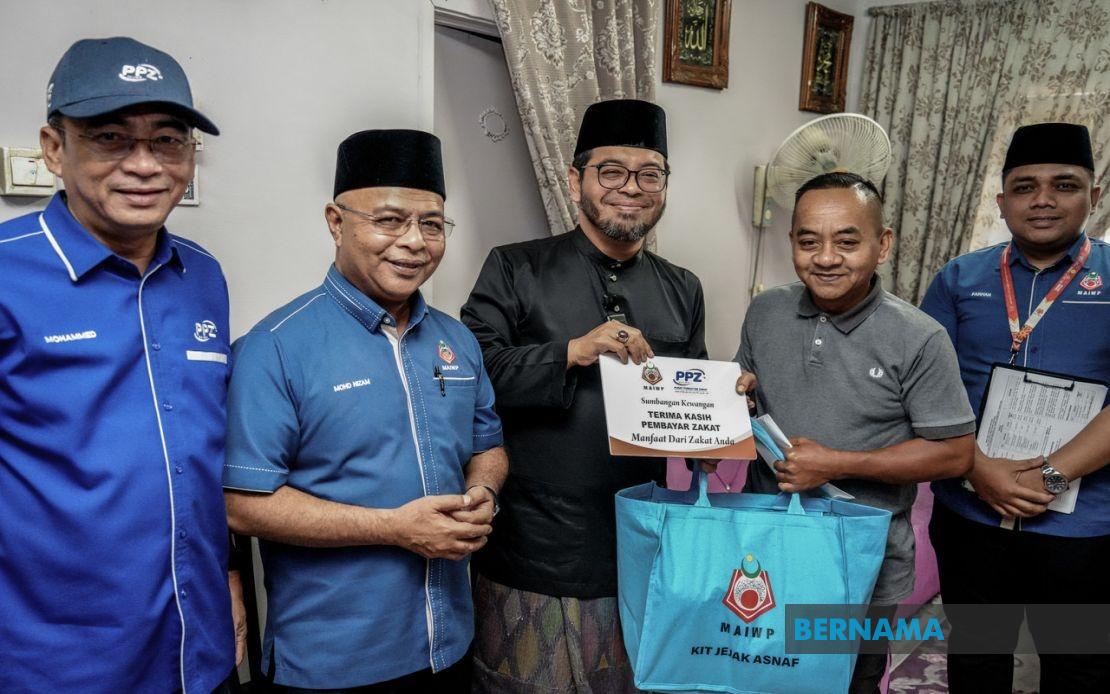
The Federal Territories Islamic Religious Council (MAIWP) has unveiled a comprehensive assistance package for a widow now responsible for five children aged between six and 15 years old, following her husband's death earlier this month. The support initiative, which encompasses monthly living allowances, rental support and educational expenses, reflects the council's commitment to identifying and addressing the specific needs of vulnerable families within the Federal Territories. Minister in the Prime Minister's Department (Religious Affairs) Senator Datuk Dr Zulkifli Hasan emphasised during a visit to the families involved that such direct engagement on the ground enables MAIWP to gain genuine insight into recipients' circumstances and calibrate assistance programmes accordingly.
Datuk Dr Zulkifli highlighted that the on-site engagement approach represents a crucial strategy for the council in delivering effective community support. Rather than applying generic assistance schemes, MAIWP's methodology involves understanding each family's unique situation to ensure that aid directly addresses their most pressing challenges. "Insya-Allah, these are among the measures we are implementing to assist the community and the people as effectively as possible," he stated following his visits to the affected households. The widow's case exemplifies this tailored approach, with MAIWP initially providing General Schooling Aid and now expanding assistance to encompass the family's broader financial obligations during their period of acute vulnerability.
The widow's household now benefits from multiple layers of MAIWP support designed to stabilise the family's immediate circumstances. Beyond the school-related funding previously extended, the council has now proposed assistance covering essential monthly living costs and accommodation expenses, all critical components for a single-income household suddenly stripped of its primary earner. This layered approach recognises that the loss of a breadwinner creates cascading financial pressures that cannot be addressed through education support alone. The family's transition from a two-income household to full dependence on public assistance required urgent intervention to prevent deeper economic hardship.
The council's community support work extends beyond this particular case, reflecting systemic challenges faced by numerous households across the Federal Territories. During the same visit, MAIWP engaged with a family comprising two parents and eight school-age children, where the father works as a Kuala Lumpur City Hall driver while the mother maintains the household full-time. This family, despite having active employment, receives General Medical Assistance covering essential supplies including diapers and diabetic medications, alongside support for wheelchair procurement and school-related expenses. The necessity of such assistance to a working household underscores the gap between wages in service sector employment and the genuine cost of raising large families in an urban environment.
Another beneficiary family represents yet another variation in vulnerability patterns within the capital's population. A divorced mother, separated since 2018, manages three school-age children while shouldering complete financial responsibility for the household. MAIWP's support to this family includes monthly cost-of-living assistance and basic necessities provision, supplemented by specific educational funding and supply assistance. The consistency of support across these diverse family structures suggests that MAIWP recognises multiple pathways into financial distress—not only sudden catastrophic events like death, but also marital breakdown and the structural challenges of single-income households with dependent children.
The financial scale of MAIWP's broader mandate becomes apparent when considering the council's cumulative disbursements. As of August 12, 2026, MAIWP had distributed RM699.57 million in assistance across the Federal Territories, a figure that underscores both the magnitude of need across Kuala Lumpur, Labuan and Putrajaya and the council's substantial resource commitment to addressing social welfare challenges. This expenditure level reflects not occasional emergency relief but rather sustained, systematised support for populations chronically struggling to meet basic needs within Malaysia's expensive urban centres.
For Malaysian policy observers, the MAIWP model offers instructive lessons about targeted social assistance. Rather than universal welfare programmes that may not reach those most in need, or one-size-fits-all schemes that fail to address specific circumstances, the council's approach combines systematic identification of vulnerable households with flexible, customised support packages. The emphasis on ground-level engagement allows caseworkers to identify emerging needs before they crystallise into crises, potentially offering more cost-effective intervention than managing acute social breakdown.
The widow's situation particularly resonates across Southeast Asia, where extended family support networks that historically managed such crises have fragmented in rapidly urbanising societies. Traditional expectations that extended family members would absorb a widow and children have become impractical in modern urban housing conditions and employment patterns. Formalised assistance through organisations like MAIWP thus fills a structural gap created by urbanisation and economic modernisation, ensuring that sudden loss of a breadwinner does not precipitate immediate destitution.
Datuk Dr Zulkifli's emphasis on understanding recipients' actual circumstances also reflects evolving approaches to social assistance across the region. Evidence-based, needs-responsive programming produces better outcomes than generic assistance, reducing both programme costs and the stigma often attached to welfare receipt. When support directly addresses identified needs—whether educational, medical or nutritional—beneficiary families experience measurable improvement in outcomes, from child school attendance to health indicators, justifying the council's investment in detailed assessment procedures.
The cases presented illustrate how employment alone does not guarantee family stability in Malaysia's contemporary economy. The DBKL driver supporting eight children, despite steady formal sector employment, requires supplementary assistance with medical supplies and educational costs. This pattern suggests that minimum wages and standard employment conditions remain insufficient for larger families in urban areas, indicating a broader structural challenge beyond the immediate cases MAIWP addresses. The council's expanded role in providing basic necessities to working families hints at unresolved tensions between employment income levels and living costs in the Federal Territories.
Moving forward, the widow's case exemplifies how MAIWP's integrated approach—combining education support, living allowances and rental assistance—aims to provide both immediate relief and medium-term stability. By covering rental expenses, the council prevents the catastrophic housing insecurity that often triggers family breakdown or children's removal from school. Educational support keeps children in the schooling system despite family trauma, protecting their long-term economic prospects. Monthly living allowances address immediate subsistence needs while the family presumably explores employment and remarriage possibilities, or receives income from other sources.
The council's work also raises questions about the adequacy and accessibility of assistance across Malaysia more broadly. The Federal Territories, as the nation's capital region, likely possess more resources and institutional capacity for systematic family support than smaller states or rural areas. Whether comparable MAIWP-style programming exists across all Malaysian states, or whether vulnerable families outside the Federal Territories receive equivalent support, remains an important consideration for national social protection equity. The visibility accorded to the widow's case through ministerial engagement may also not reflect the experiences of equally vulnerable families receiving lesser public attention or assistance.
Ultimately, MAIWP's engagement with the widow and other families demonstrates a pragmatic approach to Islamic social welfare obligations within modern urban settings. Rather than characterising assistance as charity or temporary relief, the council positions ongoing support as a practical expression of community responsibility—ensuring that families experiencing sudden loss, chronic underemployment or structural disadvantage can access the resources necessary for dignified survival and children's development. The council's accumulated distribution of nearly RM700 million reflects a sustained institutional commitment to this principle across the Federal Territories.

