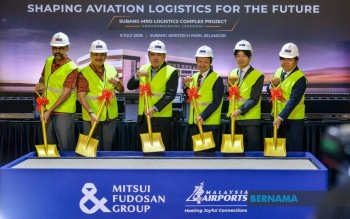
Malaysia Airports Holdings Bhd (MAHB) and Japan-based Mitsui Fudosan Group have joined forces to construct a RM80 million air cargo logistics facility at Subang, marking a significant expansion of the nation's aviation infrastructure. The collaboration sees MAHB contributing a 30 per cent stake whilst Mitsui Fudosan holds the controlling 70 per cent equity position in the venture. Transport Minister Anthony Loke Siew Fook unveiled the partnership during a groundbreaking ceremony at Subang Aerotech Park on Thursday, highlighting the government's commitment to strengthening Malaysia's position in the regional aviation and aerospace sector.
The underlying rationale for this partnership reflects a deliberate shift in MAHB's corporate strategy towards asset monetisation and operational efficiency. Rather than bearing the full burden of development and management, MAHB is capitalising on its valuable airport land holdings by inviting experienced international partners to bring capital, technical expertise, and operational know-how to the table. This model allows the airport operator to generate returns on underutilised assets whilst minimising financial risk and operational complexity. The arrangement mirrors successful precedents in other sectors where Malaysian entities have partnered with foreign investors to unlock value from strategic property holdings.
Mitsui Fudosan's involvement brings substantial pedigree to the project. The Japanese conglomerate has extensive experience in developing and operating logistics facilities across Asia, most notably at Tokyo's Haneda Airport, one of the world's busiest aviation hubs. This track record suggests the company understands the nuances of building cargo-handling infrastructure that meets international standards whilst remaining operationally efficient. According to Transport Minister Loke, the presence of such expertise will substantially reduce execution risks for Malaysia Airports, ensuring the facility achieves its intended functionality without costly overruns or operational missteps typical of complex aviation infrastructure projects.
The development will emerge as a new industrial undertaking within Subang Aerotech Park under the joint venture entity MFMA Industrial Sdn Bhd, a collaboration between Mitsui Fudosan (Asia) Malaysia Sdn Bhd and Malaysia Airports (Subang) Sdn Bhd. This legal structure provides clear governance whilst enabling both parties to leverage their respective strengths. The facility's location within the established aerotech park offers immediate operational advantages, including proximity to existing airport infrastructure, regulatory frameworks already in place, and an ecosystem of complementary aviation and aerospace businesses that can feed demand for the new complex's services.
The timing of this announcement is significant given Malaysia's efforts to reposition itself as a regional aviation and aerospace manufacturing hub. Subang Airport, historically Malaysia's oldest and most established aviation facility, has been undergoing transformation to specialise in high-value segments like maintenance, repair and overhaul (MRO) operations and aerospace manufacturing rather than general commercial passenger traffic. The new cargo logistics complex directly supports this strategic pivot by providing essential infrastructure for moving components, finished aircraft, and aerospace equipment through the facility. Such capability becomes increasingly critical as Malaysia seeks to capture market share from established competitors in Singapore and Thailand.
The air cargo sector has experienced sustained growth momentum across Southeast Asia, driven by the explosive expansion of e-commerce and the structural shift in global manufacturing supply chains. Malaysia's geographic position along major trade routes between China, India, and Australia positions it advantageously to capture cargo flows moving between these economic zones. However, competing hubs across the region have invested heavily in cargo infrastructure, and Malaysia risks falling behind without timely capacity expansion. This project addresses that gap, particularly for the specialised niche of aerospace and aviation-related cargo, where margins tend to be higher and requirements more exacting than conventional general cargo operations.
The RM80 million investment size reflects the capital-intensive nature of modern logistics infrastructure. Developing a facility that meets international standards for handling high-value aerospace components requires substantial investment in climate-controlled warehousing, security systems, specialised handling equipment, and skilled workforce training. The facility must accommodate the stringent requirements of aerospace manufacturers and operators who demand absolute reliability, precise documentation, and seamless integration with global supply chain networks. These factors explain why the project necessitates significant capital commitment and why partnering with experienced developers like Mitsui Fudosan makes strategic sense.
From a broader policy perspective, this venture exemplifies the government's approach to infrastructure development under the current administration. Rather than relying exclusively on public expenditure, which strains government budgets already committed to healthcare, education, and social spending, the model leverages private capital and expertise to build public-benefit infrastructure. This approach allows the government to catalyse development whilst preserving fiscal space for other priorities. Transport Minister Loke's comments underscore the administration's confidence in using strategic partnerships as a vehicle for infrastructure advancement, a lesson potentially applicable to other sectors facing capacity constraints.
The implications for Malaysia's competitive positioning in aviation and aerospace extend beyond Subang itself. Successful execution of this project signals to other international investors that Malaysia remains an attractive destination for aviation-related ventures. It demonstrates that government agencies like MAHB can execute complex partnerships efficiently, that regulatory frameworks facilitate such collaborations, and that there is genuine demand for aviation services in Malaysia. These factors collectively enhance Malaysia's appeal as a regional hub, potentially attracting additional aerospace manufacturing operations and support services that create high-skilled employment and generate valuable foreign exchange earnings.
Looking forward, the success of this partnership will likely influence how MAHB approaches future development opportunities at its other airport properties. Malaysia's airport network includes several facilities with significant unutilised land suitable for complementary aviation and logistics development. The Subang model, if executed successfully, could be replicated at airports like Kuala Lumpur International Airport or regional facilities, creating a portfolio of specialised aviation facilities serving different segments of the market. This approach would maximise returns on MAHB's asset base whilst contributing to broader national infrastructure objectives.

