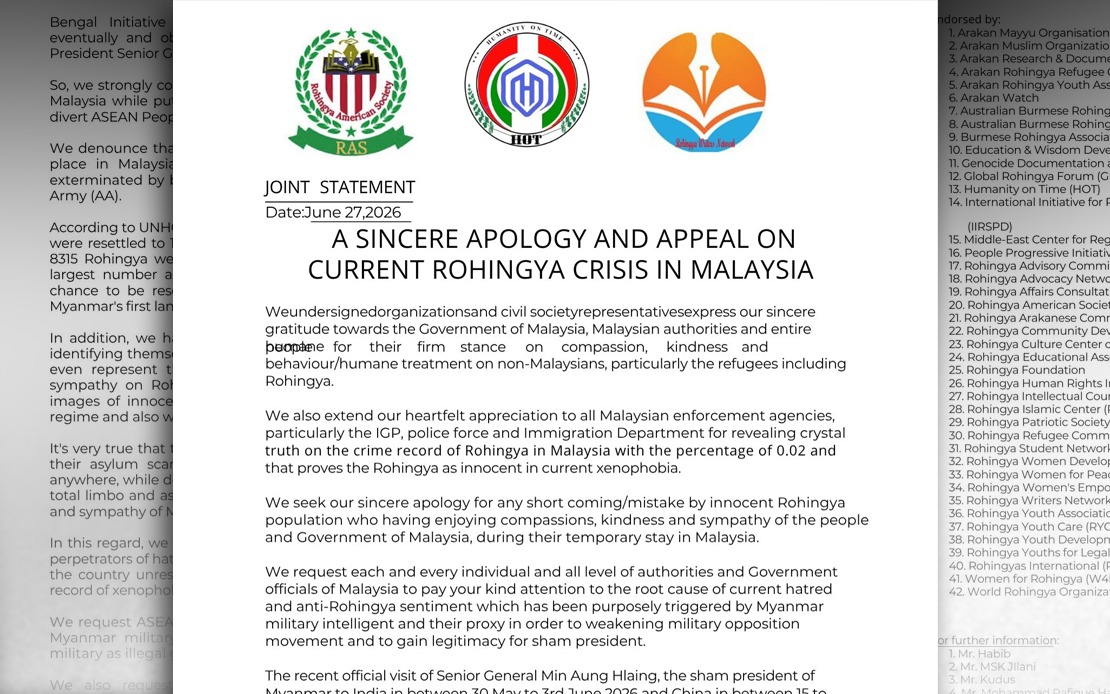
Malaysian Humanitarian Aid and Relief (MAHAR) has responded positively to a public apology issued by 40 Rohingya non-governmental organisations, viewing the gesture as evidence of accountability within the refugee advocacy sector. The acceptance of this apology, however, comes with substantive expectations that these organisations elevate their approach to humanitarian assistance beyond conventional frameworks focused on immediate material needs.
The scope of humanitarian work in Malaysia's Rohingya context requires fundamental recalibration, according to MAHAR's assessment. Current initiatives that concentrate primarily on distributing food parcels and temporary shelter, while addressing urgent suffering, fall short of addressing the deeper integration challenges facing both refugee populations and Malaysian host communities. The organisation argues that sustainable humanitarian practice must encompass education programmes that inform refugees about their rights and obligations within Malaysia's legal and social framework, creating pathways toward responsible coexistence rather than mere survival.
Cultural competency and civic understanding emerge as critical dimensions that MAHAR believes the NGO sector has underemphasised. The 40 organisations are being urged to develop initiatives that cultivate respect for Malaysian legislation, indigenous customs, cultural traditions, and established societal norms among the refugee populations they serve. Such programmes would theoretically reduce friction points between refugee communities and their Malaysian neighbours by fostering mutual understanding and demonstrating respect for host country institutions. This framing positions humanitarian work as inherently relational rather than transactional.
International advocacy remains central to any comprehensive strategy addressing Rohingya displacement, MAHAR emphasises. While acknowledging the NGOs' domestic humanitarian contributions, the organisation contends that meaningful progress requires sustained international pressure targeting the persecution mechanisms operating within Myanmar. Without addressing the structural drivers of displacement—the violence, discrimination, and systematic marginalisation that forces Rohingya communities to flee their homeland—humanitarian assistance in receiving countries becomes perpetually reactive rather than preventative. MAHAR advocates for integrated approaches combining local integration support with transnational advocacy directed at root cause elimination.
Jismi Johari, MAHAR's president, introduced a security dimension to the humanitarian debate that reflects broader Malaysian public concerns. He stressed that refugee assistance frameworks cannot afford to disregard the legitimate safety interests of either displaced populations or established Malaysian residents. The acknowledgement that some Malaysians harbour genuine concerns about community safety, particularly among those who have experienced negative incidents, recognises real tensions that purely sympathetic humanitarian narratives sometimes obscure. These concerns warrant respectful engagement rather than dismissal, according to Johari's perspective.
The challenge of communal responsibility without collective blame represents a delicate conceptual territory that Johari navigated carefully. He rejected the logical fallacy of generalising entire refugee communities based on misconduct by isolated individuals, noting accurately that criminal behaviour and social infractions exist across all demographic groups within Malaysian society. This principle applies universally—assigning group culpability for individual actions violates fundamental justice principles and undermines social cohesion. The distinction between proportionate accountability and blanket stigmatisation becomes crucial when diverse populations with varying backgrounds and circumstances interact within shared geographic and legal spaces.
Resolving tensions between legitimate safety concerns and fair community treatment demands sophisticated stakeholder engagement, Johari contended. The resolution pathway requires genuine empathy from all parties—refugees must recognise host community anxieties as rooted in genuine experience rather than prejudice, while Malaysians must understand displacement as producing trauma-informed populations whose behaviour patterns reflect extraordinary circumstances. Constructive dialogue becomes possible only when mutual respect anchors interactions and both communities acknowledge the validity of the other's fundamental needs and legitimate concerns.
MAHAR's renewed humanitarian commitment incorporates three interconnected principles: justice in addressing root causes and systemic inequities, security in protecting both refugee and host populations from preventable harm, and human dignity in recognising the inherent worth of all individuals regardless of legal status or origin. This integrated framework rejects false choices between refugee welfare and community safety, instead proposing that genuine humanitarianism must serve both populations simultaneously. The organisation positions itself as advocating for comprehensive approaches that strengthen rather than fracture Malaysian social fabric.
The acceptance of the Rohingya NGOs' apology signals potential for sectoral evolution and deeper partnership between humanitarian organisations and the broader Malaysian institutional landscape. Rather than viewing refugee assistance as existing separately from Malaysian community interests, MAHAR's message suggests incorporating host community welfare into humanitarian planning from inception. This reframing could reshape how the NGO sector designs programmes, allocates resources, and measures success—not merely by assistance delivered but by community cohesion strengthened and mutual understanding advanced.
For Malaysian policymakers and society more broadly, MAHAR's position offers a framework transcending the polarisation that often characterises refugee discourse. By acknowledging both refugee vulnerability and host community concerns as legitimate, and by emphasising shared responsibility across stakeholders, the organisation models an approach that might prove more durable than advocacy strategies that privilege one population's interests over another's. The willingness to engage 40 NGOs in collaborative improvement of humanitarian practice, rather than dismissing their work entirely, suggests confidence that constructive evolution remains possible within the refugee assistance sector.

