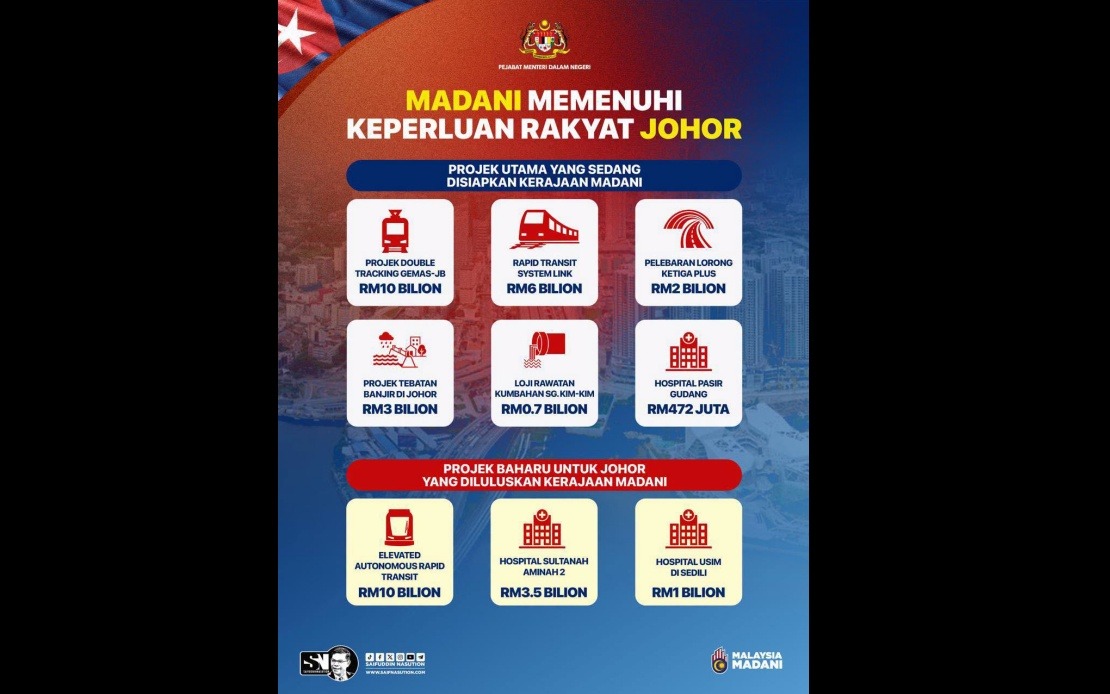
The MADANI Government has renewed its pledge to advance sustainable and inclusive development throughout Malaysia's states, with Johor serving as a key demonstration of the administration's broader development strategy. Speaking in Johor Bahru, Pakatan Harapan secretary-general Datuk Seri Saifuddin Nasution Ismail stressed that the government remains committed to raising living standards nationwide through strategic investments and targeted projects that deliver tangible benefits to communities.
As Home Minister, Saifuddin Nasution outlined how Prime Minister Datuk Seri Anwar Ibrahim's administration prioritises four key pillars in its development agenda: infrastructure modernisation, public transportation networks, healthcare expansion, and flood disaster mitigation. This multi-sector approach reflects an understanding that sustainable growth requires simultaneous advancement across essential services rather than singular focus areas. The emphasis on these domains suggests the government views long-term prosperity as inseparable from improved mobility, health accessibility, and climate resilience—concerns particularly acute in flood-prone regions like Johor.
Johor itself exemplifies this development philosophy, currently benefiting from several transformative projects at various stages of completion or planning. The Gemas-Johor Bahru Electrified Double Tracking Project represents significant investment in rail connectivity, while the Rapid Transit System Link aims to enhance urban mobility in the state's key corridors. These transportation initiatives complement highway improvements, notably the third lane widening of the PLUS Highway, which addresses congestion between major centres and facilitates inter-state commerce and movement.
Health infrastructure expansion features prominently in Johor's development pipeline. Beyond the Pasir Gudang Hospital currently under implementation, the government has approved construction of Sultanah Aminah Hospital 2 and USIM Hospital in Sedili, signalling recognition of growing healthcare demands across the state's population. These facilities address capacity constraints in medical services, particularly important given Johor's large population and status as a major industrial and commercial hub.
Environmental management represents another critical dimension of the state's transformation agenda. The Sungai Kim Kim Sewage Treatment Plant addresses water quality concerns affecting both residents and industrial operations, while the Johor flood mitigation project directly responds to the state's vulnerability to seasonal and extreme weather events. These environmental initiatives reflect growing acknowledgment that development sustainability hinges on ecological stewardship alongside economic expansion.
The approval of the Elevated Autonomous Rapid Transit system marks Johor's entry into cutting-edge transport technology adoption, positioning the state as a test case for innovative urban mobility solutions within the Malaysian context. This project signals government confidence in modernising regional transportation infrastructure beyond conventional rail and highway expansion, potentially establishing frameworks for other states' future upgrades.
Crucially, Saifuddin Nasution emphasised that development cannot be assessed purely through quantitative metrics like investment volume or project completion numbers. Instead, meaningful development must be evaluated through its impact on ordinary citizens' daily experiences—employment creation, commuting efficiency, healthcare accessibility, and overall life quality improvements. This framing distinguishes between infrastructure existence and infrastructure utility, acknowledging that building roads and hospitals matters less than ensuring they serve populations effectively and equitably.
For Malaysian and regional observers, Johor's development trajectory offers insight into how federal administrations allocate resources across state-level priorities. The concentration of major projects suggests strategic selection of high-impact initiatives that can yield multiplier effects across economic and social spheres. Transportation improvements, for instance, facilitate industrial productivity and worker mobility, while healthcare expansion supports workforce health and reduces productivity losses from untreated illnesses.
The government's development commitment also carries political dimensions. As a state where electoral competition remains intense, visible infrastructure progress and tangible service improvements directly influence voter satisfaction and political legitimacy. The catalogue of ongoing and planned projects demonstrates an attempt to translate federal policy commitments into observable, measurable outcomes that resonate with Johor residents and voters nationwide.
Looking forward, sustaining this development momentum requires consistent funding allocation, effective project execution, and timely completion of existing initiatives. Infrastructure projects frequently encounter delays and cost overruns, potentially undermining government credibility. The success of current undertakings will substantially influence public perception of the MADANI Government's competence and commitment beyond rhetorical endorsements.
For Southeast Asian readers, Malaysia's approach to state-level development coordination offers comparative interest. Many regional nations grapple with balancing central government direction with diverse state needs and capacities. Johor's experience demonstrates how federal authorities can employ specific, visible projects to advance inclusive growth while addressing environmental challenges and modernising critical infrastructure simultaneously.

