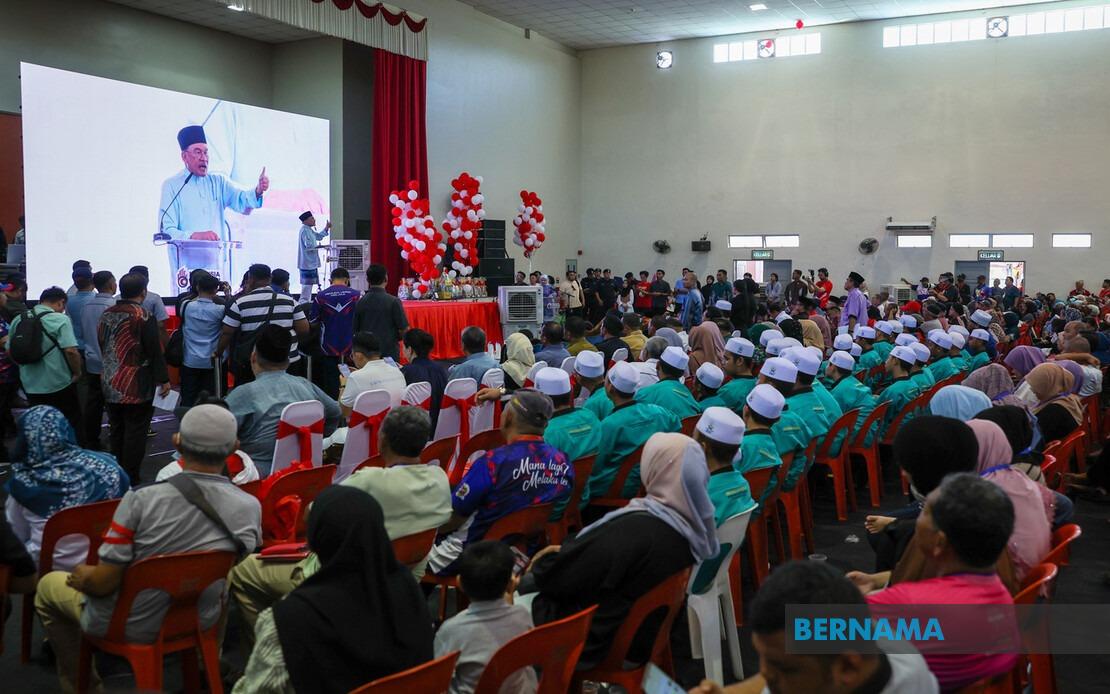
Prime Minister Datuk Seri Anwar Ibrahim has moved to address concerns about educational equity, emphasizing that the MADANI Government will continue allocating resources fairly across all schooling sectors without favouring one community over another. Speaking at the Gelombang MADANI Carnival in Alor Gajah, Melaka, Anwar sought to reassure stakeholders that enhanced support for Islamic educational institutions represents a correction of historical neglect rather than a shift away from vernacular education systems that have long received consistent backing.
The Prime Minister's statement carries particular significance in Malaysia's sensitive education landscape, where funding decisions frequently become flashpoints in communal relations. Anwar clarified that approved allocations for Chinese and Tamil schools would be formally announced in Kuala Lumpur within approximately two weeks, framing this timeline as evidence that resource distribution has already been determined and is proceeding according to schedule. This deliberate sequencing appears designed to manage expectations and prevent the perception that vernacular schools face deprioritization as the government addresses longstanding gaps in Islamic educational funding.
Anwar's emphasis on historical context proves crucial to understanding the policy shift. He noted that pondok schools and tahfiz institutions had endured prolonged resource starvation without meaningful government support until the Unity Government began restoration efforts in 2023, with further increases implemented in 2024. This chronological framing positions enhanced Islamic school funding not as new preferential treatment but as compensatory investment addressing decades of neglect. The approach reflects a recalibration rather than a reorientation of educational policy.
The Prime Minister grounded his argument in Malaysia's plural society framework, invoking the country's success as a multiracial, multi-religious nation where diverse communities coexist harmoniously. He contrasted Malaysia's peaceful experience with other states and countries where suspicion and mistrust have fractured social cohesion, suggesting that equitable resource allocation and mutual respect constitute foundational elements of national stability. This broader perspective positions educational funding decisions within a comprehensive vision of social harmony that transcends narrow sectional interests.
Anwar introduced the Islamic concept of 'ummatan wasatan' from Surah Al-Baqarah to articulate a philosophical foundation for balanced governance. Interpreting the Quranic reference, he described a balanced community as one exhibiting equilibrium across faith, knowledge, character, and relationships with fellow humans and the environment. This theological framework enables Anwar to present fair resource allocation as religiously grounded principle rather than mere pragmatic politics, appealing to Islamic values while simultaneously advancing inclusive policymaking.
The Prime Minister elaborated on what this balanced approach means in practice, arguing that Malaysia should aspire to become a global exemplar of good governance, integrity, and environmental stewardship. He contended that demonstrating cleanliness of administration, freedom from corruption, efficient management, and mutual respect among communities would inspire international emulation more effectively than expressions of hostility or sectarian division. This aspirational framing elevates educational equity from logistical necessity to civilizational commitment.
Anwar specified the practical dimensions of the government's investment in Islamic education, revealing that pondok schools and tahfiz institutions would receive upgraded infrastructure and contemporary training in artificial intelligence and computer literacy. This modernization agenda directly addresses concerns that increased support for Islamic schools might entrench traditional pedagogies disconnected from twenty-first-century skill requirements. By combining resource enhancement with technological integration, the government positions Islamic education as contemporary rather than antiquated.
The occasion itself underscored the government's commitment to visible action. The Prime Minister announced a RM1.29 million allocation specifically for infrastructure improvements at thirteen Islamic educational institutions across Melaka State. Recipients included Madrasah Tahfiz Al-Quran Wal Qiraat Kota Melaka receiving RM250,000, Sekolah Rendah Arab JAIM Pernu with RM200,000, and Sekolah Menengah Arab JAIM Al-Ahmadiah Al-Syafi'iyah Sayyidina Khadijah in Jasin securing RM160,000, among others. These institution-specific allocations demonstrate concrete resource transfer rather than rhetorical commitment.
For Malaysian readers, particularly those representing vernacular education constituencies, Anwar's statements attempt to provide reassurance without conceding the government's conviction that Islamic schools require accelerated investment. The carefully calibrated messaging acknowledges historical inequities affecting Chinese and Tamil schools while asserting that addressing Islamic school neglect does not diminish vernacular education support. This balancing act reflects the political mathematics of Malaysia's plural democracy, where education funding inevitably carries communal significance.
The timing of the announcement, made during the festival carnival format, suggests a deliberate effort to frame the message within celebratory community engagement rather than confrontational policy declaration. The presence of Datuk Seri Dr Wan Azizah Wan Ismail, Melaka Chief Minister Datuk Seri Ab Rauf Yusoh, and Deputy Higher Education Minister Adam Adli Abdul Halim reinforced official unity around the education equity agenda, presenting a consolidated government position rather than isolated Prime Ministerial commentary.
Anwar's invocation of Malaysia's multicultural success story carries particular resonance given contemporary regional developments. Throughout Southeast Asia, governments grapple with tensions between majority religious communities and minority educational traditions. Malaysia's framework of respecting diverse educational streams while ensuring adequate resource flow to all communities offers a model distinct from zero-sum approaches dominating some neighbouring jurisdictions. The Prime Minister's articulation of this philosophy acknowledges that sustained peaceful coexistence requires continuous institutional attention and equitable resource allocation.
The education sector represents one area where Malaysia's plural society framework faces regular stress testing. Funding decisions inevitably raise questions about national identity, cultural preservation, and community investment priorities. By positioning enhanced Islamic school support as historical correction while guaranteeing vernacular school resource flows, Anwar attempts to navigate these sensitivities without abandoning what he views as necessary investment redirection. The success of this approach will ultimately depend on whether announced allocations for Chinese and Tamil schools meet stakeholder expectations when formally unveiled within the promised two-week timeframe.

