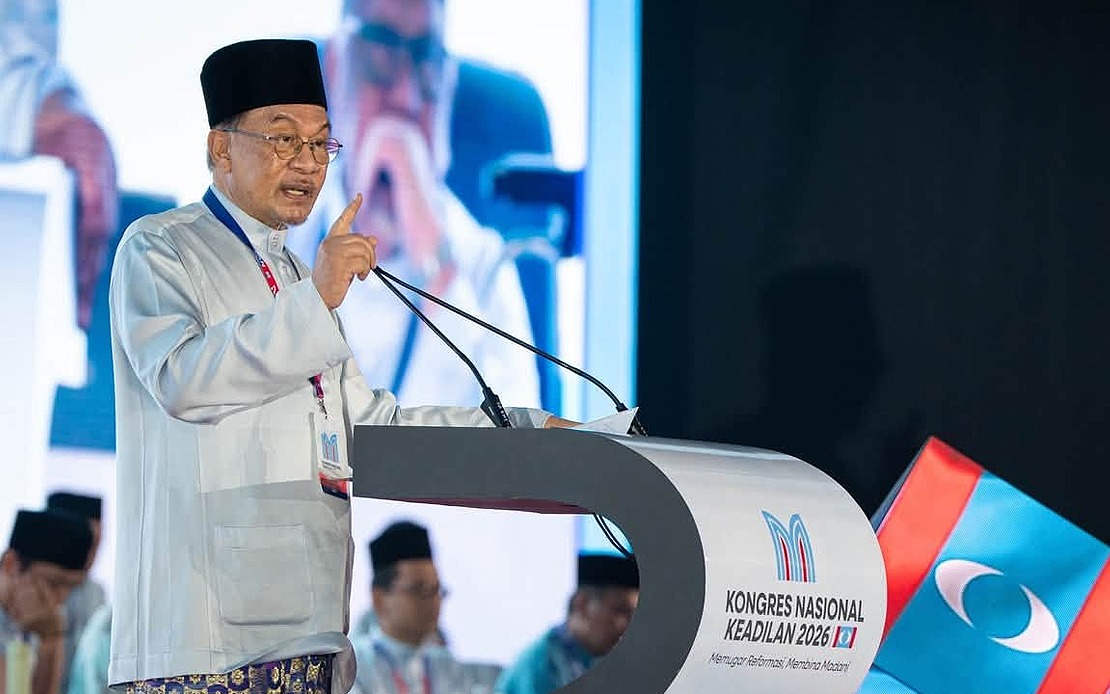
The Malaysian government's reform programme risks falling short of its potential unless the benefits of policy changes are felt directly by ordinary citizens, according to Tengku Datuk Seri Zafrul Tengku Abdul Aziz, the Prime Minister's Senior Political Advisor. Speaking at the 2026 PKR National Congress in Melaka, Tengku Zafrul underscored a fundamental challenge facing the MADANI administration: translating ambitious policy goals and impressive economic metrics into tangible improvements in people's daily lives across all segments of society.
The distinction Tengku Zafrul drew between macro-level economic performance and ground-level perception reflects a growing awareness within government circles that strong headline figures alone cannot sustain public confidence. Malaysia's six percent economic growth, which exceeded forecasts, remains largely abstract for many citizens unless they experience wage improvements, better services, or reduced living costs. This gap between statistical success and lived experience represents one of the most pressing governance challenges facing Prime Minister Anwar Ibrahim's administration as it seeks to build momentum toward the next general election.
Communication failures, rather than policy failures, appear to be a central concern. Tengku Zafrul explicitly acknowledged that the MADANI Government has implemented numerous initiatives, yet many Malaysians remain unaware of their existence or scope. This represents a communications crisis as much as a policy implementation one. Government agencies and the ruling coalition have collectively failed to effectively articulate what they have accomplished, leaving the field open for opposition narratives and public scepticism. The advisor's frank admission that poor public awareness constitutes "our delivery shortcoming" rather than a failure of citizens to pay attention demonstrates notable candour about organisational weaknesses.
The PKR National Congress, held at the Melaka International Trade Centre under the theme "Reviving Reform, Building MADANI", provided a platform for party members to debate the direction of government policy. Tengku Zafrul confirmed that discussions at the two-day gathering largely aligned with PKR President Anwar Ibrahim's keynote address, suggesting broad internal consensus around the government's reform trajectory. This unity contrasts with the fractious coalition politics that has characterised Malaysian governance, indicating that at least within PKR, the dominant party in the ruling alliance, messaging discipline appears intact.
Among the initiatives highlighted by Prime Minister Anwar were landmark changes such as the abolition of the Universities and University Colleges Act (AUKU), a move that addresses longstanding demands from student activists and civil society organisations. The repeal of AUKU, which previously restricted campus-based political activity, represents a significant symbolic victory for those advocating greater democratic freedoms. Beyond education reform, the government is directing attention toward rehabilitation of critical institutions including the Federal Land Development Authority (FELDA), a statutory body that has struggled with financial difficulties and declining relevance in recent years. These efforts demonstrate that the MADANI administration recognises substantial institutional restructuring remains necessary.
The government's economic agenda figures prominently in upcoming budget announcements, suggesting that fiscal policy will attempt to address inflation, employment, and income distribution concerns. For Malaysian voters—particularly those in lower income brackets who struggle with rising living costs—the real test of MADANI's competence lies in whether budget measures translate into price relief or wage growth. The government's challenge extends beyond formulating sound economic policy to ensuring that the mechanisms for implementation function efficiently across the byzantine structure of Malaysian federal and state bureaucracies.
Tengku Zafrul's assessment that PKR's strength depends on "readiness to listen better" and machinery improvements points toward internal party reforms designed to enhance responsiveness to grassroots concerns. This emphasis on organisational renewal reflects recognition that electoral victory in 2022 has not automatically translated into public enthusiasm or sustained political momentum. For a party that came to power on a reform platform after the electoral upheaval of 2018, maintaining credibility with reform-minded constituencies requires demonstrable progress on systemic change, not merely procedural adjustments.
The regional context adds additional complexity. Southeast Asian voters increasingly scrutinise whether governments deliver on their promises, as evidenced by electoral volatility across the region. Malaysia's experience with the MADANI administration will influence perceptions of reform governance throughout Southeast Asia. If Anwar's government successfully demonstrates that anticorruption efforts, institutional reform, and inclusive economic growth can be achieved simultaneously, it would provide a counternarrative to claims that such objectives are mutually incompatible.
The emphasis on ensuring all social strata benefit from government initiatives addresses a persistent criticism that reform programmes often advantage urban middle classes while neglecting rural and lower-income communities. This distributive concern carries particular weight in Malaysia, where regional and ethnic income disparities remain pronounced. Whether the MADANI Government can design and implement policies that genuinely reach disadvantaged constituencies, rather than merely claiming to do so, will substantially determine its political future.
Looking forward, Tengku Zafrul's appeal for intensified communication efforts suggests the government recognises that winning back public trust requires not just better policies but better storytelling about those policies. In an era of social media fragmentation and competing narratives, even well-designed initiatives struggle for visibility. The MADANI administration faces the dual challenge of implementing reforms effectively while simultaneously ensuring citizens understand and appreciate what has been accomplished, a task that requires sophisticated coordination between ministerial agencies, party machinery, and strategic communications infrastructure that Malaysian government has historically struggled to maintain.
The path forward depends substantially on whether PKR and its coalition partners can sustain the discipline and focus required for long-term institutional reform. Initial signs from the Melaka congress suggest internal coherence around reform objectives, but translating party consensus into sustained administrative performance across multiple government agencies remains the genuine test of the MADANI government's reformist credentials.

