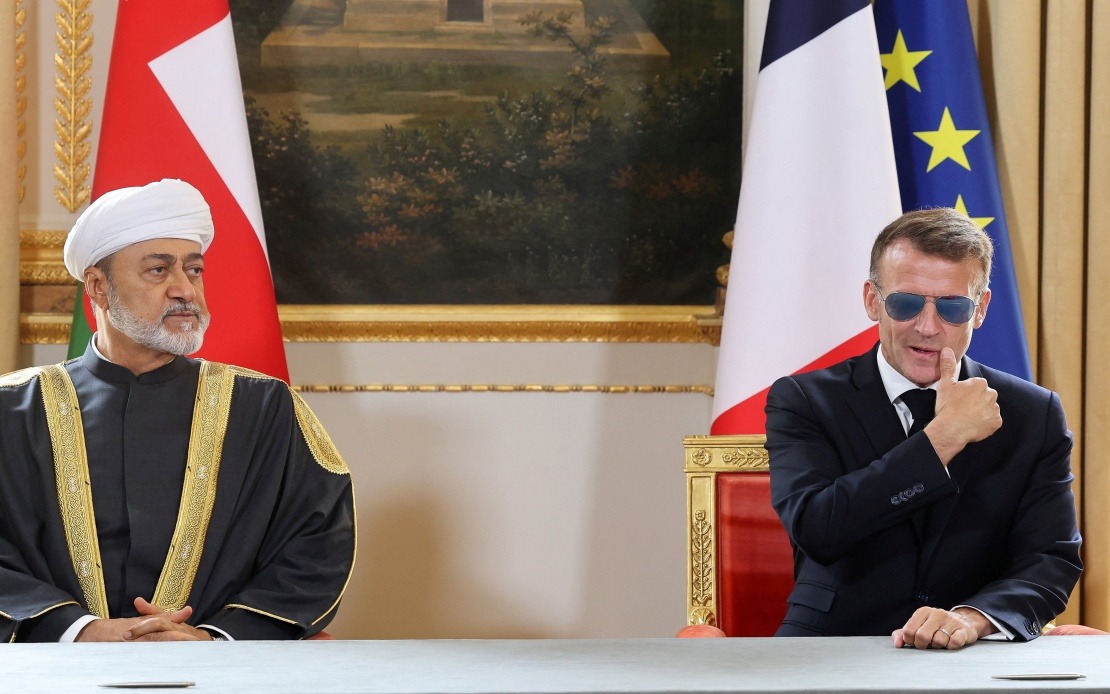
French President Emmanuel Macron appeared at the Élysée Palace on Monday wearing his now-familiar aviator sunglasses during a bilateral meeting with Sultan Haitham bin Tariq of Oman, marking another public outing of the eyewear that has become something of a signature accessory. According to French media outlets citing sources close to the president, Macron donned the sunglasses due to an eye problem that continues to require protection from bright light. The French leader maintained the eyewear throughout the diplomatic engagement, a decision that underscores the persistent nature of his optical condition rather than any attempt at fashion-forward diplomacy.
The eye issue affecting Macron dates back to January of this year, when his office disclosed that he was suffering from a minor eye inflammation that necessitated wearing protective sunglasses for approximately two weeks. What might have otherwise remained a routine medical matter became fodder for international commentary and satirical observations when Macron subsequently appeared in the aviators at the World Economic Forum in Davos earlier this year. The seemingly casual accessory choice triggered a wave of public attention, with observers both within France and internationally seizing upon the distinctive appearance for commentary and humorous comparison.
International figures, including United States President Donald Trump, directed pointed remarks toward Macron's sunglasses-clad appearance at Davos, using the occasion to offer their own running commentary on the French president's look. Within France itself, social media users and commentators drew playful comparisons between Macron's aviators and the iconic eyewear worn by Tom Cruise in the action film Top Gun, a reference that resonated widely across entertainment-conscious audiences. These reactions transformed what was intended as a medical accommodation into a moment of unexpected cultural significance, demonstrating how even practical health decisions by world leaders can capture public imagination in an age of constant scrutiny and social media commentary.
The sunglasses themselves, an aviator-style model, are products of Henry Jullien, a French luxury eyewear manufacturer with a distinguished heritage in optical craftsmanship. Following Macron's high-profile appearance in Davos, the company experienced a pronounced surge in customer inquiries about the specific model that the president had worn. Rather than shy away from the association, Henry Jullien embraced the connection, leveraging the Macron moment as a marketing opportunity by continuing to feature photographs of the French president wearing their product in promotional materials.
The phenomenon illustrates a broader truth about contemporary politics and consumer culture: when a world leader's personal accessory attracts attention, commercial interest frequently follows. Henry Jullien's decision to capitalize on the visibility reflects standard business practice in the luxury goods sector, where association with prominent figures can dramatically enhance brand recognition and desirability. The company's strategic approach has likely contributed to sustained interest in the model among consumers seeking to replicate, or at least acknowledge, the distinctive look that has become synonymous with Macron's recent public appearances.
For Southeast Asian observers, the incident offers an intriguing window into the intersection of politics, media scrutiny, and personal image management in Western democracies. French political culture, while formal in many respects, permits a degree of lighthearted public commentary on leaders' personal choices that reflects the broader democratic tolerance for humor and criticism. The sustained coverage of Macron's eyewear stands in contrast to many regional political contexts, where such focused attention on a leader's appearance might be considered inappropriate or even disrespectful.
The bilateral meeting with Sultan Haitham bin Tariq represents France's continued engagement with the Gulf region, a strategic priority for European nations seeking to maintain diplomatic and economic relationships in the Middle East. Oman, under the Sultan's leadership since 2020, has maintained a distinctive foreign policy emphasizing neutrality and mediation in regional disputes. The French-Omani relationship encompasses defence, trade, and cultural dimensions, making such high-level meetings significant for both nations' strategic interests.
Macron's willingness to conduct the meeting while visibly managing his eye condition sends an implicit message about the continuity of state business regardless of minor health matters. The decision to proceed with the engagement without postponement or cancellation demonstrates the expectations placed upon national leaders to maintain their diplomatic schedules despite personal inconveniences. This approach reflects the demanding nature of high-level political office, where health issues must be managed rather than allowed to disrupt essential governmental functions.
The sunglasses incident, while seemingly trivial, encapsulates several contemporary dynamics in global politics. First, it demonstrates how quickly leaders' personal attributes can become subjects of international discourse and cultural commentary. Second, it illustrates the commercial opportunities that arise when prominent figures inadvertently endorse products through high-visibility public appearances. Third, it highlights differing cultural attitudes toward public commentary on political figures' personal characteristics. Finally, it serves as a reminder that even world leaders managing straightforward medical conditions cannot escape the omnipresent attention of global media and digital audiences seeking novel angles on political news.

