Celebrations of Maal Hijrah 1448H unfolded across Malaysia on June 17, centred on a compelling message: the Islamic calendar's commemoration of Prophet Muhammad's migration serves as a contemporary reminder of positive transformation, principled governance, and collective Muslim advancement. The nationwide observance brought together spiritual leadership and community figures to reflect on how the hijrah principle—migration towards moral and social improvement—remains relevant to modern challenges facing Malaysia and the broader Islamic world.
The ceremonial gatherings integrated multiple dimensions of Islamic practice and reflection. Throughout the day, participants engaged with Quranic recitations, attended scholarly lectures addressing contemporary issues, and participated in formal recognition programmes honouring individuals who exemplify hijrah's principles in their professional and community work. This multifaceted approach emphasised that spiritual observance and practical civic contribution form interconnected components of a healthy Islamic society. The celebrations underscored that meaningful religious observance extends beyond ritual into tangible service to the public good and advancement of civilisation.
Government representation at the national level demonstrated official commitment to the observance. Deputy Prime Minister Datuk Seri Fadillah Yusof and Minister in the Prime Minister's Department (Religious Affairs) Dr Zulkifli Hasan attended the main event, which drew approximately 5,000 participants. Their presence reflected how Malaysian policymakers view Maal Hijrah not merely as a religious occasion but as a platform for reaffirming the nation's foundational Islamic values and their integration within broader governance frameworks. The theme, "MADANI Dihayati, Ummah Diberkati"—emphasising the lived experience of Malaysia's MADANI development framework and divine blessing for the Muslim community—connected spiritual renewal directly to the government's contemporary policy agenda.
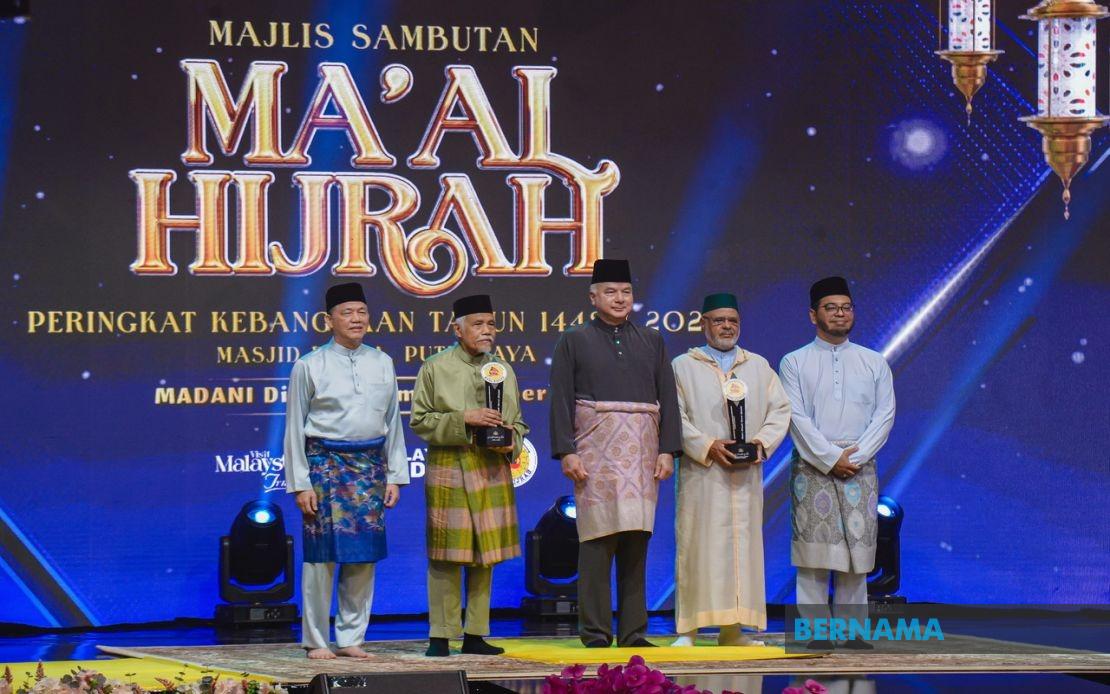
Recognition programmes highlighted individuals whose life trajectories embody hijrah's transformative essence. Sultan Nazrin, Sultan of Perak, conferred the National Tokoh Maal Hijrah Award upon Prof Emeritus Datuk Dr Osman Bakar, rector of the International Islamic University Malaysia. Dr Bakar's distinguished academic career bridging Islamic thought and scientific inquiry represents a model of intellectual hijrah—the migration of scholarship toward rigorous engagement with both religious and secular knowledge domains. This recognition signals that Malaysia's leadership values contributions transcending conventional boundaries between religious and secular expertise.
The International Tokoh Maal Hijrah Award went to Dr Ahmad Al-Raysuni, a Moroccan Islamic jurisprudence scholar, acknowledging the global dimensions of Islamic intellectual traditions. By honouring a non-Malaysian recipient, the celebrations recognised that hijrah operates transnationally and that learning flows across Muslim-majority societies. This gesture reflects Malaysia's positioning within broader Islamic networks and its aspiration to contribute meaningfully to worldwide Muslim discourse on contemporary ethical and governance challenges.
State-level celebrations in Sabah demonstrated how the Maal Hijrah message resonates across Malaysia's diverse regions. An estimated 1,000 attendees gathered at ceremonies where Chief Minister Datuk Seri Hajiji Noor welcomed dignitaries including Tun Musa and his wife Toh Puan Faridah Tussin. The involvement of state executives and local government officials underscored how Maal Hijrah functions as a unifying occasion cutting across administrative hierarchies and bringing together secular and religious authority figures in common purpose.
Award recipients embodied diverse pathways of service within Sabah's Islamic community. Datuk Ag Sharin Alimin, a community activist and former director of the state Islamic Religious Affairs Department, received recognition in the male category, reflecting his sustained institutional and grassroots contributions. Datuk Masnah Matsalleh, former deputy state secretary, was honoured for female leadership in public administration, highlighting women's integral roles within governance structures that support Islamic community welfare. These selections demonstrated deliberate effort to ensure recognition cut across gender and institutional divides.
A particularly poignant award recognised Jusoh @ Muda Ismail, a 95-year-old Quranic teacher whose nearly-century lifespan encompasses Malaysia's transformation from colonial territory to independent nation. As the adopted son and student of the late Tuan Guru Haji Mat Lintar, a renowned Quranic scholar, Jusoh represented intergenerational transmission of Islamic knowledge and the continuity of religious learning traditions across decades of rapid social change. His recognition honoured those who, often outside formal institutional frameworks, sustain the intellectual and spiritual foundations of Islamic practice within communities.
For Malaysian and Southeast Asian readers, these celebrations carry particular significance in the current regional context. As Muslim-majority societies navigate complex pressures of globalisation, technological disruption, and geopolitical realignment, the emphasis on hijrah as purposeful positive transformation offers a conceptual framework for addressing contemporary anxieties. The celebration's focus on quality leadership and ummah unity responds implicitly to concerns about polarisation, institutional trust deficits, and questions about Islam's relationship with modernity that occupy public discourse across the region.
The recognition of diverse award recipients—spanning academia, religious scholarship, community activism, public administration, and traditional Quranic pedagogy—reflected a capacious understanding of how hijrah manifests across professional and social domains. Rather than privileging one sector or approach, the celebrations suggested that meaningful Islamic contributions emerge through medicine, law, education, civil service, and grassroots community work alike. This inclusive vision potentially counters narratives that position Islam primarily in oppositional or separatist relationship to modern institutions.
The nationwide scope of celebrations, with simultaneous observances in multiple states and localities, demonstrated how a specifically Islamic religious occasion connects to broader national identity. Unlike observances confined to mosques or religious organisations, Maal Hijrah 1448H encompassed governmental structures, educational institutions, and civil society participation. This integration suggests how Malaysia manages religious pluralism by allocating public recognition to Islamic observances while maintaining secular governance frameworks—a model that other Southeast Asian nations with Muslim minorities observe with varying degrees of interest and concern.
Looking forward, the emphasis on transformation and renewed commitment contained in Maal Hijrah messaging may influence how Malaysian leaders subsequently approach policy challenges. The celebration's articulation of hijrah as purposeful migration toward justice, wisdom, and communal welfare provides rhetorical resources for justifying reform initiatives and addressing critics who question whether institutions adequately serve public interests. Whether these celebrations translate into substantive institutional or policy shifts will depend on how seriously leadership integrates the articulated values into subsequent decision-making processes.