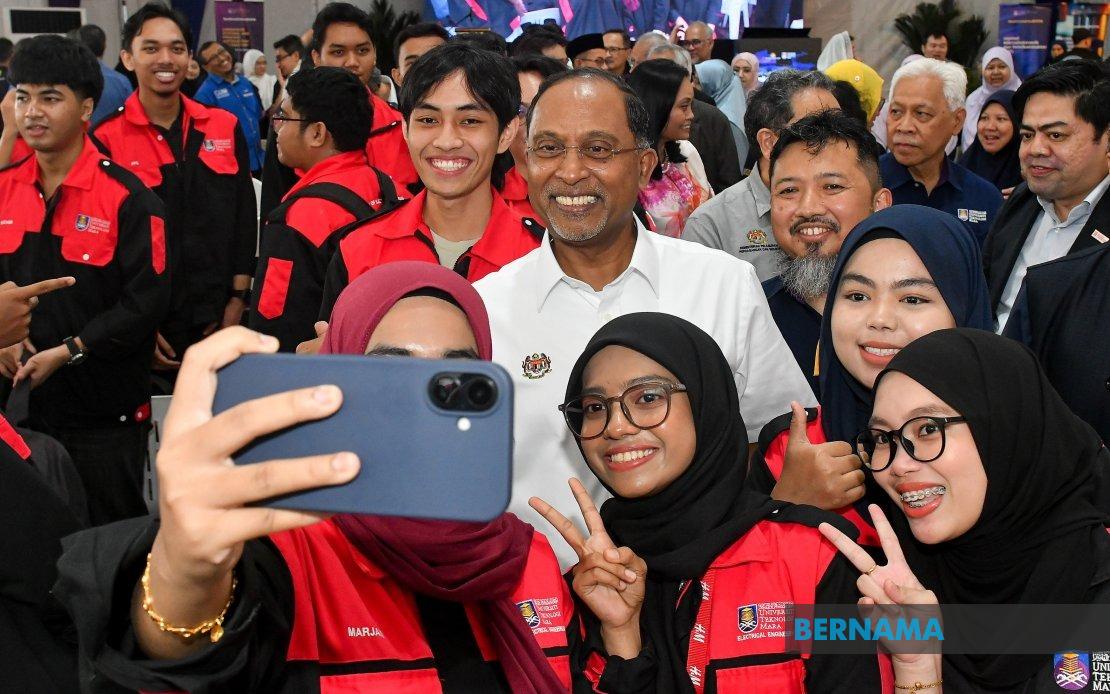
The newly operational Light Rail Transit 3 (LRT3) Shah Alam Line is reshaping how students navigate their daily commutes to Universiti Teknologi MARA's main campus, with Higher Education Minister Datuk Seri Dr Zambry Abd Kadir crediting the transport link with easing congestion and lowering travel expenses across the sprawling Klang Valley region. Speaking during an event at UiTM Shah Alam on June 30, Zambry underscored the palpable enthusiasm among students who now benefit from direct rail access via the dedicated UiTM Shah Alam Station, describing the project as a critical intervention for a campus experiencing rapid expansion and mounting traffic pressures.
The Shah Alam Line, which commenced operations recently following Prime Minister Datuk Seri Anwar Ibrahim's launch last Sunday, stretches across 20 stations linking suburban communities from Bandar Utama through to Johan Setia in Klang. The route encompasses major nodes including Stadium Shah Alam, Pasar Klang, and Jambatan Kota, effectively threading together multiple residential clusters with commercial and educational hubs. The geographic breadth of the network positions UiTM Shah Alam at a strategic midpoint along the corridor, enabling students from disparate parts of the Klang Valley to access campus through a single reliable transit option rather than relying on personal vehicles or congested bus services.
A promotional incentive sweetens the offering: Prime Minister Anwar announced that all LRT3 Shah Alam passengers will travel free of charge from June 29 through July 31, a month-long subsidy designed to encourage adoption and demonstrate the service's value to commuters. For UiTM's predominantly cash-conscious student population, this concession removes a meaningful financial barrier to daily campus access, potentially catalysing broader behavioural shifts toward public transport usage. The free-fare window also allows university authorities to gather data on ridership patterns and demand, information valuable for planning future service enhancements and justifying continued infrastructure investment in the education sector.
Beyond mobility improvements, Zambry highlighted UiTM's simultaneous push into semiconductor talent development through the launch of the Semiconductor@UiTM initiative at the Tuanku Abdul Halim Mu'adzam Shah Engineering Complex. The university has deployed a RM20 million government allocation toward building infrastructure, recruiting specialised faculty, and designing industry-aligned curricula centred on Electrical and Electronics Engineering (E&E). This initiative embodies a deliberate national strategy to cultivate a technically skilled workforce capable of sustaining Malaysia's foothold in the global semiconductor supply chain, a sector currently generating over RM300 billion annually and representing approximately 13 per cent of worldwide chip production and design revenues.
The Semiconductor@UiTM programme reflects broader alignment with Malaysia's National Semiconductor Strategy (NSS), a coordinated policy framework aimed at ensuring the country's competitiveness in an increasingly consolidated and technology-intensive industry. By upgrading facilities and embedding industry partnerships within academic curricula, UiTM positions itself to become a regional training hub capable of producing graduates who meet international standards and are immediately deployable within multinational chipmakers and local semiconductor enterprises. The initiative emphasises reciprocal knowledge transfer between university researchers and industry practitioners, exposing students to cutting-edge fabrication techniques, design methodologies, and supply-chain realities that purely theoretical classroom instruction cannot convey.
Zambry framed UiTM's semiconductor commitment as evidence of the university translating substantial government capital allocations into tangible economic returns, a narrative increasingly central to public sector higher education discourse in Malaysia. Rather than viewing university funding as consumption, the minister presented the RM20 million investment as a strategic input into human capital formation directly supporting national economic priorities. This framing carries implications for budget-setting and institutional accountability, suggesting that universities demonstrating alignment with government economic strategies may secure preferential resource allocation in increasingly competitive funding environments across Southeast Asia.
The timing of the LRT3 launch and the Semiconductor@UiTM announcement reflects deliberate coordination between transport and higher education policy domains. Enhanced campus accessibility via modern rapid transit can bolster UiTM's recruitment appeal, particularly among students from outer Klang Valley suburbs who previously faced prohibitive commute times. Conversely, concentrating advanced technical training at a campus increasingly well-connected by public transport justifies infrastructure investment and signals to investors and international partners that Malaysia is building integrated ecosystems linking educational excellence with physical accessibility and economic competitiveness.
Regional observers note that Malaysia's semiconductor strategy operates within broader Southeast Asian competition for chipmaking investments and talent. Vietnam, Thailand, and Indonesia are simultaneously investing in semiconductor education and manufacturing capacity, creating a regional race to develop domestic expertise and attract multinational investment. UiTM's initiatives position the institution as a significant player within this competitive landscape, though success ultimately depends on whether graduate outputs genuinely meet industry expectations and whether Malaysian employers retain talent domestically rather than losing it to higher-wage jurisdictions such as Singapore or Taiwan.
The convergence of transport improvements and skills development also underscores evolving approaches to regional economic development in Malaysia. Rather than concentrating advanced facilities and training exclusively in Kuala Lumpur's central business district, authorities are strategically positioning secondary university campuses like UiTM Shah Alam as nodes within distributed knowledge networks. The LRT3 connection validates this spatial strategy by ensuring that UiTM's semiconductor programmes remain accessible without requiring students to navigate central city congestion or relocate entirely, thereby democratising access to premium technical education and distributing economic benefits across the metropolitan periphery.
UiTM vice-chancellor Professor Datuk Dr Shahrin Sahib@Sahubuddin was present during the June 30 announcement, underlining institutional commitment to the semiconductor initiative. University leadership's visible participation signals that the programme represents a sustained strategic priority rather than a temporary project, an important message to faculty considering specialisation investments and to employers assessing where to source graduate hires. Semiconductor manufacturing is capital and knowledge-intensive, meaning employers require confidence in long-term institutional commitment before establishing sustained recruitment relationships with universities.
Zambry characterised UiTM's semiconductor initiative as establishing a benchmark that other Malaysian universities would be expected to emulate, effectively positioning UiTM as a sector leader and setting a standard against which government and employers will measure institutional contributions to high-technology skill formation. This competitive framing may encourage other universities to launch complementary programmes in semiconductors or adjacent high-tech domains, potentially accelerating Malaysia's sectoral capacity-building but also raising questions about whether multiple universities can simultaneously develop world-class semiconductor programmes given finite pools of specialised faculty and laboratory equipment.
The minister also noted that the combined mobility and skills initiatives demonstrate how coordinated public investment across infrastructure and education domains can amplify individual project benefits. Students enjoying reliable transport access to campus are better positioned to engage intensively in academic work and practical training. Conversely, a campus offering premium technical programmes becomes more competitive at attracting geographically dispersed student talent when physical accessibility barriers diminish. This systems-level integration represents an evolution beyond siloed sectoral planning, though implementation complexity increases proportionally to the breadth of coordination required.
Looking forward, the sustainability of both initiatives depends on execution quality and measurable outcomes. The LRT3 system must maintain reliability and service frequency to retain commuter confidence beyond the promotional free-fare period. Similarly, the Semiconductor@UiTM programme must demonstrate graduate employment outcomes, employer satisfaction, and research contributions validating the RM20 million investment. Malaysian policymakers will be monitoring whether these joint initiatives successfully translate into enhanced student mobility, expanded domestic semiconductor capacity, and measurable contributions to national economic competitiveness in a sector where Malaysia seeks to maintain global relevance despite intensifying regional and international competition.

