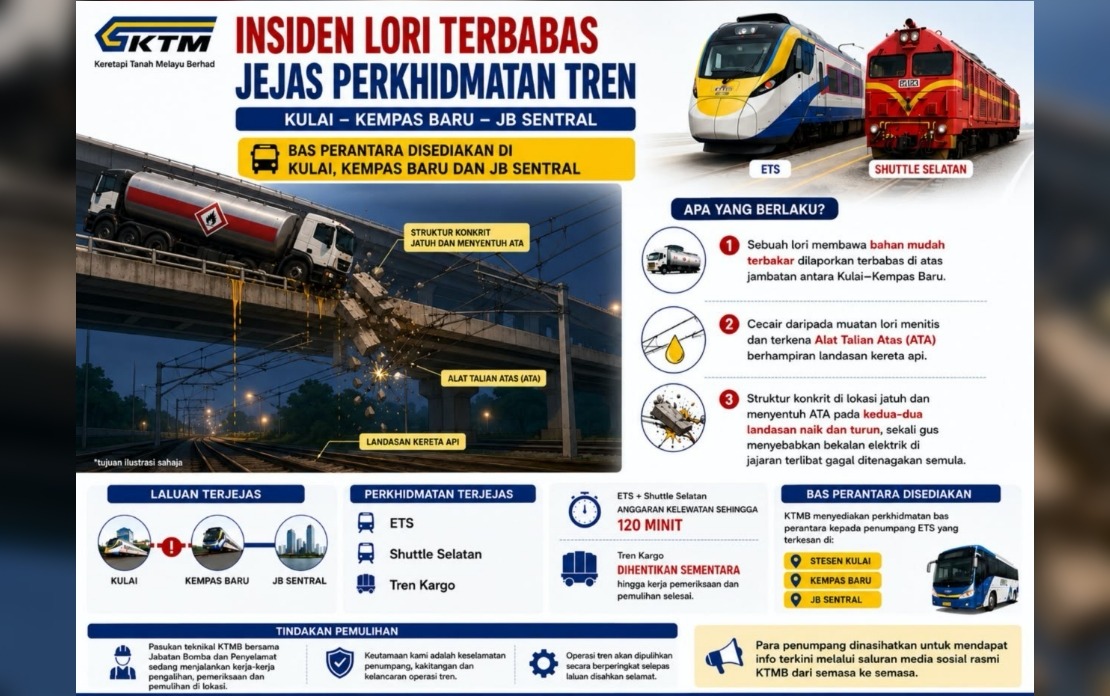
A transport accident in Johor Bahru has disrupted commuter services along a major railway corridor after a lorry veered off course near active rail infrastructure. The incident, which involved a vehicle transporting flammable materials, caused a loss of electrical power to the Kulai–Kempas route, forcing the cancellation of scheduled services for both the Electric Train Service and Shuttle Selatan throughout Tuesday evening. The disruption highlighted the vulnerability of Malaysia's rail network to vehicular accidents occurring in proximity to track infrastructure, a recurring challenge for national railway operator Keretapi Tanah Melayu Berhad (KTMB) as road and rail corridors increasingly overlap in developed areas.
Kelay authorities mobilised cleanup and repair crews immediately following the power failure to restore safe operating conditions. The scope of damage required more than standard maintenance procedures, as workers had to assess structural integrity around the affected infrastructure and address contamination risks associated with the spilled flammable cargo. KTMB disclosed the situation to the public through social media channels, providing real-time updates as restoration work progressed. This communication approach reflected growing pressure on state-owned transport operators to maintain transparency with passengers during service disruptions, particularly given the high volume of daily commuters depending on these routes for work, education, and leisure travel.
Passengers faced significant inconvenience as evening rush-hour services were affected. The Kulai–Kempas line serves several population centres in the southern Johor region, connecting communities to the state capital and major employment hubs. Two specific trains encountered substantial delays: the ETS9449 service ran 32 minutes behind schedule, whilst the ETS9533 service was delayed by 55 minutes, as of 10:37 pm. KTMB cautioned that these figures remained provisional, subject to further changes depending on how quickly engineers could restore full electrical capacity to the line.
To mitigate passenger hardship, KTMB arranged alternative transport solutions at three key stations: Kulai, Kempas Baru, and JB Sentral. Shuttle buses were deployed to provide substitute services for ETS passengers, enabling continuity of journeys despite the rail service interruption. However, Shuttle Selatan passengers received different instructions. Rather than offering replacement vehicles, KTMB recommended that Shuttle Selatan users switch to other transportation modes such as personal vehicles, taxis, or ride-sharing services. This distinction reflected the different operational structures of the two services and may have created additional expense for passengers who had already paid fares.
Financial compensation arrangements formed an important part of KTMB's response to the disruption. The operator announced that fare adjustments would be extended to all affected passengers, though specific details regarding the amount or mechanism for claiming reimbursement were not immediately disclosed. Such compensation policies are increasingly standard across transport operators in Malaysia and Southeast Asia, acknowledging that service failures impose real costs on users through additional travel expenses, late arrivals, and lost productivity. The willingness to offer refunds demonstrates KTMB's recognition that public trust depends partly on accountability when operational failures occur.
The incident raises broader questions about transport infrastructure resilience in Malaysia's rapidly urbanising landscape. As road networks expand and rail lines extend through increasingly populated areas, the frequency of vehicle-related rail incidents may increase unless comprehensive safety measures are implemented. Barriers, improved signage, and driver education campaigns could reduce the likelihood of vehicles straying onto or near railway reserves. The involvement of a flammable cargo carrier added another layer of risk, as accidents involving hazardous materials can trigger secondary incidents including fires or chemical contamination affecting both human safety and environmental quality.
For commuters in the Johor region, such disruptions underscore the importance of maintaining redundancy in transport networks. The Kulai–Kempas corridor carries considerable passenger volume, and any single-point failure can create cascading delays affecting thousands of people. Investment in alternative routes, whether road-based or rail-based, could provide options when primary services become unavailable. The relative ease with which shuttle bus services were mobilised suggests that KTMB possesses contingency capacity, but deploying these resources consumes time and diverts vehicles from other operations.
The timing of this incident during evening peak hours compounded its impact. Many workers use the ETS to commute homeward, and disruptions at this time affect not only the directly inconvenienced passengers but also secondary users such as families awaiting their return. Schools, businesses, and households in the surrounding areas may experience knock-on effects as dependent individuals experience delayed arrivals. The cascading nature of transport disruptions in modern urban systems means that a single accident at one location can reverberate through multiple sectors of the local economy and society.
KTMB's public apology and guidance for passengers seeking further assistance reflected standard corporate crisis communication practices. Station staff were instructed to provide support to confused or frustrated passengers, a human-centred approach that recognises emotional dimensions of service failures alongside logistical ones. However, the efficacy of this response depended on adequate staffing levels at affected stations and the quality of training provided to frontline workers handling public inquiries during peak-stress situations.
Looking forward, this incident may prompt KTMB and relevant regulatory authorities to review safety protocols around railway reserves, particularly in areas where road traffic remains in close proximity to rail infrastructure. Collaborative discussions with road transport operators, municipal authorities, and hazardous materials regulators could identify practical improvements to prevent recurrence. The broader Southeast Asian context matters here, as several countries in the region face similar challenges of integrating aging infrastructure with modern transport demands, and shared learning about incident prevention could benefit regional transport networks. For Malaysian passengers, the incident served as a reminder that modern transport systems, despite technological sophistication, remain vulnerable to human error and the unpredictable interactions between different transport modes.

