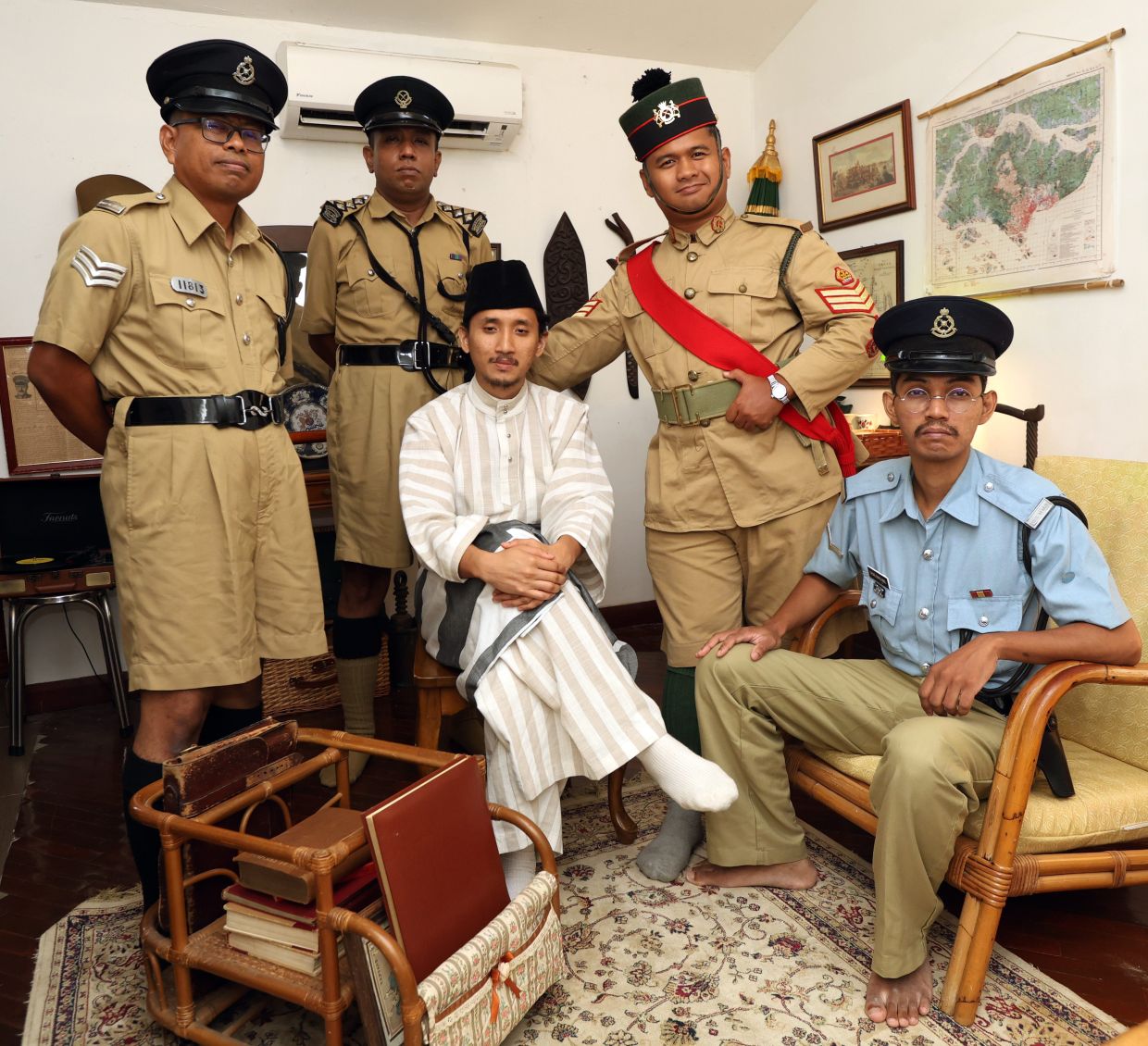
On weekend afternoons, members of Persatuan Reka Ulang Sejarah (PRUS) gather in period military uniforms to discuss and demonstrate historical events with scholarly precision. What might appear as costume roleplay is, in reality, a carefully researched educational endeavour born from a genuine concern that Malaysian schoolchildren are increasingly disconnected from their own national story. This volunteer-driven group has evolved from informal collectors' meetings into a registered society with a mission to make history tactile, visible, and unforgettable for audiences who might otherwise encounter the past only through textbook illustrations and monochrome photographs.
The organisation's origins trace back to the early 2010s, when military uniform enthusiasts and collectors attended exhibitions at Port Dickson Army Museum near the former Royal Malaysian Air Force Base in Sungai Besi, Kuala Lumpur. These gatherings gradually developed into a coordinated initiative operating under the informal banner "We Are Re-enactors" before achieving formal registration as PRUS in 2023. The transition from hobby community to registered society marked a crucial turning point, enabling members to organise sanctioned events at educational institutions and cultural venues. This institutional recognition has proved essential for expanding their reach beyond weekend meetups into structured programmes that align with school curricula and museum programming.
Chairman Abdul Hakim Abdul Raniidentifies a specific historical problem that motivated the group's formalisation: widespread confusion about military uniforms across different eras and service branches. During periods when photography was still monochrome, distinguishing between the dress of various military forces became challenging for contemporary observers and researchers alike. PRUS members recognised that hands-on demonstration could resolve these ambiguities far more effectively than written descriptions or archival photographs. By wearing, displaying, and explaining authentic uniforms in controlled educational settings, they could establish visual and factual clarity about Malaysia's defence heritage during the pre-Independence era and early years of nationhood.
What distinguishes PRUS from casual costume groups is their insistence on comprehensive historical accuracy extending well beyond uniform details. The organisation's members have invested substantial time studying period-specific etiquette, body language, marching techniques, and verbal protocols that characterised soldiers of earlier decades. Abdul Hakim, who works professionally as a tour guide and previously served in the Territorial Army (Askar Wataniah), emphasises that authenticity serves educational purposes rather than entertainment alone. Recreating historical scenarios demands extensive preparation, from consulting original pre-Independence military manuals to mastering navigation techniques and combat formations that have long since become obsolete.
A July jamboree organised by PRUS exemplified this commitment to rigorous historical reconstruction. Over two days and one night, members participated in supervised training encompassing marching drills, map reading, navigation exercises, and simulated combat manoeuvres all based on authentic historical documentation. Significantly, safety regulations required substituting wooden sticks for actual weapons during combat demonstrations, a pragmatic compromise that preserved pedagogical value without risk. Abdul Hakim's personal military background proved invaluable in leading these sessions, as he could draw upon lived experience to explain the reasoning behind specific procedures and protocols that students of history might otherwise find mystifying.
The group's collaboration with Malaysia's film and television industry represents another dimension of their historical advocacy work. Production designers and directors increasingly turn to PRUS members for consultation on period-appropriate uniforms and military bearing, ensuring that dramatic reconstructions maintain visual fidelity to their historical subjects. Vice chairman Mohd Fadzreeq Mokti clarifies that these engagements transcend mere extra work; members view on-screen appearances as opportunities to model authentically how people actually moved, dressed, and conducted themselves during specific historical periods. This attention to detail strengthens the educational value of visual media, preventing the casual inaccuracies that can accumulate in entertainment productions and gradually distort public understanding of history.
August and September represent peak activity months for PRUS, coinciding with National Month celebrations and Malaysia Day commemorations. During these periods, members transport their uniform collections to exhibitions and public events, deliberately positioning themselves as accessible historical resources for younger audiences. Abdul Hakim has observed concerning gaps in young Malaysians' historical knowledge, noting that students frequently struggle to identify important figures and pivotal events from their nation's past. He views this knowledge deficit not as inevitable generational change but as a crisis requiring urgent intervention through multiple channels, with schools representing the most promising entry point for reaching receptive minds during formative years.
Mohd Fadzreeq, who teaches in a Malaysian school, has witnessed directly how historical uniforms transform student engagement. When he appears at school wearing period-appropriate dress (with explicit headmaster approval), students respond with pronounced enthusiasm and curiosity, repeatedly requesting future appearances. He attributes this response to the experiential learning that visual and tactile history provides compared to abstract textbook instruction. Young learners, he observes, demonstrate greater retention and enthusiasm when they can see physical examples, ask direct questions, and receive immediate explanations from knowledgeable guides. The museum and classroom settings that children occasionally visit remain inaccessible to many, making PRUS members serve a crucial role as "walking museums" bringing history directly into community spaces.
The educational philosophy underlying PRUS operations reflects a sophisticated understanding of pedagogy and historical consciousness. Members invest considerable personal time consuming specialist books, original manuals, and archival materials to deepen their own knowledge before public presentations. This preparatory work ensures that casual visitors' questions receive substantive, accurate responses rather than superficial approximations. The group rejects framing their activities as mere costume display or entertainment spectacle, instead emphasising the responsibility they bear as historical interpreters. Every uniform detail, every marching step, every verbal explanation represents an opportunity to embed accurate historical understanding within audiences who might otherwise inherit distorted or incomplete versions of Malaysian heritage.
PRUS's emergence reflects broader regional challenges concerning historical literacy and national identity formation among younger Southeast Asian populations. In Malaysia specifically, rapid modernisation and educational priorities emphasising STEM subjects have sometimes marginalised humanities and history education. The group's activities demonstrate that dedicated community engagement can partially compensate for institutional gaps, though such volunteer efforts remain inherently limited in scale and reach. For PRUS members, the ultimate aspiration extends beyond weekend gatherings and exhibition appearances; they hope their meticulous reconstructions will inspire systematic improvements in how Malaysian schools and cultural institutions transmit historical knowledge. Whether this grassroots initiative can generate broader policy attention toward heritage education remains uncertain, but their commitment to historical accuracy and public engagement has already established PRUS as a distinctive voice advocating for Malaysians' deeper connection with their own complicated, multifaceted past.

