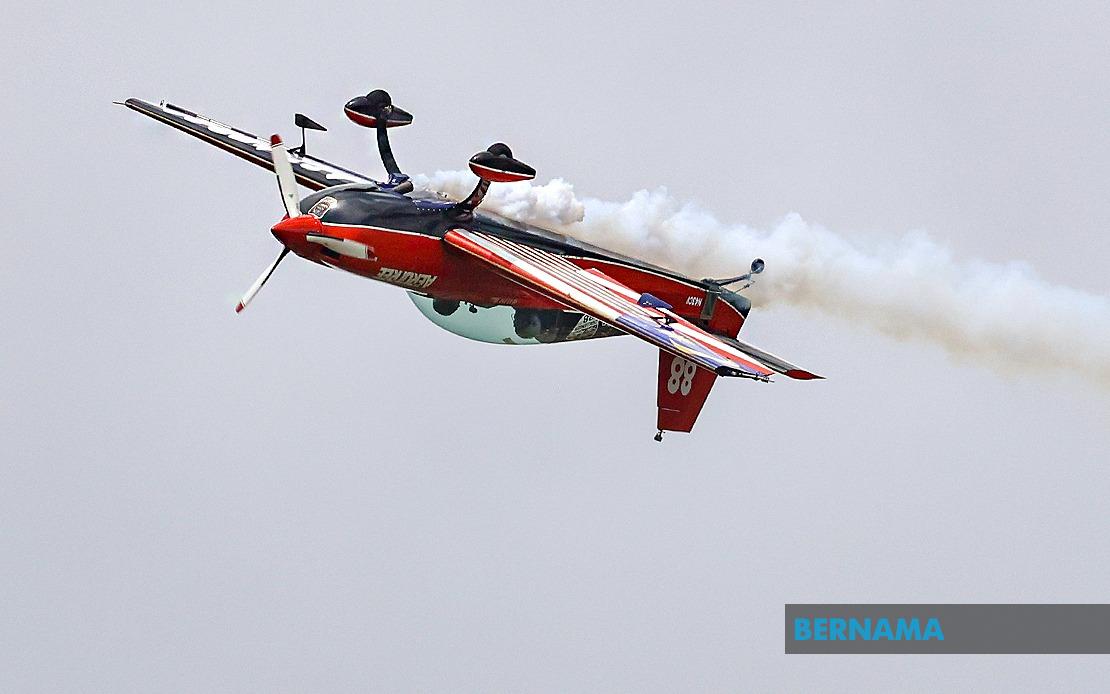
Major (Retired) Datuk Halim Othman, aged 60, took centre stage at the inaugural 'Merdeka Sunset Show: Melukis Senja' during Malaysia's 69th National Day celebrations in Putrajaya on August 30, leveraging four decades of accumulated aviation expertise to deliver a spectacular twilight aerobatic performance. The retired Royal Malaysian Air Force fighter pilot, widely recognised as the first Malaysian to qualify for the prestigious Red Bull Air Race World Championship, commanded a solo display at 7 pm that combined precise aerial manoeuvres with smoke trails and pyrotechnics set against the natural backdrop of a setting sun, establishing a distinctive visual centrepiece for the National Month festivities.
The concept underlying the performance extended beyond mere spectacle. Rather than simply executing daring loops and rolls, Halim approached the evening's demonstration as an expression of disciplined expertise refined across a military career spanning since 1985 and subsequent ventures into competitive international air racing. His philosophy underscores a fundamental truth often misunderstood by observers: aerobatic flying represents far more than reckless daring. Instead, it demands meticulous understanding of aircraft engineering limits, comprehensive mastery of flight dynamics, and the psychological fortitude required to push boundaries while remaining perpetually aware of safe operational parameters. This philosophical framework shaped not only his technical accomplishments but also his deliberate positioning as a role model for younger Malaysians considering careers in aerospace.
Halim's competitive journey through international racing circuits provided crucial validation of Malaysian aeronautical capabilities. During his participation in the Red Bull series, he encountered predominantly non-Malaysian competitors, with particularly few pilots from across Asia competing at the championship level. This demographic reality transformed his racing goals into a patriotic mission of representation. By performing competitively alongside and occasionally outperforming seasoned international rivals, Halim effectively challenged prevailing assumptions about Asian aviation talent. His 2014 victory at the Challenger Cup competitions in both Ascot, United Kingdom, and Las Vegas, United States, coupled with a runner-up finish at the Red Bull Ring in Austria, demonstrated that Malaysian pilots could operate successfully within the world's most demanding aerial racing environments.
The breadth of aircraft Halim has commanded throughout his career illustrates the scope of his technical mastery. His operational experience encompasses advanced military platforms including the MiG-29N, the F/A-18D Hornet, the A-4 Skyhawk, and the F-5E Tiger, each presenting distinct flight characteristics and operational challenges. Beyond military equipment, he has also piloted sophisticated corporate jets including the Learjet 35A and King Air 350i, demonstrating adaptability across multiple aviation sectors. This diverse portfolio, accumulated through genuine operational requirements rather than accumulation for its own sake, equipped him with the nuanced understanding necessary to manage the Extra 300L aerobatic aircraft during his Red Bull participation and now during increasingly elaborate display performances.
Prior to headlining the Merdeka Sunset Show, Halim had already pioneered similar performance concepts at the regional level. The 'Melukis Senja' format debuted previously at Chenang during the Langkawi International Maritime and Aerospace Exhibition, suggesting a deliberate development of aerial artistry that synthesises technical precision with aesthetic presentation. Rather than viewing the Putrajaya performance as an isolated anniversary celebration stunt, it represented a continuation of an emerging entertainment genre specifically designed for Malaysian and Southeast Asian audiences. This positioning carries implications for future National Day commemorations and international aerospace exhibitions throughout the region, where audiences increasingly expect sophisticated visual narratives rather than conventional flyovers.
Beyond his individual performances, Halim's broader institutional contributions have substantially shaped Malaysia's contemporary aeronautical landscape. As founder and president of Aerotree Defence and Services Sdn Bhd, he has positioned himself within the commercial aerospace sector while maintaining connections to national celebration and development objectives. His central role in establishing Krisakti, Malaysia's inaugural official aerobatic display team, which made its debut at LIMA 2011, demonstrated early recognition of the market and morale potential inherent in coordinated aerial performances. Krisakti's emergence represented a significant institutional development, moving Malaysia from relying on individual pilots or military formations to possessing a dedicated civilian aerobatic ensemble capable of competing visually with international counterparts.
Looking forward, Halim articulated ambitious expansion plans that suggest how individual achievement translates into organisational capability development. His announcement regarding a forthcoming six-aircraft aerobatic team equipped with coloured smoke systems indicates plans for substantially more elaborate and visually impressive future displays. Such formations require not merely pilot talent but also rigorous coordination protocols, maintenance infrastructure, and safety management systems that position Malaysia within an emerging category of nations capable of sustaining professional aerobatic teams. The implications extend beyond entertainment value; such teams function as visible demonstrations of national technical competence and organisational sophistication that resonate internationally, particularly during aviation-focused exhibitions like LIMA.
Halim's framing of these activities within corporate social responsibility rhetoric reveals an understanding that public investment in aerospace talent development requires institutional justification beyond patriotic sentiment. By explicitly connecting aerobatic performances to youth engagement and aerospace career pathway development, Halim positions spectacular displays as components of broader human capital strategy. This rationale carries particular resonance in Malaysia's context, where aerospace represents an identified economic development priority yet struggles to attract sufficient local talent into technical and professional roles. When influential figures like Halim explicitly dedicate resources toward demonstrating aerospace career possibilities to younger Malaysians, they contribute to addressing structural workforce challenges that constrain sector expansion.
The significance of Halim's career trajectory and continuing contributions extends beyond individual achievement into broader questions regarding Malaysia's positioning within regional and global aerospace hierarchies. His qualification for the Red Bull Air Race World Championship broke perceptual barriers about Malaysian pilot capabilities, while his subsequent competition results validated that preliminary accomplishment through sustained international performance. These achievements occurred within competitive environments where success cannot be fabricated through favourable judging or domestic advantages; the Red Bull circuit maintains unmistakable objective criteria for pilot ranking and performance evaluation. Halim's success therefore carries evidential weight regarding Malaysian aeronautical competence that extends beyond patriotic rhetoric into demonstrable international standing.
The institutional implications of Halim's work remain particularly relevant for Malaysia's aerospace ambitions. The country has invested substantially in major aviation projects and infrastructure while simultaneously struggling to develop sufficient indigenous technical expertise and pilot talent. Halim's multiple roles—as accomplished pilot, business proprietor, display team founder, and now visible representative of Malaysian aeronautical achievement—demonstrate how individual excellence can catalyse institutional development. His commitment to establishing training and performance frameworks that feature multiple aircraft and pilots suggests a transition from personality-dependent achievements toward sustainable systems capable of surviving individual retirements.
Looking toward Malaysia's future national celebrations and aerospace exhibitions, the Merdeka Sunset Show represents an inflection point in how the nation visually represents itself through aviation. Rather than defaulting to conventional military formations or imported international display teams, Malaysia now possesses homegrown talent capable of delivering sophisticated performances that compete aesthetically and technically with international standards. Halim's continued involvement in these performances, combined with his commitment to developing new aerobatic teams featuring expanded aircraft formations, suggests that Malaysia's aviation identity will increasingly reflect indigenous capability rather than external dependence. This shift carries symbolic importance that transcends entertainment, signalling to both domestic audiences and international observers that Malaysian aerospace ambitions rest upon genuine accumulated expertise rather than aspirational rhetoric.

