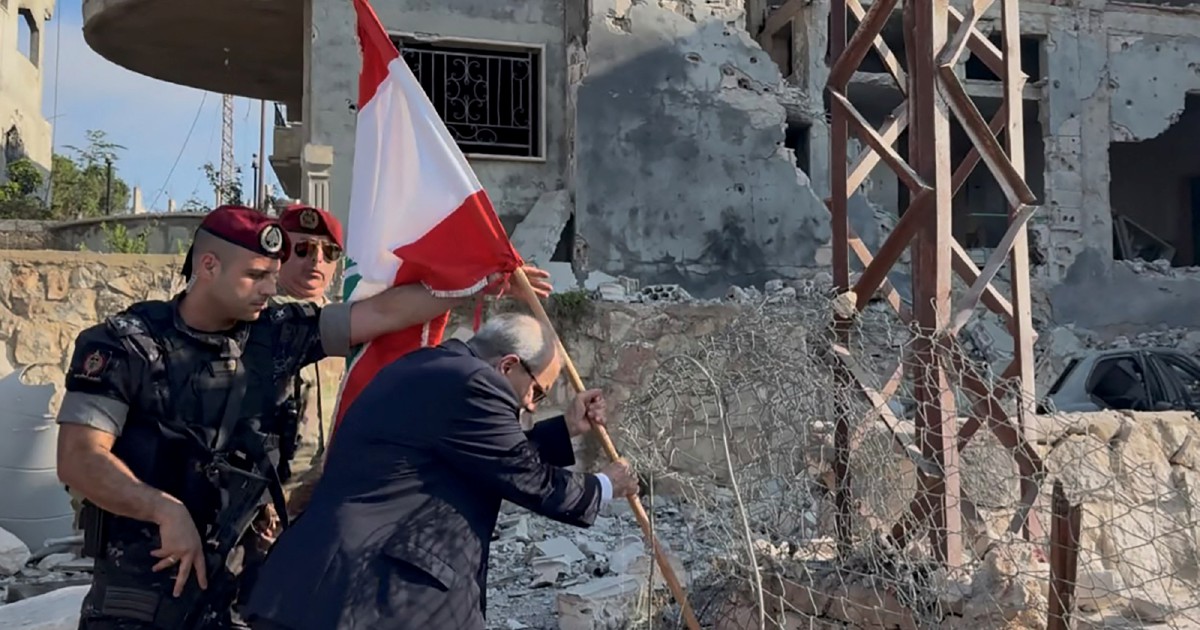
Lebanese Prime Minister Nawaf Salam has doubled down on his government's demand for a comprehensive Israeli military withdrawal from territories under Israeli occupation, delivering the message during a visit to Zawtar al-Gharbiyah, a village where Lebanese armed forces have recently taken up positions. The remarks underscore Beirut's determination to translate ceasefire arrangements into tangible territorial recovery, even as the mechanics of implementing such withdrawal remain undefined and politically contentious.
The timing of Salam's statement carries significant weight in the regional context. Lebanon's military deployment to these border areas represents one of the most assertive moves by the Lebanese state in years, signalling an attempt to reassert governmental authority in regions where non-state actors have traditionally held sway. This recentralisation of state military presence has been a cornerstone of international efforts to stabilise the Lebanon-Israel border, yet it simultaneously places Beirut in the uncomfortable position of enforcing sovereignty claims against a militarily superior neighbour.
Salam's visit to Zawtar al-Gharbiyah appears calibrated to demonstrate tangible progress to a domestic constituency that has endured decades of conflict, displacement, and economic hardship. By positioning himself alongside newly deployed military personnel, the Prime Minister attempts to embody the state's commitment to recovery and restoration of full territorial control. Such symbolic gestures matter enormously in Lebanese politics, where competing narratives about national dignity, resistance, and pragmatism constantly vie for supremacy among diverse confessional communities.
The question of Israeli withdrawal has become increasingly complex, as Beirut seeks to distinguish between occupied territories and areas of disputed control. Israel has maintained a military presence in south Lebanon in various capacities since 1978, with the current configuration reflecting decades of military occupation punctuated by sporadic conflict and temporary arrangements. Salam's insistence on "complete" withdrawal suggests a maximalist negotiating position, though the practical boundaries of what constitutes Lebanese territory remain contested and poorly demarcated in some sectors.
For Malaysian and broader Southeast Asian observers, Lebanon's struggle offers instructive parallels regarding sovereignty assertion in the face of external military pressure. The deployment of state military forces into previously contested regions mirrors challenges faced across Asia-Pacific, where smaller nations must navigate between maintaining territorial claims and avoiding direct confrontation with more powerful neighbours. Lebanon's experience illustrates the persistent difficulty of translating international agreements into on-the-ground realities when underlying power imbalances remain unchanged.
The Lebanese military's recent deployment represents a significant institutional development, as the armed forces have historically remained relatively marginalised compared to powerful militias and community-based security structures. Building capacity and credibility for these state institutions requires not only financial resources but also political consensus among Lebanon's fractious political factions. International support for military strengthening has been forthcoming, yet structural weaknesses and factional tensions continue to undermine institutional coherence.
Salam's assertion that Beirut is "working towards" complete withdrawal, rather than claiming imminent success, suggests realistic acknowledgement of the extended timeline such negotiations will require. The language choice indicates understanding that Israeli withdrawal will emerge through sustained diplomatic pressure rather than military victory, positioning Lebanon within a framework of negotiated settlement despite the asymmetry favouring the militarily stronger party. This approach reflects lessons learned from previous conflicts and ceasefire arrangements in the region.
The Prime Minister's visit to newly deployed military positions also carries implications for Hezbollah and other armed groups that have historically dominated security matters in southern Lebanon. The state's renewed military presence could eventually constrain the operational space for non-state actors, though this process remains fraught with political risk given Hezbollah's deep roots within Lebanese society and its military capabilities. Salam's assertion of state authority through military deployment represents an incremental step toward reducing parallel security structures, though comprehensive change remains distant.
International dimensions loom large over Lebanon's withdrawal demands. Various parties including the United States, France, and regional actors have invested diplomatically in ceasefire arrangements and territorial stabilisation. The success of these arrangements depends substantially on Israeli cooperation with withdrawal timelines and security verification mechanisms, areas where past agreements have foundered. Lebanon's ability to extract concessions from Israel depends partly on maintaining international pressure and partly on demonstrating credible state military capacity in border regions.
The economic context further complicates Lebanon's situation. The country faces severe fiscal constraints that limit military spending and development investment in border communities. Israeli withdrawal alone will not resolve the deeper structural problems afflicting Lebanon's economy, governance, and social cohesion. Yet territorial recovery carries profound symbolic importance, potentially restoring national confidence and creating space for reconstruction and reconciliation efforts that economic revival will require.
Salam's statements must also be understood as addressing domestic political constituencies, particularly communities displaced by decades of conflict who look to the state for meaningful recovery of lost territory and homes. The Prime Minister's emphasis on "complete" withdrawal appeals to patriotic sentiments while setting negotiating parameters that acknowledge the gap between desired outcomes and likely compromises. This rhetorical strategy attempts to maintain domestic political support for the government while engaging in the messy practical work of territorial negotiation.

