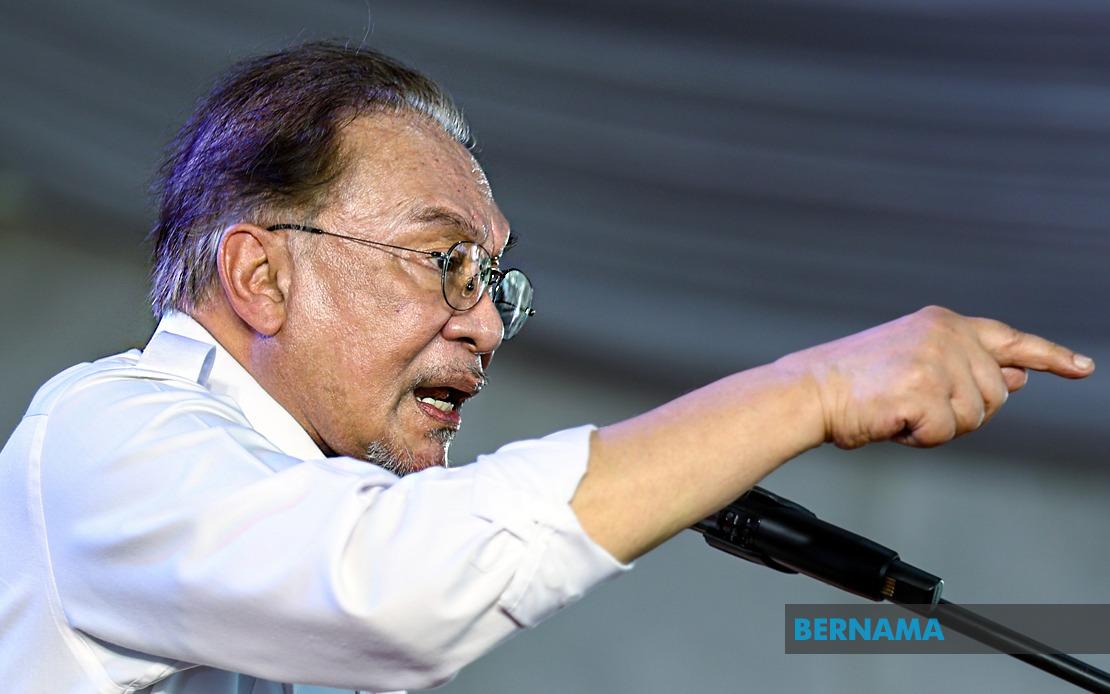
Prime Minister Datuk Seri Anwar Ibrahim has stressed that leadership across federal, state and local government tiers must maintain fair engagement with all communities as a cornerstone of national cohesion and stability. Speaking during a gathering with Johor community representatives at a hi-tea session in Johor Bahru, Anwar underscored that such inclusive governance practices represent a fundamental requirement for Malaysia's continued development and social harmony, extending beyond economic metrics alone.
While acknowledging that the MADANI Government has implemented reforms at the national level, Anwar recognised that meaningful challenges persist in translating these commitments into tangible outcomes at state and municipal administration levels. This gap between federal policy intent and ground-level implementation remains a critical area requiring sustained attention and refinement across all jurisdictions to ensure consistency in the government's approach to inclusive governance.
Clarifying his position on community engagement, Anwar emphasised that fairness in administration does not entail automatic approval of every petition or application submitted by citizens. Rather, he stressed that governance institutions must extend genuine opportunity for residents to voice their perspectives, substantiate their concerns, and present their arguments through processes that demonstrate transparency and impartiality. This framework ensures that communities perceive—and can verify—that decision-making bodies operate with integrity and apply consistent standards across all applications regardless of the applicant's background.
The Prime Minister articulated that state governments and local authorities bear responsibility for maintaining receptiveness to community dialogue while simultaneously adhering to existing statutory frameworks and established governance principles. This balance between accessibility and adherence to law represents the essence of responsive yet accountable administration, distinguishing between legitimate engagement and capitulation to pressure that might contravene existing rules or departmental guidelines.
Beyond structural governance, Anwar broadened his remarks to encompass Malaysia's broader development trajectory and national identity. He contended that assessing the nation's advancement through conventional economic indicators alone provides an incomplete picture, arguing instead that true progress encompasses the preservation of social unity, cultivation of compassion, and maintenance of reciprocal respect across Malaysia's ethnically and religiously diverse population. This holistic conception of national success reflects growing recognition that sustainable development requires simultaneous attention to both material prosperity and social cohesion.
Elaborating on economic expansion, Anwar highlighted the geographic diversification of investment flows and development initiatives throughout Malaysia. Notably, economic growth increasingly extends beyond established commercial centres such as the Klang Valley and Penang to encompass emerging regions including Negeri Sembilan, Melaka and Johor—particularly through the Johor-Singapore Special Economic Zone framework—alongside Sabah and Sarawak. This geographical rebalancing signifies deliberate efforts to distribute economic opportunities more equitably across the federation, potentially addressing long-standing regional disparities in development and employment.
Addressing technological advancement, Anwar cautioned that Malaysia's engagement with artificial intelligence, digital infrastructure modernisation, and the transition toward renewable energy sources must remain anchored in robust moral foundations, cultural sensitivity and religious values. This caveat reflects concerns that rapid technological adoption, if pursued without principled guardrails, could potentially erode cultural traditions or spiritual dimensions that constitute integral elements of Malaysian identity and social fabric.
The Prime Minister expressed genuine concern regarding the persistence of divisive narratives framed along racial and religious lines, which he identified as corrosive forces undermining national cohesion and testing the resilience of Malaysia's multicultural compact. He called upon religious leaders and community custodians to amplify their advocacy for faith-based principles encompassing compassion, justice, and mutual comprehension, suggesting that spiritual leaders occupy a distinctive position to counter polarising rhetoric within their respective constituencies.
Anwar further emphasised that all leaders, irrespective of their institutional position, bear fundamental responsibility for ensuring information accuracy and actively rejecting narratives that weaponise ethnic or religious identity for narrow political advancement. This emphasis on leadership accountability for public discourse quality addresses a critical vulnerability in Malaysia's social cohesion architecture, where deliberate misrepresentation or inflammatory messaging can rapidly mobilise constituencies along divisive lines.
Referencing aspirations that cut across Malaysia's diverse communities, Anwar articulated the fundamentally shared nature of basic societal goals. Citizens across ethnic and religious backgrounds, he noted, fundamentally desire quality education for their offspring, healthcare provisions for dependents, and functional infrastructure serving their localities. He underscored that the freedom to practise individual beliefs and religious traditions, rather than representing novel demands, constitutes established constitutional rights guaranteed by Malaysia's founding fathers—principles affirming that diversity and faith observance occupy protected spaces within the nation's foundational legal architecture.
The gathering included Deputy National Unity Minister R Yuneswaran, signifying the government's institutional commitment to the themes Anwar articulated. The emphasis on community engagement across all governance levels carries particular relevance for Malaysian states where coalition compositions differ from federal arrangements, where local councils exercise significant service delivery authority, and where implementation of national policy frameworks requires coordination among politically diverse administrations. For Southeast Asian observers, Malaysia's emphasis on balancing development imperatives with social cohesion management offers instructive lessons regarding multicultural governance in regions experiencing similar ethnic and religious complexity.

