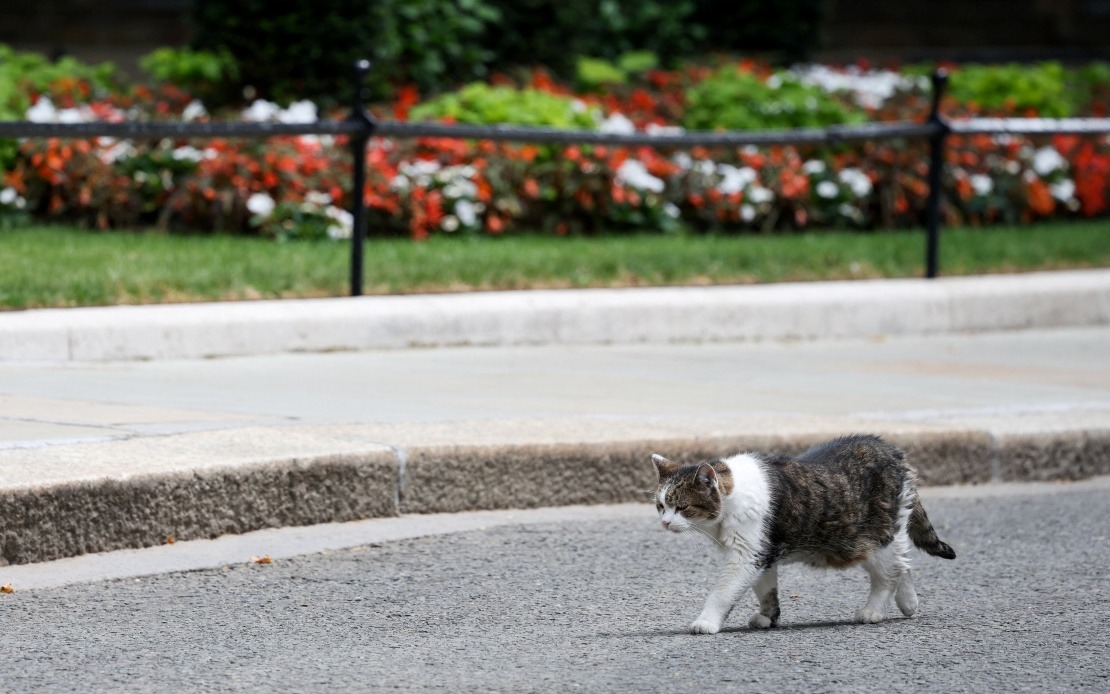
Larry, the tabby cat who has become an iconic fixture of British political life, continues his remarkable tenure at 10 Downing Street with the arrival of the United Kingdom's latest prime minister, Andy Burnham. The feline's longevity in the official residence has now extended across six separate prime ministerial administrations, making him one of the most enduring occupants of the building. On Tuesday, July 21, as Burnham held his inaugural Cabinet meeting following his ascent to office, Larry was observed wandering the grounds outside the historic residence, seemingly unfazed by the change in leadership that has consumed considerable attention across Westminster and the broader British political establishment.
The image of Larry patrolling the exterior of 10 Downing Street while the machinery of government convened indoors encapsulates the peculiar stability that this four-legged resident has come to represent within a political system otherwise characterised by frequent upheaval and transition. Unlike the ministers and civil servants who shuffle through the corridors with predictable regularity, Larry has maintained his position through successive governments of different political complexions and administrative philosophies. His continued presence serves as a silent witness to the ebb and flow of British political fortunes, a constancy that transcends the ideological divisions that separate the various prime ministers whose tenures he has observed.
The significance of Larry's tenure extends beyond mere curiosity value in British popular culture. The cat has acquired genuine symbolic weight within the national consciousness, representing continuity in an institution that has experienced considerable disruption in recent years. As the United Kingdom has navigated profound political shifts—from Brexit negotiations through multiple leadership transitions and ongoing constitutional questions—Larry has remained a reassuring constant at the heart of government. His presence at Downing Street has become sufficiently recognisable that his movements and activities generate genuine public interest, a phenomenon that speaks to the human appetite for symbols of stability and tradition during periods of significant change.
Burnham's assumption of the prime ministerial office marks another milestone in Larry's extraordinary career as the most prominent resident of 10 Downing Street. The incoming government will undoubtedly bring its own agenda, priorities, and staffing arrangements to the building, yet Larry's established role within the residence suggests that his position transcends the normal political transitions that reshape the administrative landscape. His appointment as Chief Mouser to the Treasury, a title that has adorned several of his predecessors, carries with it an implicit recognition that certain continuities must be maintained even as personnel and policies transform around them.
The relationship between British prime ministers and their celebrated cat has generated considerable affection among the public and press, transforming what might otherwise be a mundane detail of life at Downing Street into a matter of genuine national interest. Photographs and accounts of Larry's daily activities have frequently appeared in British media outlets, and his social media presence has attracted thousands of devoted followers who track his movements with the kind of attention typically reserved for celebrity figures. This phenomenon reflects a broader psychological phenomenon whereby citizens seek out symbols of permanence and reassurance, particularly when major political transitions are occurring with unsettling frequency.
For Malaysian observers and readers in Southeast Asia, the story of Larry illustrates a distinctly British approach to institutional symbolism and the persistence of tradition within modern democratic governance. The notion that a domestic animal can serve as an emblem of continuity and stability, commanding genuine public affection and media coverage, reflects cultural values that have deep historical roots within British society. The building itself—10 Downing Street—carries symbolic weight as the seat of executive power, and the animal who inhabits it alongside the prime minister participates in that symbolic resonance, however unconventionally.
The timing of Larry's observation on the grounds during Burnham's first Cabinet meeting carries particular poignancy, suggesting that even as the machinery of government shifts and recalibrates to accommodate new leadership, the fundamental character of the institution persists. The cat's indifference to the historic meeting occurring within the building underscores the distinction between the temporary occupants of political office and the more durable structures and traditions within which they operate. In a world characterised by rapid political change and institutional disruption, such symbols of continuity acquire heightened significance, offering reassurance that certain constants persist beyond the reach of electoral cycles and policy shifts.
Larry's remarkable longevity at 10 Downing Street, spanning now six different prime ministers, stands as a testament to the stability of British institutional frameworks despite surface-level political turbulence. The cat's continued presence and activity within and around the official residence reassure both British citizens and international observers that underlying institutional continuities endure beneath the drama of political succession. As Burnham settles into his role and shapes his government according to his vision and priorities, Larry will presumably continue his customary routines, serving as a living reminder of the institutional permanence that outlasts any individual holder of political office.

