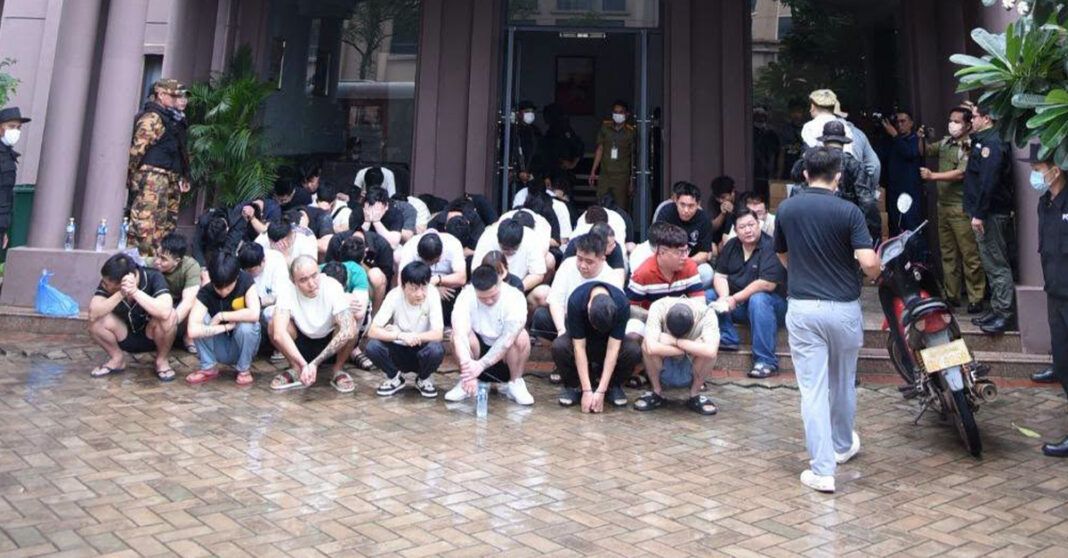
Vientiane police executed a substantial enforcement operation on 8 August, targeting a telecommunications fraud and online gambling network operating from a facility within the Thatluang Lake Special Economic Zone. The coordinated raid culminated in the detention of 261 individuals drawn from seven different countries, marking one of the largest such operations in recent months and underscoring the scale at which transnational criminal syndicates have entrenched themselves in Laos.
The detainee composition reveals the international character of these scam operations. Chinese nationals represented the predominant group with 153 suspects, a pattern that reflects the operational dominance of Chinese crime networks in Southeast Asia's digital fraud ecosystem. Vietnamese accounted for 61 detainees, Thai nationals numbered 36, while Taiwanese, Malaysian, South Korean and Myanmar citizens each represented smaller contingents of five, two, two and two respectively. This multinational composition suggests sophisticated international coordination and potentially shared infrastructure across borders, with operators from different nations collaborating on a common platform.
The technological apparatus seized during the raid illuminates the industrial scale of the operation. Authorities confiscated nearly 500 desktop computers and laptops alongside 2,355 mobile phones, demonstrating the substantial capital investment and technical infrastructure required to sustain such networks. These devices serve multiple functions: processing victim communications, managing cryptocurrency transactions, hosting spoofed landing pages, and coordinating operations across multiple time zones. The sheer volume suggests the facility operated as a centralised hub orchestrating fraud campaigns across multiple jurisdictions simultaneously.
Investigators confirmed that Lao Thatluang Investment Development Co., Ltd. held the building lease, raising questions about how such entities obtain legitimate-appearing corporate registrations whilst operating illegal activities. Police indicated that the investigation would extend beyond the detained individuals, with particular focus on identifying the operation's leadership and upstream accomplices who maintain operational control from potentially safer jurisdictions. This investigative approach acknowledges a critical reality: detention of mid-level operatives yields limited disruption unless authorities can unravel the management and financial networks sustaining the enterprise.
The Vientiane raid constitutes a component of a broader national enforcement campaign against scam networks. Laotian authorities have recognised that their territory has become a preferred operational base for transnational fraud rings, offering permissive regulatory environments, willing populations seeking employment, and proximity to affluent target markets across Asia. This structural vulnerability has transformed Laos into a regional hub for criminal operations that victimise citizens throughout Southeast Asia, East Asia and beyond.
Complementing the August 8 operation, authorities executed a second major enforcement action two days later on 10 August, deporting 41 Thai suspects across the 1st Lao-Thai Friendship Bridge to Thai authorities. This followed an earlier handover of 32 Thai nationals through the same crossing on 6 August, indicating active cooperation mechanisms between Laotian and Thai law enforcement. The cumulative deportation of at least 73 Thai nationals suggests both the significant Thai participation in these networks and developing bilateral coordination on repatriation procedures.
These recent operations connected to an earlier July intervention targeting the ST Vegas complex located in Dongphosy village, Hatsayfong district, Vientiane. The 18 July raid secured 589 suspected scammers, predominantly Thai nationals supplemented by Lao, Vietnamese and Cambodian detainees. The ST Vegas facility and Thatluang Lake operations likely represented different nodes within interconnected criminal networks rather than isolated incidents, suggesting coordinated infrastructure across multiple physical locations.
For Malaysian readers, these developments carry particular relevance. The presence of Malaysian nationals among the detained suspects indicates operational connections to Malaysia, whether as recruitment nodes, money laundering conduits, or fraud campaign targets. Malaysian citizens employed in these operations face serious legal jeopardy under Laotian criminal law, whilst Malaysian residents remain at elevated risk as victims of campaigns originating from these facilities. The incidents highlight how Southeast Asian countries have become both operational bases and victim pools for digitally-enabled organised crime.
The enforcement momentum demonstrated through multiple coordinated operations suggests that Laotian authorities have elevated this issue within their law enforcement priorities. The technical sophistication of these networks and their multinational composition, however, present substantial investigative challenges. Prosecuting individual detainees offers limited systemic impact; disrupting financial flows, identifying external investors and command structures, and preventing operational reconstitution requires sustained intelligence effort and regional coordination extending beyond current mechanisms.
Regional cooperation patterns have begun shifting. The bilateral Thai-Lao deportation arrangements and the apparent coordination between Thai and Laotian investigators suggest developing frameworks for addressing transnational organised crime. Yet significant coordination gaps persist with other affected nations, including Malaysia, Vietnam and Cambodia. Establishing formalised mutual legal assistance protocols and joint task forces could enhance investigation quality and prosecution success rates.
Looking forward, the strategic challenge confronting authorities extends beyond enforcement operations. These networks persist because underlying economic incentives attract recruits, permissive regulatory frameworks enable operations, and digital infrastructure provides operational anonymity. Addressing the phenomenon requires concurrent attention to labour market conditions driving recruitment, regulatory reforms tightening oversight of business entities, and international cooperation on digital forensics and financial tracking. The current enforcement surge, whilst impressive in scale, represents necessary but insufficient response to structural vulnerabilities that continue generating operational opportunities for transnational crime syndicates.

