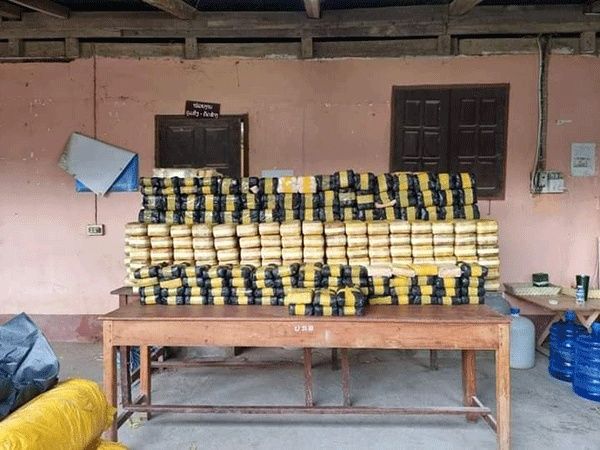
Xaysomboun province in central Laos is confronting a mounting drug crisis, with narcotics-related crimes dominating its criminal landscape. During the first six months of 2024, drug offences represented 24 of 54 total cases recorded by provincial authorities—a striking 44 per cent of all criminal activity. This alarming proportion has prompted security leaders to call for comprehensive action to curtail trafficking and consumption, signalling that the province views drug-related crime as its most urgent law enforcement challenge.
The breakdown of drug cases reveals the workload facing investigators in the province. Of the 24 drug offences documented, only two had been concluded and referred to prosecutors by mid-year, whilst 22 remained under active investigation. This investigative backlog underscores both the volume of suspected drug activity and potential constraints on resources within the provincial security apparatus. Across all criminal categories, police resolved 15 cases, concluded four for prosecution, and settled six through other means, leaving 29 cases still pending investigation—a pattern suggesting systemic pressures on the justice system.
The focus on Xaysomboun's drug problem intensified during an August 7 visit by Police Lieutenant General Vanthong Kongmany, the nation's top security minister. Meeting with Police Brigadier General Ouday Insouvanh, who heads the Xaysomboun Provincial Public Security Command, the minister stressed the necessity for escalated efforts against narcotics trafficking and newer drug variants. His visit and subsequent directives reflect central government concern about drug proliferation in provinces, particularly those with proximity to porous borders and potential trafficking networks.
The urgency in Laos extends beyond Xaysomboun. At a National Assembly session last month, Prime Minister Sonexay Siphandone reported that nationwide authorities processed 1,786 drug cases during the same six-month period, resulting in 4,025 arrests including 93 foreign nationals. Substantial quantities of drugs, manufacturing equipment, and vehicles were seized. These figures demonstrate that drug enforcement has become a cornerstone of Laotian security policy, reflecting both the scale of the problem and the government's determination to address it. The designation of drug suppression as a national priority five years ago has given the campaign sustained institutional backing.
Beyond narcotics, the security minister tasked Xaysomboun authorities with intensifying efforts against smuggling, human trafficking, theft, burglary, illegal mining, and gambling. This broadened mandate reflects recognition that criminal enterprises often interconnect—trafficking networks may launder proceeds through gambling operations, for instance. The expansion of security priorities suggests that provincial authorities must simultaneously manage multiple threat vectors, complicating resource allocation and enforcement strategy.
A particularly significant new directive addresses cybercrime and social media regulation, aligning provincial operations with ministry orders. This addition represents an evolution in Laotian law enforcement priorities, acknowledging that criminal activity increasingly occurs online. Drug trafficking coordination, illegal gambling platforms, human trafficking logistics, and fraud commonly exploit digital channels. By incorporating cybercrime into provincial security frameworks, the government attempts to close enforcement gaps in the digital realm, though capacity-building in this domain remains uncertain.
Road safety emerged as another major concern during the ministerial visit. Xaysomboun recorded 60 traffic accidents in the six-month period, resulting in four deaths, 80 injuries, and damage to 109 vehicles. Financial losses exceeded 2.56 billion kip, equivalent to roughly USD 125,000. These statistics illustrate how public safety extends beyond criminal justice into transportation infrastructure and accident prevention—domains where enforcement, vehicle standards, and driver education intersect. The human and economic toll underscores government interest in comprehensive security governance.
Tourism and foreign national management represent additional operational priorities. Officers inspected 1,698 tourists during the period, including 396 foreign nationals, as part of immigration oversight. This surveillance function reflects Laotian concerns about potential threats associated with international visitor flows, whether related to drug trafficking, illegal employment, or security risks. Xaysomboun, as a province with tourism potential, requires balanced approaches to welcoming visitors whilst maintaining security controls.
The minister's instructions to provincial leadership transcend operational tactics, emphasizing institutional discipline and personnel development. He called for strengthened political and ideological education among officers, compliance with Party policies and state law, and improved adherence to public security disciplinary codes. These directives suggest concern about inconsistent implementation or potential corruption within provincial ranks. By emphasizing leadership quality, professional standards in immigration management, and assignment of personnel according to expertise, the minister signalled that security effectiveness depends on organizational integrity and capability development.
For Malaysia and broader Southeast Asia, Xaysomboun's struggle with drug trafficking carries regional implications. Laos, positioned between major drug-producing regions and consumer markets, functions as a transit hub for narcotics destined for Thailand, Vietnam, and beyond. Drug crime patterns in Xaysomboun may reflect trafficking trends affecting neighbouring countries, including Malaysia. Strengthened Laotian enforcement could redirect trafficking routes or increase domestic consumption—outcomes that neighbouring nations monitor closely. The prominence of drug crime in central Laos also highlights transnational dimensions often overlooked in national policy discussions.
The broader security architecture revealed through the ministerial visit reflects Laotian government ambitions to modernize law enforcement across traditional and emerging domains. Integrating cybercrime and social media oversight alongside narcotics enforcement and human trafficking prevention demonstrates recognition that contemporary security challenges transcend borders and conventional categories. However, implementation capacity remains uncertain—whether provincial forces possess adequate training, technology, and resources to execute this expanded mandate remains unclear. Success will depend on sustained central government investment and provincial leadership commitment to institutional professionalization.

