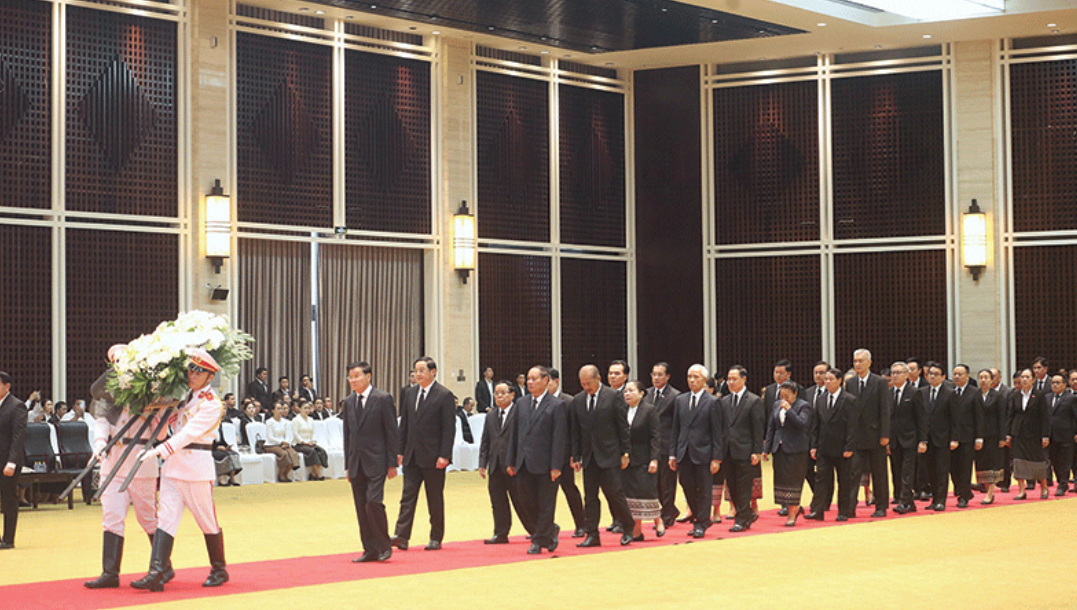
The death of Xaysomphone Phomvihane, President of Laos's National Assembly and a senior figure in the Lao People's Revolutionary Party hierarchy, has prompted an unprecedented display of mourning across the highest echelons of Laotian leadership. On Sunday, August 9, Party Secretary General and President Thongloun Sisoulith led an official wreath-laying ceremony at the National Convention Hall in Vientiane, where dignitaries from across the state, military, business and civil sectors gathered to bid farewell to the prominent statesman who passed away on Saturday.
The ceremonial gathering underscored the substantial influence Xaysomphone wielded within Laos's political establishment. As both a Politburo member and head of the National Assembly—the country's legislative body—he occupied a position of considerable authority in the communist state's governance structure. His career spanned decades of service to the Party and nation, making his departure a significant moment of transition for an institution that has relied heavily on his stewardship and institutional knowledge. The scale of attendance and the prominence of those offering tributes reflected the esteem with which he was regarded throughout the Lao political system.
The wreath-laying proceedings proceeded through a carefully choreographed sequence that illustrated the hierarchies and familial connections within Laotian elite circles. President Thongloun Sisoulith headed the first delegation representing the Lao People's Revolutionary Party Central Committee, establishing the symbolic primacy of the Party apparatus in national mourning rituals. Subsequent delegations followed, each representing crucial pillars of state power: the National Assembly's Standing Committee, led by Vice President Sounthone Xayachack; the Government delegation under Prime Minister Dr Sonexay Siphandone; and representation from the Party Central Committee secretariat. The participation of multiple family branches—including the Phomvihane, Siphandone, Phommathat and Pheuyavong families—illuminated how political authority in Laos remains concentrated among interconnected lineages of revolutionary leaders.
Xaysomphone's own biography exemplifies this dynastic pattern of governance. Born on December 12, 1956, he was one of six sons of Kaysone Phomvihane, the late founding president of the Lao People's Democratic Republic. His five brothers—Xaysongkham, Santiphab, Thongsavan, Sanyahak and Ounkham—have also achieved senior governmental positions, with Santiphab currently serving as Deputy Prime Minister and Minister of Finance. This concentration of familial influence within the state apparatus reflects patterns common across single-party communist regimes in Southeast Asia, where revolutionary credentials and bloodlines often determine access to high office.
The ceremony extending into Monday, August 10, as senior officials from ministries, Vientiane municipal authorities and retired Party and government leaders continued arriving to pay respects, demonstrated the breadth of Xaysomphone's institutional connections. Foreign diplomats stationed in Vientiane also visited the National Convention Hall to offer condolences, signalling that despite Laos's limited international profile, the death of its legislative chief warranted diplomatic acknowledgement from the international community. This aspect proved particularly significant given regional sensitivities and Laos's delicate balancing act between major power influences in Southeast Asia.
Vietnam's unprecedented declaration of two days of national mourning—August 10-11—underscores the exceptional nature of Xaysomphone's standing within the broader Indochinese revolutionary movement. The Vietnamese leadership's decision to formally mourn a Laotian official reflects the exceptionally close ties binding the two communist states, ties forged through decades of shared anti-colonial struggle and ongoing security and economic cooperation. The dispatch of delegations from Vietnam's National Assembly, Ministry of Public Security and Ministry of National Defence to Vientiane demonstrated that Hanoi treated Xaysomphone's passing as an affair of significant bilateral importance rather than merely a neighbouring country's internal matter.
Within Laos itself, national mourning has been declared for five days, from August 8 to 12, a period during which the National Convention Hall remained open for continued tributes. The duration of official mourning, combined with the decision to conduct Xaysomphone's cremation with full state honours at the That Luang esplanade on August 12, indicates the ceremonial weight accorded to his passing. The timing of cremation—beginning at 1 p.m. on August 12—permits maximum attendance from both domestic and international mourners, suggesting organisational coordination befitting a head of state rather than merely a legislative officer.
The concentration of tributes from party organs, government ministries, the Lao Front for National Development, and representatives from the business community illustrates how completely Xaysomphone's career intertwined with virtually every significant institution in Laotian governance. His decades of service to the National Assembly enabled him to accumulate political capital and relationships extending across generational cohorts within the Party elite. For Malaysian and Southeast Asian observers, this succession moment in Laos carries implications regarding potential shifts in legislative leadership and whether the Party will maintain continuity by promoting another member of the revolutionary aristocracy or pursue broader institutional renewal.
Xaysomphone's death occurs at a moment of economic uncertainty across Indochina, with Laos facing fiscal pressures and debt sustainability concerns that may preoccupy incoming legislative leadership. His passing removes from the scene a figure who embodied continuity with the revolutionary generation that established the Lao People's Democratic Republic in 1975. The mourning ceremonies, while honouring his contributions to state-building and Party consolidation, inevitably raise questions about how Laotian leadership will navigate contemporary challenges requiring potentially different approaches than those employed during the post-revolutionary era in which Xaysomphone built his career and reputation.

