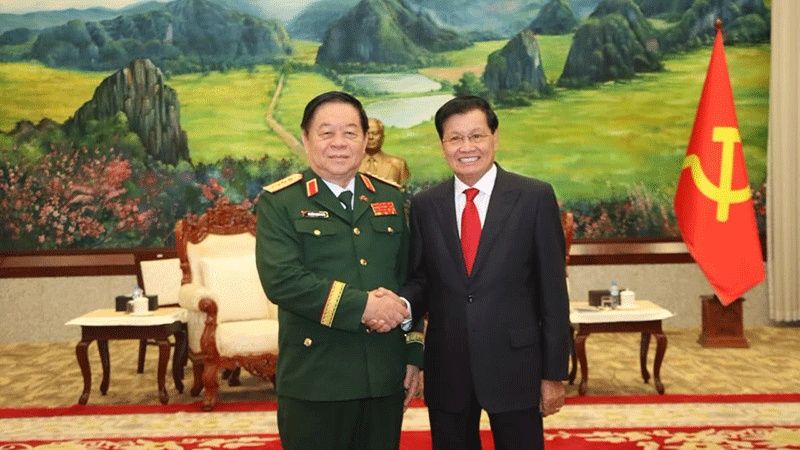
The relationship between Laos and Vietnam received fresh momentum this week as senior military and political leaders from both nations reaffirmed their commitment to deepening defence cooperation and cementing their strategic partnership. President Thongloun Sisoulith of Laos extended a warm welcome to General Nguyen Trong Nghia, Chairman of the General Department of Politics of the Vietnam People's Army, during an official visit spanning August 5–7, with the encounter highlighting the enduring importance that both governments place on their military and diplomatic connections in Southeast Asia's increasingly complex geopolitical landscape.
The visit, which culminated in a courtesy call at the presidential office in Vientiane on Thursday, August 6, underscores the priority both nations assign to their bilateral defence relationship at a time when regional security challenges require closer coordination among neighbouring states. General Nguyen Trong Nghia's delegation-level visit was explicitly designed to strengthen defence cooperation and further consolidate what both capitals describe as a longstanding special relationship built on foundations established decades ago. President Thongloun characterised the visit as a significant step forward in deepening the multifaceted partnership between Laos and Vietnam, encompassing not only military dimensions but also party-to-party links, governmental cooperation, and people-to-people exchanges.
Beyond the symbolic value of high-level meetings, the talks produced concrete agreements on areas of practical cooperation that will shape the bilateral defence relationship over the coming period. The discussions between the General Departments of Politics of both militaries identified several priority areas for expanded collaboration, with political education and military exchanges emerging as central pillars. Both nations recognised that fostering mutual understanding among military personnel and younger generations about the historical context of their friendship strengthens the institutional foundations of their partnership and helps insulate bilateral relations from external pressures.
Border management cooperation featured prominently in the discussions, reflecting the reality that Laos and Vietnam share an extensive land frontier spanning over 2,000 kilometres. Effective coordination on border security, customs arrangements, and cross-border movement of goods and people remains essential for both nations' territorial integrity and regional stability. The commitment to deepen cooperation in this domain suggests both countries seek to address any vulnerabilities that might exist along their shared boundary while also facilitating legitimate cross-border commerce and exchange that benefits their populations.
Personnel training and military-to-military exchanges represent another significant dimension of the expanded cooperation framework. By rotating officers and soldiers between their respective military establishments, Laos and Vietnam create opportunities for institutional learning, professional development, and relationship-building among military professionals. These exchanges help standardise procedures, improve interoperability in potential joint operations, and foster a shared operational culture that transcends national boundaries. Such practical cooperation is particularly valuable in addressing transnational security challenges such as human trafficking, drug smuggling, and environmental degradation that do not respect borders.
General Khamlieng Outhakaisone, Laos's Deputy Prime Minister and Minister of National Defence, also received the Vietnamese delegation, signalling the high-level attention given to the visit across Laos's civilian and military leadership. The fact that both defence and political leaders engaged with the visiting general reflects the comprehensive nature of the bilateral relationship and the seamless integration of military and civilian government functions in both communist-led systems. Such coordination ensures that defence cooperation receives political support from the highest levels and that military agreements align with broader foreign policy objectives.
Lieutenant General Vongsone Inpanphim, who serves as Deputy Minister of National Defence and head of the Lao People's Army's General Department of Politics, led the military-level discussions with his Vietnamese counterpart. The conversations at this level focused on expanding Party and political work cooperation—a dimension that underscores how regional security partnerships in Southeast Asia often intertwine military, political, and ideological dimensions. For single-party states like Laos and Vietnam, ensuring party-level coordination complements governmental and military cooperation, creating multiple channels through which strategic consensus can be developed and maintained.
The emphasis on educating younger generations about the historical basis and contemporary value of Laos-Vietnam friendship reflects both nations' understanding that strategic partnerships require active cultivation and transmission of institutional memory. By investing in historical education and cultural exchange, both countries seek to embed their relationship within the consciousness of future leaders and citizens, making partnership the default orientation rather than a contingent arrangement vulnerable to shifting leadership preferences. This intergenerational approach to relationship-building is characteristic of how Southeast Asian nations with strong historical ties maintain their strategic alignments across decades.
Vietnam's reiteration of its commitment to preserving and promoting the special relationship comes at a time when regional powers are actively competing for influence throughout Indochina. Laos occupies a strategically significant position as a landlocked nation sandwiched between Thailand, Cambodia, Vietnam, China, and Myanmar, making it a focal point for broader regional competition. By strengthening ties with Laos, Vietnam seeks to maintain influence in a country that has historically served as a buffer and corridor for Vietnamese strategic interests. The language employed by both nations—invoking great friendship, special solidarity, and strategic cohesion—reflects the emotional and historical dimensions that underpin what both capitals present as more than merely transactional defence cooperation.
For Malaysia and other ASEAN members, the deepening Laos-Vietnam defence relationship carries implications for broader regional stability and the evolution of the Association's internal dynamics. A strengthened Laos-Vietnam partnership potentially shifts the balance within ASEAN toward the Indochinese subregion and may influence how consensus-building functions within the organisation. The emphasis both nations place on their special relationship, rooted in historical communist party bonds and wartime collaboration, sometimes creates parallel structures of cooperation that operate alongside formal ASEAN mechanisms. Understanding these bilateral partnerships helps Malaysian policymakers navigate the complex network of overlapping allegiances and cooperation frameworks that characterise contemporary Southeast Asian geopolitics.
The visit ultimately demonstrates how neighbouring states in Southeast Asia continue to invest in military and strategic partnerships even as they manage complex relationships with multiple powers competing for regional influence. Laos and Vietnam's reaffirmation of their commitment to comprehensive cooperation across defence, politics, and people-to-people domains reflects a pragmatic approach to regional security in which historical relationships, geographic proximity, and shared ideological heritage combine to create durable strategic partnerships. For regional observers, such high-level exchanges provide valuable signals about how states assess their security interests and which partnerships they consider essential to their long-term stability and prosperity.

