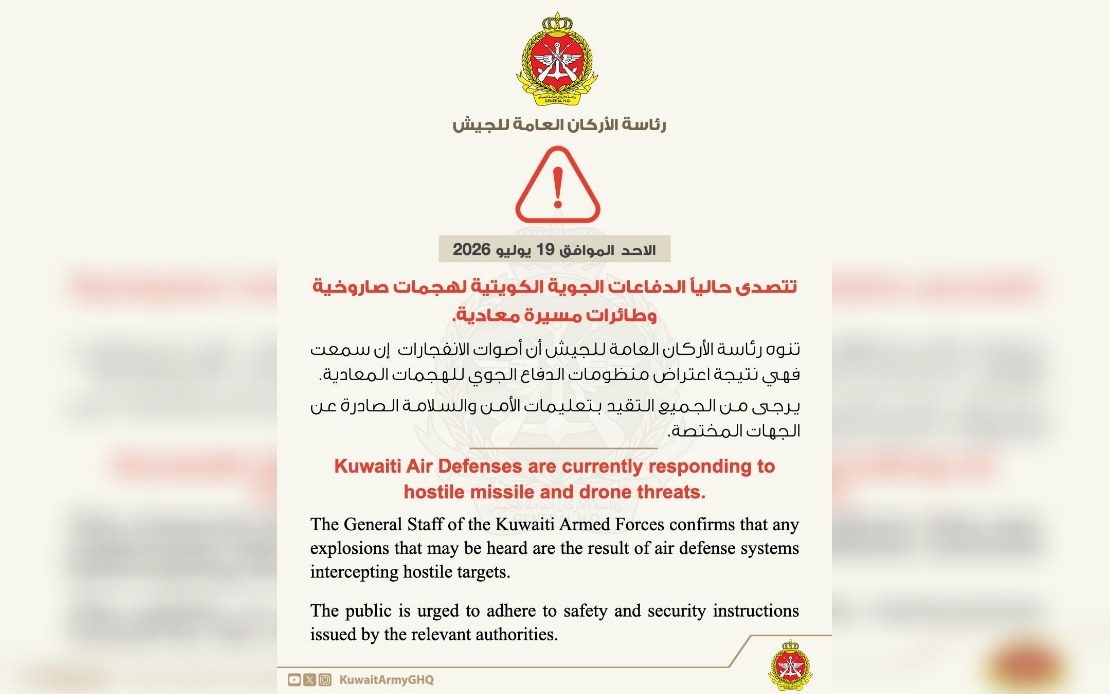
Kuwait's military has confirmed that the nation's defence forces are actively countering a fresh wave of hostile aerial threats, including missiles and unmanned systems, as regional tensions between Iran and the United States show no signs of abating. The Kuwaiti army announced on Sunday through social media that it is currently engaged in defensive operations, with military officials explicitly stating that residents may hear explosions resulting from air defence installations neutralising incoming targets. The disclosure underscores the precarious security situation unfolding across the Gulf as two major powers engage in tit-for-tat military operations across multiple countries in the region.
The escalating cycle of strikes began when the United States launched successive waves of military operations against Iranian targets, triggering a retaliatory response from Tehran. Iran has since conducted its own strikes against what it characterises as American military installations and facilities scattered across several regional nations, prominently including Kuwait. This pattern of action and reaction represents a dangerous acceleration in hostilities that threatens the stability of one of the world's most strategically important regions. The persistence of these attacks, despite international diplomatic efforts, reveals the deep-rooted nature of the confrontation between Washington and Tehran.
Kuwaiti authorities have simultaneously issued security advisories to the general population, urging residents to remain vigilant and adhere to official guidance. Such measures are standard practice during periods of heightened military activity and cross-border threats, helping to minimise civilian casualties and ensure public safety. The military's transparency about the nature of the defensive operations—explicitly framing explosions as intentional interceptions rather than incoming strikes—appears designed to reassure Kuwaitis that their air defences are functioning effectively.
The involvement of Kuwait in this broader conflict represents a significant complication for the small Gulf nation. As a country heavily dependent on oil production and international trade, sustained military tensions directly threaten economic activity and investor confidence. Kuwait has historically maintained relatively balanced diplomatic relations with both Iran and the United States, positioning itself as a moderate voice within regional geopolitics. However, the current crisis forces Kuwait into the uncomfortable position of hosting American military assets while enduring Iranian retaliation, a situation that strains its traditional diplomatic posture.
From a Southeast Asian perspective, the Kuwait crisis carries important implications. As a major trading partner and energy supplier to the region, disruptions to Kuwaiti stability could reverberate through global supply chains affecting Malaysian and ASEAN economies. Energy prices, already sensitive to geopolitical events in the Middle East, could experience further volatility if the situation deteriorates. Additionally, many Southeast Asian nations have significant expatriate communities in Kuwait, making civilian security concerns particularly relevant to governments across ASEAN.
The broader context of this escalation involves a memorandum of understanding brokered by Pakistan in June, which was intended to de-escalate tensions and establish a framework for lasting peace between Iran and the United States. The fact that hostilities have continued unabated despite this diplomatic initiative demonstrates the difficulty in translating agreements into meaningful changes in behaviour when fundamental strategic interests remain in conflict. Both nations appear to view military escalation as a viable tool for projecting power and achieving political objectives in the region.
The role of unmanned systems in these operations reflects the modernisation of regional military capabilities. Drones have become increasingly sophisticated and represent a challenge for traditional air defence systems designed primarily for conventional aircraft. Kuwait's air defence network must contend with multiple threat vectors simultaneously, complicating defensive operations. The necessity of intercepting these targets with surface-to-air systems creates visible evidence of the conflict, with explosions audible across populated areas—a reality that brings the distant confrontation between superpower rivals directly into the experience of ordinary Kuwaiti citizens.
For regional stability more broadly, the presence of American military facilities in Kuwait constitutes both a security provider and a source of friction. While these bases offer protection against conventional threats from larger neighbours, they simultaneously make Kuwait a potential target for actors opposed to American presence in the region. This paradox illustrates the complex security dilemmas facing smaller Gulf states attempting to balance national security with avoiding becoming collateral damage in larger power competitions.
The international community watches this situation with concern, recognising that escalation in the Gulf carries risks of unintended consequences. Miscalculation in such a tense environment could trigger wider conflict, with implications extending far beyond the immediate combatants. Malaysia and other ASEAN nations, while geographically distant, have substantial interests in preventing full-scale regional warfare that could disrupt global commerce and energy markets. The current trajectory, characterised by repeated military strikes and ongoing defensive responses, creates an unstable equilibrium that could fracture with minimal additional provocation.

