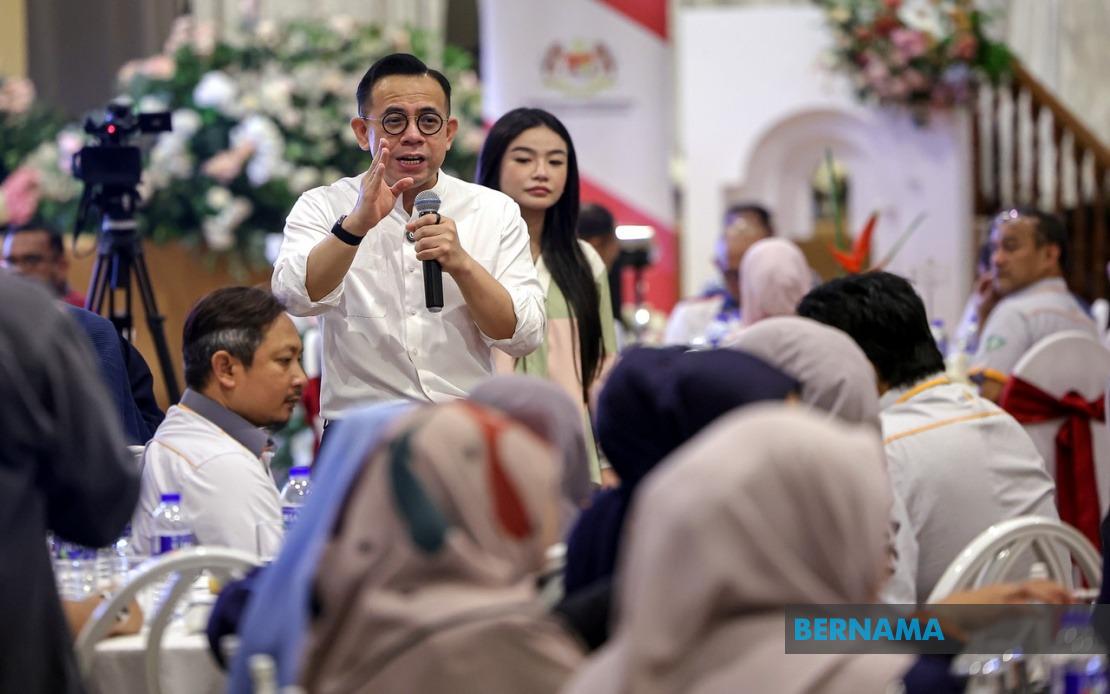
The Ministry of Entrepreneur Development and Cooperatives (KUSKOP) has made substantial progress in its commitment to strengthening Malaysia's entrepreneurial landscape, having released nearly RM7 billion in support mechanisms during the opening half of 2026. This significant financial intervention has reached more than 213,000 micro, small and medium enterprises across the country, marking a pivotal moment in the government's efforts to sustain business viability amid an increasingly volatile global economic environment. Minister Steven Sim announced these achievements during an assembly in Seremban, underscoring the tangible impact of directed government support filtering down to grassroots business operators who form the backbone of Malaysia's economy.
The distribution forms part of the Power Up 10K initiative, an ambitious programme designed to inject liquidity and structural support into Malaysia's MSME sector. With RM7 billion already deployed in six months, the scheme remains on trajectory to achieve its full-year disbursement target of RM15 billion. This halfway checkpoint demonstrates sustained bureaucratic momentum and suggests that if current deployment rates hold, the ministry will comfortably exceed its stated objectives. The diversity of support mechanisms—ranging from direct financing to capacity-building programmes—indicates a multifaceted approach rather than one-dimensional cash transfers, suggesting policymakers recognise that enterprise sustainability requires more than simple monetary infusions.
Negeri Sembilan has emerged as a demonstration of the programme's geographic penetration, with the state receiving RM345 million distributed among more than 6,600 local entrepreneurs. This provincial breakdown reveals that government funding mechanisms are functioning effectively at state level, translating ministerial directives into on-the-ground assistance. The Negeri Sembilan case study carries particular significance for regional administrators and policymakers monitoring implementation quality across Malaysia's diverse economic geography. For entrepreneurs in less-developed states or those operating outside Klang Valley commercial centres, such targeted allocation patterns provide evidence that support infrastructure is not concentrated exclusively among metropolitan business clusters.
Minister Sim articulated a philosophical shift in how KUSKOP intends to position its constituent agencies. Rather than maintaining passive institutional postures awaiting entrepreneur inquiries, the ministry has mandated that agencies become proactive facilitators actively marketing available schemes and programmes. This reorientation reflects recognition that information asymmetries and bureaucratic opacity represent genuine obstacles preventing entrepreneurs from accessing entitled support. The emphasis on roadshows, social media engagement, and direct outreach suggests KUSKOP is adapting institutional communication strategies to match contemporary information consumption patterns, particularly among younger business operators less likely to navigate traditional government channels.
A critical dimension of KUSKOP's strategy involves reducing compliance burdens that entrepreneurs face navigating overlapping regulatory frameworks. Minister Sim acknowledged that while global factors such as oil price fluctuations remain beyond government control, domestic policy costs warrant aggressive attention. This perspective reflects growing appreciation that regulatory compliance represents a quantifiable drag on enterprise profitability, particularly affecting smaller operators lacking dedicated administrative capacity. By explicitly targeting compliance cost reduction, KUSKOP signals intent to examine whether existing regulations achieve their intended policy objectives or function primarily as expensive procedural hurdles. For Malaysian entrepreneurs competing internationally, streamlined compliance regimes could improve cost competitiveness relative to regional competitors.
The ministry's repositioning of state-level agencies as competitive entities represents an underutilised but potentially powerful reform mechanism. By encouraging healthy competition among government agencies to accelerate fund disbursement and improve service delivery, KUSKOP introduces market-like incentive structures into bureaucratic processes. This gamification approach—implicitly rewarding agencies demonstrating superior performance—may generate efficiency improvements without requiring formal organisational restructuring. Negeri Sembilan's performance metrics become comparative benchmarks against which other states can measure themselves, creating informal performance pressure that traditional hierarchical management sometimes fails to generate.
For Malaysia's broader economic strategy, this half-year performance against KUSKOP targets carries implications extending beyond simple disbursement statistics. The MSME sector encompasses approximately two million enterprises employing roughly five million workers, making entrepreneur viability directly connected to employment stability and household income resilience. Sustained capital flows into this segment help insulate the broader economy from potential contraction, particularly if external shocks manifest through reduced export demand affecting larger manufacturing concerns. By maintaining robust MSME support even amid global economic uncertainty, Malaysia builds economic diversification and reduces dependency on large corporate sectors vulnerable to concentrated shocks.
The timing of KUSKOP's mid-year progress announcement reflects deliberate communication strategy aligning government initiatives with media cycles and public attention patterns. By demonstrating tangible achievements rather than projecting future commitments, the ministry establishes credibility for its institutional competence and execution capability. This builds political capital necessary for advocating future budget allocations and strengthens ministerial standing relative to competing policy priorities. For business confidence indicators—increasingly important measures of economic sentiment—visible government support mechanisms may encourage entrepreneurs to undertake expansion investments they might otherwise defer pending economic certainty.
Regional comparative context further illuminates Malaysia's KUSKOP initiative significance. Southeast Asian governments increasingly recognise MSME support as essential development infrastructure, though implementation quality varies considerably. Malaysia's RM15 billion annual commitment positions it comparably to regional peers while the stated emphasis on efficiency and accessibility suggests learning from earlier iterations. Entrepreneurs operating across Southeast Asian jurisdictions frequently cite regulatory complexity and capital access difficulties as primary constraints; initiatives directly addressing these friction points attract disproportionate attention within business communities.
Looking forward, sustaining the Power Up 10K programme's momentum requires continued organisational discipline and agency commitment. The ministerial directive emphasising proactive outreach places new obligations on KUSKOP's constituent bodies to transform from reactive institutional structures into entrepreneurial support facilitators. This cultural reorientation often proves more challenging than bureaucratic restructuring because it requires front-line staff to fundamentally reconceptualise their institutional role. Success metrics extending beyond simple disbursement figures—measuring business survival rates, employment creation, and revenue growth among programme participants—would provide more complete pictures of actual programme impact.
Minister Sim's emphasis on reducing external compliance costs while acknowledging that macroeconomic factors remain beyond policy control demonstrates realistic assessment of government capacity constraints. Malaysian entrepreneurs face genuine challenges from global commodity prices, international supply chain volatility, and exchange rate fluctuations that no domestic policy programme can ameliorate. Within these constraints, however, government possesses genuine leverage to improve domestic operating environments through streamlined regulations and accessible support infrastructure. This calibrated ambition—accepting environmental limitations while maximising controllable policy levers—represents pragmatic economic governance differentiating effective support programmes from ineffectual bureaucratic gestures.
The KUSKOP initiative ultimately reflects broader Malaysian economic policy emphasis on managing structural transitions as manufacturing-dependent growth models face headwinds. By targeting MSME support, the government acknowledges that future employment generation and income growth increasingly derives from smaller enterprises and entrepreneurial ventures rather than large manufacturing plants or foreign direct investment-driven export sectors. Whether this reallocation of policy attention translates into measurable improvement in small business performance and employment creation will become apparent only through multi-year tracking of participant outcomes.

