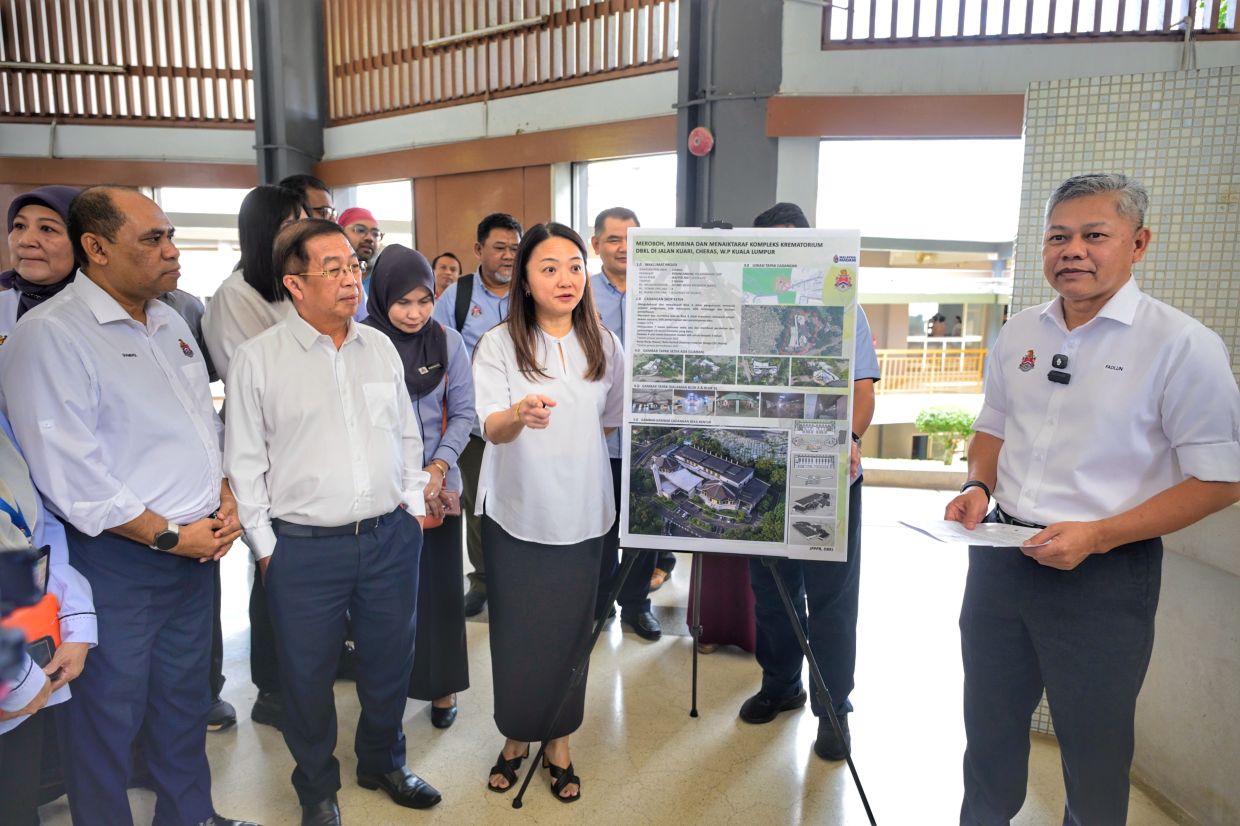
Kuala Lumpur City Hall has committed RM45 million to significantly expand and modernise the Cheras crematorium facility, addressing mounting pressure on burial and cremation services in the capital. The substantial investment reflects growing recognition among city planners that infrastructure supporting religious and cultural practices must keep pace with demographic shifts and population growth in the federal territories. Mayor Datuk Seri Fadlun Mak Ujud outlined the ambitious upgrade plan during a site visit on Wednesday, emphasising that the initiative represents a deliberate response to changing community requirements rather than a reactive measure forced by capacity crises.
The expansion project will add three brand-new cremation units to the complex situated on Jalan Kuari in Cheras, bringing total capacity from the current seven units to ten. Construction is scheduled to commence by February 2025, with completion anticipated within a two-year timeframe. This phased approach prioritises service continuity; four units will remain fully operational throughout the upgrading works, ensuring that families and communities dependent on the facility face minimal disruption during what many regard as sensitive and deeply personal occasions. The staggered rollout demonstrates careful planning to balance infrastructure modernisation with uninterrupted public service delivery.
The Cheras crematorium stands as Kuala Lumpur's sole facility operated directly by City Hall specifically for non-Muslim communities. Since commencing operations in 1977, it has emerged as a critical piece of urban infrastructure handling over 5,800 cremations annually. This volume underscores the substantial non-Muslim demographic within Malaysia's capital, a constituency whose cultural and religious requirements demand dedicated, professionally managed facilities. The facility's longevity—now approaching five decades—has made the upgrade both necessary and strategically important for maintaining service quality and upholding religious dignity during end-of-life ceremonies.
Cheras Member of Parliament Tan Kok Wai emphasised the urgency of accelerating the project, highlighting that a facility surpassing fifty years of continuous operation must evolve alongside Kuala Lumpur's expanding population. His intervention signals broader political recognition that religious infrastructure spending commands support across party lines and demographic constituencies. The dual emphasis on age-related deterioration and population growth reflects practical concerns: aging infrastructure becomes increasingly prone to breakdowns during critical moments, while population increases create queuing backlogs and delayed services that distress grieving families. The upgrade thus addresses both maintenance imperatives and service demand expansion simultaneously.
The initiative received formal approval under Malaysia's 13th Malaysia Plan, demonstrating alignment with national development priorities and ensuring budgetary allocation within the broader federal developmental framework. This inclusion signals that the Federal Government recognises religious and cultural infrastructure as integral to urban planning rather than peripheral considerations. Such recognition carries particular significance in a multicultural nation where equitable provision of services across communities remains foundational to social cohesion and mutual respect.
Paralleling cremation infrastructure discussions, Minister in the Prime Minister's Department (Federal Territories) Hannah Yeoh raised complementary challenges facing Muslim burial grounds. She disclosed that the Federal Government is actively negotiating with the Selangor state government to identify suitable sites in Semenyih for constructing additional Muslim cemeteries. This parallel initiative acknowledges that Kuala Lumpur faces acute space constraints that render traditional expansion within city boundaries increasingly untenable. The conversation between federal and state authorities over Semenyih reflects practical boundary-crossing necessitated by geographic realities, as metropolitan demands for essential services consistently outstrip supply in constrained urban environments.
Yeoh's observation that Kuala Lumpur lacks adequate space for expanding burial grounds articulates a broader challenge confronting Southeast Asian cities managing rapid urbanisation whilst preserving space for essential community facilities. Religious cemeteries and cremation sites occupy substantial land footprints that become progressively more difficult to locate in densely developed urban cores where property values escalate exponentially. Engaging Selangor authorities demonstrates regional cooperation approaches that acknowledge metropolitan services operate across administrative boundaries in reality, even where formal governance structures remain fragmented.
The RM45 million investment must be contextualised within broader urban infrastructure spending patterns. Capital cities across Southeast Asia increasingly recognise that cremation and burial facilities constitute essential services deserving public investment comparable to transportation, water, or waste management infrastructure. Yet these facilities often receive lesser political attention and funding priority, creating bottlenecks that compound during public health crises or population surges. Kuala Lumpur's proactive upgrade contrasts with reactive approaches wherein crises force emergency expansions.
The Cheras crematorium expansion carries implications extending beyond ceremonial considerations into broader Malaysian discussions about religious pluralism and inclusive governance. Public capital investment in non-Muslim religious infrastructure demonstrates governmental commitment to serving all communities equitably, reinforcing constitutional principles of religious freedom and equal citizenship. Such investments matter symbolically and practically, as they validate minority communities' place within the national polity whilst ensuring their access to dignified end-of-life services.
For Malaysian readers, the upgrade signals that federal and city administrations are attempting to address infrastructure deficits identified by communities themselves. The two-year implementation timeline and maintenance of partial operations throughout construction reflect lessons learned from previous major infrastructure projects. However, successful execution depends on adequate allocation of skilled labour, specialised cremation technology, and project management expertise—areas wherein delays have historically plagued Malaysian construction ventures. Monitoring project progress against stated timelines will provide insights into current administrative capacity for delivering complex urban infrastructure on schedule.
The initiative also raises questions about long-term planning sufficiency. If the expanded ten-unit facility accommodates projected demand through 2027 or beyond remains unexplained, creating uncertainty about whether this investment represents a comprehensive solution or merely another intermediate measure. Rapid urbanisation could potentially render even the expanded capacity inadequate within a decade, necessitating further expansions or alternative approaches such as improved cremation technology or decentralised facilities.
Beyond Kuala Lumpur, the Cheras crematorium expansion offers case study material for other Malaysian cities managing multiethnic populations. George Town, Penang and other metropolitan areas likely confront comparable infrastructure pressures requiring proactive political engagement and budgetary commitment. The investment philosophy demonstrated here—treating religious infrastructure as essential public services warranting significant capital expenditure—could usefully inform similar deliberations elsewhere in the region, promoting more equitable and inclusive urban planning approaches that respect the full spectrum of community requirements.

