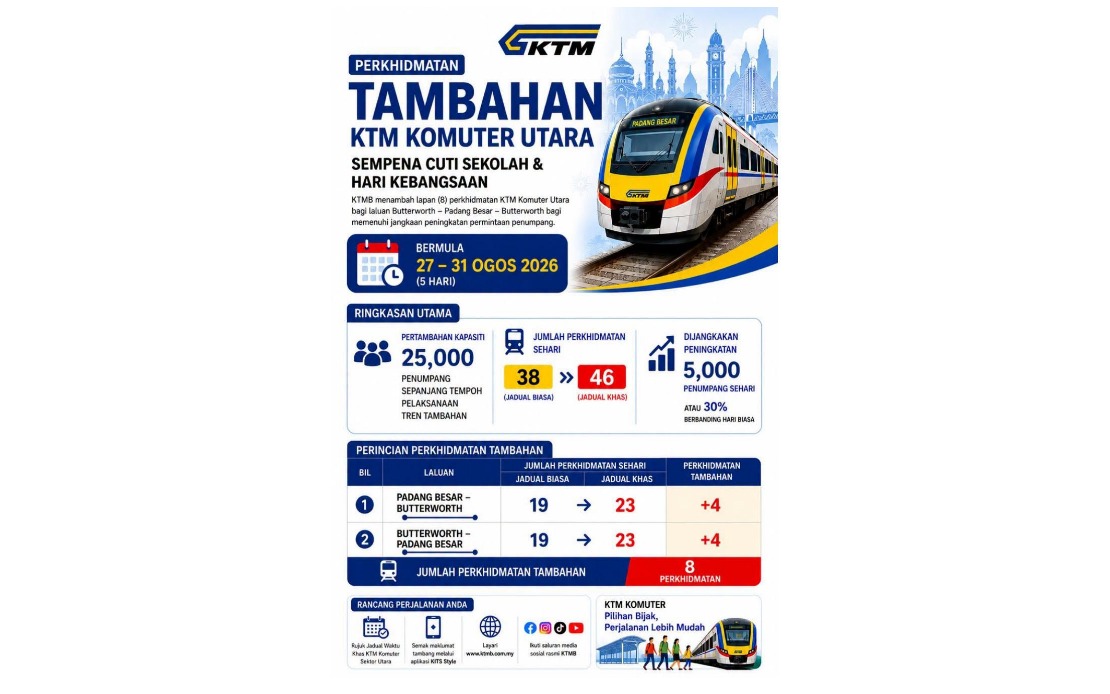
Keretapi Tanah Melayu Berhad (KTMB) is significantly expanding capacity on its northern commuter rail network to accommodate surging passenger volumes during the upcoming school holidays and National Day celebrations. The rail operator announced it will introduce eight additional KTM Komuter Utara services serving the strategically important Butterworth-Padang Besar corridor from Thursday through Monday, August 27 to 31, marking a substantial boost to daily train availability on this busy inter-state route.
The intervention represents part of KTMB's broader strategy to enhance public transport reliability during peak travel periods when Malaysian families traditionally undertake regional journeys. By implementing a special timetable specifically designed for the Northern Sector during this five-day window, the national rail operator aims to relieve congestion pressures that typically emerge when schools close and the nation celebrates its independence. The decision reflects institutional recognition that commuter rail services must adapt dynamically to predictable demand fluctuations rather than maintaining rigid schedules year-round.
Under the enhanced schedule, the daily service count on the entire Butterworth-Padang Besar-Butterworth route will climb from the standard 38 services to 46 services, representing a roughly 21 per cent operational uplift. This expansion demonstrates KTMB's capacity to mobilise additional rolling stock and crew resources when circumstances warrant, though such periodic enhancements also underscore persistent capacity constraints during normal operations. The distribution of additional services is evenly split between the two directional flows: four extra trains will operate northbound from Padang Besar to Butterworth, lifting that direction from 19 to 23 daily services, while four southbound services from Butterworth to Padang Besar will similarly increase from 19 to 23 daily departures.
KTMB forecasts that these measures will accommodate approximately 5,000 additional passengers daily throughout the implementation period, totalling around 25,000 extra travellers across the five-day initiative. The projection reflects anticipated demand growth of roughly 30 per cent above baseline weekday patronage, a reasonable estimate for holiday periods when leisure and family travel typically spike. This traffic model helps KTMB justify the operational costs associated with deploying extra trains, crews, and maintenance resources, though the willingness to incur such expenses also indicates that profitable holiday-period revenue offsets incremental spending.
The northern commuter rail corridor connects three significant Malaysian states with distinct geographical and economic characteristics. Penang, with its developed urban centres and tourism appeal, generates substantial outbound holiday traffic. Kedah and Perlis, more rural and traditionally agricultural regions, see reverse flows as residents journey to larger cities for seasonal festivities and shopping. The Butterworth-Padang Besar route thus functions as critical infrastructure enabling internal Malaysian mobility, particularly for middle and working-class families who depend on rail rather than private vehicles for longer intercity journeys. Enhanced service frequency during predictable peak periods helps ensure equitable access to holiday travel opportunities across income levels.
The deployment of special timetables represents a pragmatic operational approach distinct from permanent capacity expansion. Rather than constructing additional railway infrastructure or purchasing new trains—capital-intensive investments with long planning horizons—KTMB achieves immediate relief by optimising existing resources. This suggests the utility of flexible operational models that distinguish between baseline service obligations and cyclical surge requirements. However, the recurring need for such supplementary scheduling also raises questions about whether permanent service frequencies on major corridors adequately reflect actual travel patterns, or whether baseline timetables remain artificially constrained by budgetary or workforce limitations.
For passengers planning travel through Penang, Kedah, and Perlis during this period, the expanded schedule substantially widens journey options while reducing average wait times between consecutive services. Rather than accepting rigid departure slots, travellers gain flexibility to adjust plans around their preferences, improving the competitive positioning of rail relative to private cars and express buses. The accessibility of schedule information through multiple channels—the KITS Style mobile application, KTMB's website, and official social media—reflects modern customer service practices, though some passengers may still face friction accessing digital information, particularly older or rural demographic segments.
The timing of this announcement demonstrates KTMB's ability to coordinate with broader government calendars around school holidays and National Day. This level of planning suggests adequate internal forecasting capacity and administrative coordination, yet it also highlights how Malaysian public transport decisions remain reactive rather than proactive—responding to holiday calendars rather than, for instance, considering whether enhanced year-round frequencies might unlock sustained ridership growth. The five-day intervention provides temporal relief but does not address structural questions about whether the Butterworth-Padang Besar corridor represents optimally utilised national rail infrastructure.
Southeast Asian transport networks increasingly face pressures from rising vehicle ownership and urban sprawl, with rail systems competing for marginal travel demand against private cars and coach services. Malaysia's experience with KTM Komuter demonstrates how targeted capacity enhancements during predictable peak periods can maintain competitiveness without massive permanent infrastructure expansion. However, this approach carries inherent limitations: seasonal scheduling adjustments cannot fundamentally transform rail's relative attractiveness against alternatives, and they cannot compensate for broader service quality issues affecting year-round ridership. KTMB's August initiative thus represents capable crisis management rather than long-term service transformation.
The announcement also carries modest implications for regional connectivity within Southeast Asia. The Butterworth-Padang Besar corridor terminates at Malaysia's northwestern border, with onward rail connections into southern Thailand. Enhanced Malaysian service frequencies contribute marginally to integrated regional mobility frameworks, though practical cross-border rail travel remains constrained by border formalities, distinct gauge systems, and limited international service coordination. Nevertheless, every capacity improvement on border-adjacent corridors marginally enhances the viability of cross-border commerce, tourism, and personal travel throughout the region.
Looking forward, KTMB's willingness to implement periodic service expansions suggests organisational capacity to respond to identified bottlenecks, though the recurring nature of these initiatives may eventually warrant permanent service increases on major corridors. Malaysian transport planning increasingly acknowledges rail's role in sustainable urban and intercity mobility, yet public investment remains episodic and reactive. The August Komuter enhancements represent competent tactical operations within a system that arguably requires more ambitious strategic expansion to genuinely transform travel patterns and reduce road congestion across the nation.

