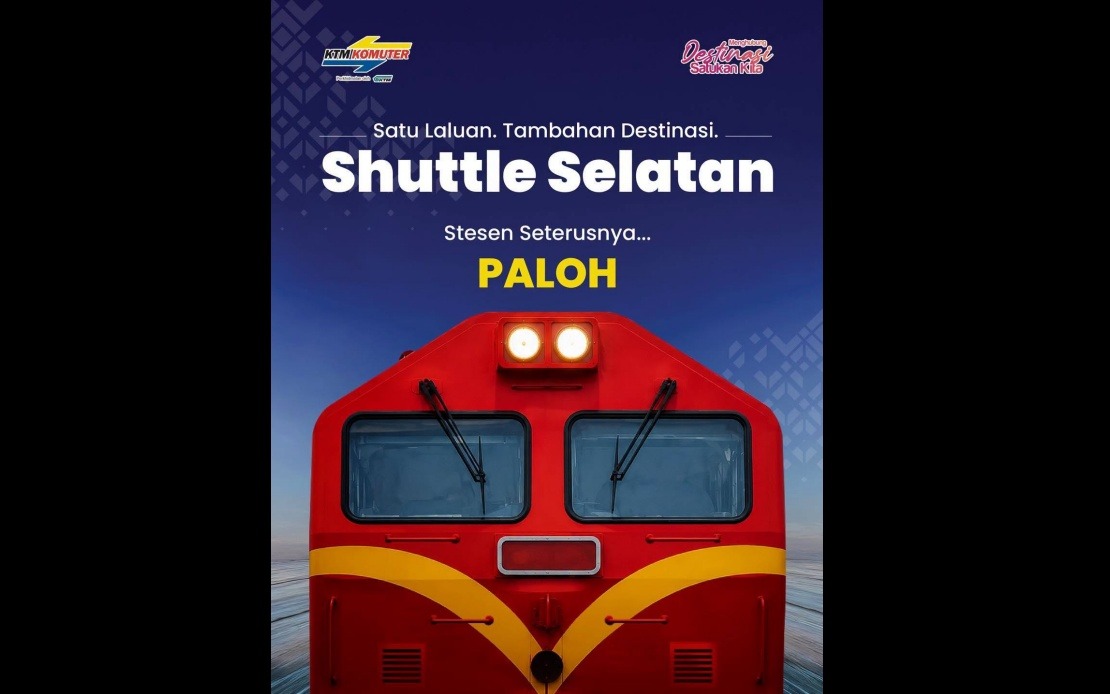
Keretapi Tanah Melayu Berhad (KTMB) will launch an extension of its Southern Shuttle service beginning August 8, marking a significant expansion of rail connectivity across Johor's central corridor. The new route will link Paloh with JB Sentral, serving seven intermediate stations and completing a crucial portion of the Transport Ministry's broader strategy to enhance public transport infrastructure in the southern region. This development arrives less than three months after the Southern Shuttle's initial rollout, demonstrating rapid government commitment to rail service expansion despite Malaysia's historical challenges with domestic rail infrastructure investment.
The extended service will operate across Paloh, Kluang, Renggam, Layang-Layang, Kulai, Kempas Baru and JB Sentral, with the full journey from Paloh to the Johor Bahru terminus requiring approximately two hours. Rather than relying on new track construction, KTMB will utilise existing alignment from the Gemas-Johor Bahru Electrified Double-Track Project (PLBEGJB), an infrastructure component that represents years of previous capital investment now being leveraged for additional service value. This pragmatic approach allows the government to deliver expanded regional connectivity without waiting for completely new rail infrastructure to be completed, a crucial consideration given Malaysia's need for rapid transport modernisation.
The daily schedule reflects careful planning for commuter demographics across central Johor. Ten trips will operate each direction, with the earliest departure from Paloh at 3.55 am reaching JB Sentral by 5.52 am, while the final evening service from JB Sentral departs at 8.30 pm. This timing deliberately accommodates workers commuting not only within Johor but continuing into Singapore via the Johor Bahru border crossing, acknowledging the intense people movement between Malaysia and Singapore that defines regional labour markets. Each train will accommodate up to 400 passengers, providing meaningful capacity for growing travel demand along this corridor.
Connectivity improvements extend beyond the main Paloh-JB Sentral route through connecting services at Kempas Baru Station, which will link passengers to the separate Kempas Baru-Pasir Gudang-Kempas Baru line. This integration strengthens the broader regional network by allowing seamless transfers to Pasir Gudang's industrial zone, recognising that modern rail systems must function as integrated networks rather than isolated routes. The arrangement demonstrates transport planning that considers industrial geography and worker dispersal patterns across multiple employment centres rather than simple point-to-point connections.
For passengers, a compelling pricing strategy makes the service immediately attractive compared to private vehicle ownership or alternative transport modes. The promotional one-way fare of RM7.70 from Paloh to JB Sentral represents a substantial discount from the standard RM15.30 rate and will remain in effect until new electric trains enter service. Beyond discounted fares, the MyRailLife Pass programme extends free travel eligibility to children aged four to six, students from primary through secondary level, and persons with disabilities—recognising vulnerable user groups who particularly benefit from affordable public transport. These provisions address equity concerns often overlooked in transport planning, ensuring that expansion benefits extend across socioeconomic strata rather than privileging affluent commuters.
The initial Southern Shuttle operations, prior to this August 8 expansion, recorded 3,209 passengers across its two starting routes, a figure that may appear modest but represents meaningful uptake given the service's recent introduction and limited initial geographic scope. This early adoption suggests genuine demand for rail alternatives in central Johor, challenging persistent Malaysian perceptions that car-dependent commuting is inevitable in suburban and regional contexts. The expansion announcement appears strategically timed to capitalise on growing passenger familiarity and confidence in the service before extending into additional markets.
Broader economic considerations underscore the Transport Ministry's rationale for rapid expansion. The service explicitly aims to support the Johor-Singapore Special Economic Zone (JS-SEZ), a strategic economic initiative requiring reliable workforce mobility and logistics connectivity between Malaysian and Singaporean locations. By enhancing rail links across central Johor, the government removes transport bottlenecks that might otherwise constrain investment and employment in this economically critical corridor. Additionally, expanded rail utilisation reduces reliance on private vehicles, addressing congestion and environmental concerns that increasingly shape transport policy discussions across Southeast Asia.
The expansion strategy reflects lessons from KTMB's earlier operational experiences and broader regional transport modernisation efforts. Rather than pursuing comprehensive infrastructure overhauls requiring lengthy timelines, the approach prioritises service rollout using existing assets, allowing incremental improvement while simultaneously building user bases and operational expertise. This methodology aligns with growing international recognition that transport transformation requires balanced focus on infrastructure, operations, pricing, and service integration—rather than infrastructure investment alone.
For Malaysian commuters, particularly those in Johor's central areas, the expansion introduces meaningful practical alternatives to car-dependent mobility patterns. Journey times of approximately 120 minutes from Paloh to JB Sentral represent competitive alternatives to driving, especially when accounting for parking costs, fuel consumption, and congestion delays. The early morning schedules specifically accommodate Singapore-bound workers, addressing a demographic whose cross-border commuting significantly impacts Malaysian-Singaporean transport corridors and labour market integration. As new electric trains eventually supplement the current fleet, further service improvements and potential capacity increases would enhance the network's long-term competitiveness.
The expansion demonstrates Malaysian government transport policy moving toward regional connectivity and cross-border mobility considerations, recognising that modern economic zones require seamless movement across jurisdictional boundaries. KTMB's rapid implementation of expanded service suggests growing institutional capacity and political priority for rail modernisation, areas where Malaysian performance has historically lagged regional peers. As Southeast Asia continues rapid urbanisation and cross-border economic integration intensifies, transport initiatives like the Southern Shuttle expansion signal meaningful directional shifts in Malaysian infrastructure investment and planning priorities.

