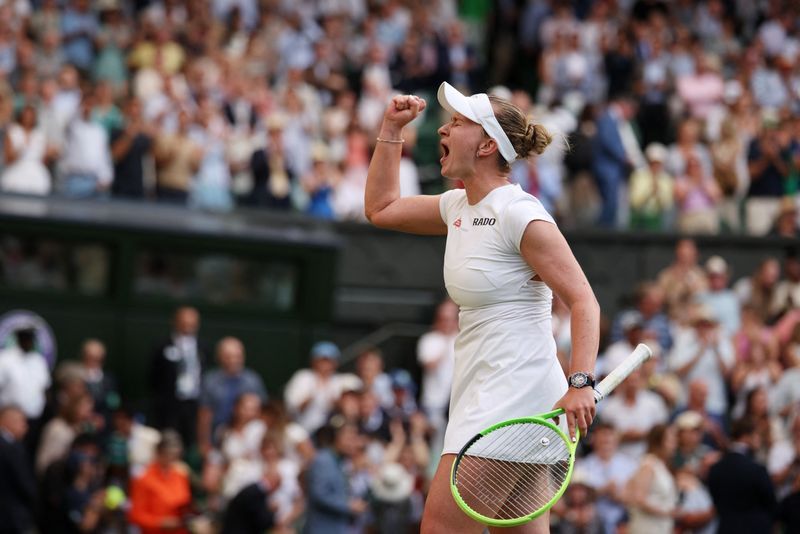
Czech veteran Barbora Krejcikova displayed the resilience of a champion on Wednesday at the All England Club, recovering from an opening-set deficit to eliminate fifth seed Mirra Andreeva with a 4-6 7-5 6-4 victory on Centre Court. The performance secured Krejcikova's passage into the third round and underscored the championship pedigree she brings to grass-court competition, having claimed the Wimbledon title earlier this year alongside her French Open success.
The match unfolded as a clash between contrasting trajectories in women's tennis. Krejcikova, an established force across multiple surfaces and formats, faced 19-year-old Andreeva, whose momentum had peaked just weeks earlier when the Russian teenager captured her maiden Grand Slam title at Roland Garros. The generational gulf between them became apparent in the opening moments, when Krejcikova's aggressive tennis propelled her to a 3-0 lead and suggested a potentially one-sided affair. Yet this impression proved misleading, a cautionary tale about dismissing emerging talent based on early dominance.
Andreyeva's recovery and ultimate first-set victory illustrated why her breakthrough in Paris resonated throughout the professional tennis circuit. The youngster's capacity to find her rhythm midway through the opening set, coupled with her ability to capitalize on Krejcikova's temporary loss of intensity, sent notice that this opponent possessed the weaponry to trouble established competitors. Breaking the Czech player's serve at crucial junctures, Andreeva forced a tiebreaker dynamic that favored her momentum, eventually claiming the set 6-4 to level the contest.
Krejcikova's response demonstrated the mental fortitude distinguishing multi-Grand Slam champions from talented prospects. Rather than becoming unraveled by conceding the first set after such a positive start, the Czech veteran recalibrated her approach and executed with clinical efficiency in the second set. Her service game solidified, her returns sharpened, and her tactical acumen—honed across decades of professional competition—gained ascendancy over Andreeva's youthful exuberance. The turnaround yielded a 7-5 second-set victory that fundamentally shifted the match's trajectory.
The deciding set transformed into a battle of wills, with Andreeva's composure beginning to fray under mounting pressure. The Russian saved a remarkable six match points, each reprieve briefly suggesting a potential comeback that never quite materialized. Krejcikova's superior court management and experience in high-pressure situations ultimately prevailed, as she converted on her seventh opportunity to secure the victory. The psychological toll of those consecutive match-point escapes appeared to deplete Andreeva's reserves precisely when she needed them most.
Post-match, Krejcikova reflected on the intensity of their encounter with the measured perspective of someone who has navigated tennis's highest stakes repeatedly. She emphasized that this marked merely the fifth meeting between them, yet each confrontation had demanded total commitment. Her recognition of Andreeva's exceptional talent—the complete skillset and trajectory stretching before the teenager—came across as both magnanimous acknowledgment and genuine respect for a rival generating serious momentum in the sport. The Czech champion's pride in producing commanding tennis on the sport's most iconic stage reflected her deep appreciation for Centre Court's mystique and its place within tennis lore.
The victory elevated Krejcikova's record against Andreeva to 3-2 overall, though the close nature of recent encounters suggested the gap between them continues narrowing. For Malaysian and Southeast Asian tennis enthusiasts, the match offered insights into the competitive dynamics shaping women's professional tennis. The emerging generation, embodied by players like Andreeva, possesses unprecedented physical capability and technical sophistication, yet the accumulated experience and mental resilience of established champions like Krejcikova remain formidable barriers to breakthrough moments.
Krejcikova's next opponent will be fellow Czech Nikola Bartunkova, ensuring a domestic matchup in the third round. While Andreeva's immediate future remains uncertain following this setback, her trajectory suggests such losses represent developmental waypoints rather than career-defining setbacks. Her frustration—evidenced by racket incidents—reflected legitimate anger at opportunities squandered rather than despair about her long-term prospects. The Russian teenager will likely emerge from Wimbledon disappointed but undeterred, her spring breakthrough serving as validation that she belongs at tennis's elite level.
For Krejcikova, continued momentum at Wimbledon represents the logical continuation of a season where she has reasserted herself as a multisurface competitor capable of winning major championships. Her experience navigating pressure-packed moments and her ability to elevate performance when required remain the hallmarks distinguishing her from less-tested opponents. The third-round clash with Bartunkova will present another opportunity to showcase the combination of technical excellence and mental fortitude that defines championship-calibre tennis.

