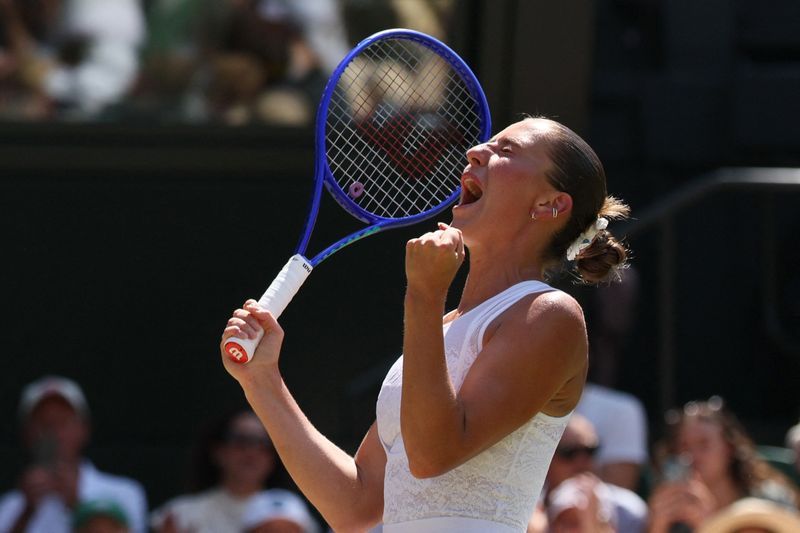
Ukrainian tennis player Marta Kostyuk has powered her way into the Wimbledon semi-finals after dismantling Italy's Jasmine Paolini in straight sets on Wednesday, delivering one of the day's most commanding performances on a sweltering Centre Court. The 12th seed claimed victory 6-3 6-2 in a match that lasted just over an hour, consolidating her position among the tournament's elite as the event enters its decisive stages.
Kostyuk established her dominance early, racing through the opening set with remarkable efficiency. She captured the first six games in merely 36 minutes, breaking Paolini's serve twice—first when the Italian led 2-1, then again to secure the set at 5-3. This aggressive start set the tone for the entire encounter, with the Ukrainian taking clear control through powerful forehand striking and consistent service performance. The speed of her set victory signalled to spectators that this would be no prolonged battle.
The 24-year-old's performance proved especially noteworthy given her Wimbledon debut on Centre Court and the nature of her opponent. Paolini, the 13th seed, had reached the previous year's final and possessed tournament pedigree that many emerging players lack. More significantly for Kostyuk's narrative, she had lost her previous two encounters against the Italian, suggesting this quarter-final represented a crucial moment in their rivalry. The Ukrainian appeared determined to erase that recent record and moved purposefully through the second set.
Kostyuk extended her dominance in the second set with clinical precision. She broke Paolini's serve immediately to establish a 2-0 lead, then added another break to move 3-1 ahead. Crucially, Paolini failed to generate a single break point opportunity throughout the entire second set, leaving her unable to apply pressure or manufacture momentum shifts. This absence of offensive opportunities illustrated how thoroughly Kostyuk had controlled proceedings and dominated the baseline exchanges.
The Ukrainian's powerful forehand proved the decisive weapon in her arsenal. She deployed this shot with consistent accuracy and depth, forcing Paolini into defensive positions and preventing the Italian from establishing her own rhythm on court. Where Paolini typically relies on court positioning and tactical acumen, Kostyuk's direct hitting style proved overwhelming on the day, demonstrating the generational power gap between different eras of women's tennis.
Even with Queen Camilla observing from the Royal Box, the crowd's attempts to bolster Paolini's morale proved insufficient to shift the match's trajectory. Kostyuk remained emotionally composed and tactically sharp, never allowing sentiment or partisan support to distract from her clinical execution. She completed her victory in approximately 69 minutes total, sealed with a second match point on Paolini's serve—a fitting conclusion to a match where the Italian struggled significantly on her own service games.
Kostyuk's semi-final progression holds broader significance for Eastern European tennis and women's sport more generally. As a Ukrainian athlete competing at sport's highest levels amid ongoing international challenges, her continued success provides representation and inspiration for the region. Her breakthrough performance on Centre Court, one of tennis's most hallowed grounds, marks a significant milestone in her career trajectory and suggests she possesses the temperament and skill to compete meaningfully in major championship events.
For Paolini, the defeat represents a disappointing conclusion to what had been a resurgent season by her standards. Having reached the previous year's final and maintained her ranking among the tournament's seeds, she would have harboured genuine expectations of reaching the final stages once again. The comprehensive nature of this loss—dominated particularly in service statistics and break point conversions—will require significant reflection as she evaluates her performance during this tournament.
Kostyuk's advancement also reflects broader trends in women's professional tennis, where power and aggressive baseline play increasingly dominate over traditional serving tactics and defensive positioning. The Ukrainian embodied this modern style throughout the quarter-final, rarely allowing rallies to extend beyond three or four strokes and consistently dictating play through her forehand wing. This approach, while sometimes criticised by traditionalists, has become the template for success among younger players who grew up training with contemporary coaching methodologies.
Moving forward into the semi-finals, Kostyuk enters as a player with genuine momentum despite her outsider seeding. Her demolition of a seeded opponent suggests she has discovered an optimal technical and tactical framework for success on grass courts, potentially altering perceptions about her suitability for Wimbledon's specific demands. Whether she can maintain this form against fellow semi-finalists remains uncertain, but her Centre Court performance has undoubtedly announced her as a legitimate contender for the tournament's later stages.

