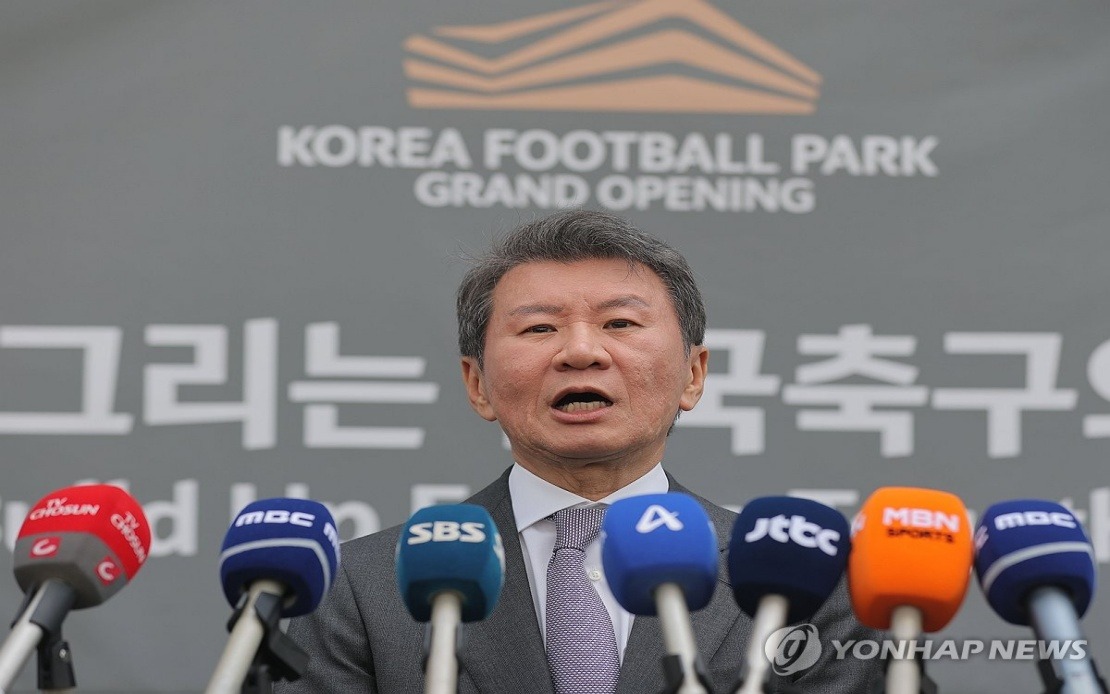
South Korea's football administration enters a transitional phase following the resignation of Korea Football Association (KFA) president Chung Mong-gyu on Monday. The decision came after Chung convened what would be his final executive meeting at the KFA's headquarters in Cheonan, located roughly 90 kilometres south of Seoul, where he formally submitted his letter of resignation.
Chung's departure accelerates a timeline he had previously outlined in late May, when he announced intentions to step down after the FIFA World Cup concluded. Rather than remaining until the tournament's official conclusion on July 20 by South Korean time, he opted to leave the position fourteen days early—a choice directly influenced by the national team's disappointing group stage performance. This early exit signals the depth of pressure facing Korean football leadership following an unexpectedly premature elimination from the competition.
The South Korean squad, managed by Hong Myung-bo, concluded group play with just three points accumulated from one victory and two defeats, finishing third in Group A. This tally proved insufficient to qualify among the eight best-performing third-place teams eligible for the knockout rounds. Coach Hong responded by resigning immediately after the team's mathematical elimination became certain, taking personal responsibility for the underwhelming results on the international stage.
Chung's tenure as KFA president had already attracted significant criticism well before this tournament. The appointment of Hong Myung-bo as national coach in July 2024 drew particularly sharp scrutiny from observers and commentators who questioned the transparency and methodological rigour of the selection process. These concerns escalated when the Ministry of Culture, Sports and Tourism conducted an extensive examination of KFA administrative practices during that period, ultimately concluding that Chung and several other senior federation officials warranted disciplinary action due to documented irregularities in operational procedures.
The governance tensions between the football body and the ministry remain unresolved, with legal proceedings ongoing. Ministry officials have signalled intentions to commence another comprehensive audit of the KFA in response to this World Cup elimination, intensifying institutional friction at a sensitive moment for Korean football. This audit threatens to compound already serious reputational damage and raises questions about the federation's capacity to manage both internal reform and the upcoming leadership succession.
According to established KFA protocols, one of four vice presidents will assume the role of interim leader pending a formal election process. Crucially, Chung was completing only his first year of a fourth term spanning nearly three years, meaning his successor must face electoral validation within sixty days of his departure. This compressed timeline places significant pressure on the organisation to expedite leadership selection while managing external scrutiny and internal division.
The electoral system for KFA presidency involves a collegiate voting mechanism comprising heads of regional football associations, K League club executives, players, coaches, and referees. Participation in last year's presidential election reached approximately ninety-five percent, with 183 of 192 eligible voters casting ballots, suggesting a functional, if contested, democratic process within the sporting body. However, this conventional methodology now faces potential disruption from government intervention.
Culture, Sports and Tourism Minister Chae Hwi-young has recently indicated dissatisfaction with existing KFA election procedures, suggesting that the federation's leadership must demonstrate responsiveness to public sentiment regarding the World Cup debacle. The minister's remarks carried implicit pressure for institutional reform, essentially signalling that preserving current electoral arrangements would prove politically untenable given public disappointment. This governmental posturing introduces an external dimension to what should technically remain an internal sporting matter.
The Korean Sport and Olympic Committee (KSOC), the nation's paramount sports governance body, will convene a general assembly on July 16 to consider amendments affecting member association elections. Discussion points include potentially extending the standard sixty-day election window and introducing direct voting mechanisms to replace the current collegiate system. These proposed changes would fundamentally alter how football leadership selection functions, representing a significant governance shift that could establish precedents across Korean sports administration more broadly.
Chung's official statement, released through KFA channels, balanced acknowledgment of his shortcomings against assertions of his commitment to football development. He characterised his presidency as encompassing both achievements and disappointments, attributing successes to players and supporters whilst accepting personal responsibility for failures. His pledge to remain engaged as a devoted supporter suggests a measured departure rather than complete disengagement from Korean football, though his immediate influence on institutional direction will substantially diminish.
For Malaysian and Southeast Asian observers, this episode illustrates governance vulnerabilities within sports federations when institutional autonomy collides with government objectives and public expectations following major competitive setbacks. The KFA's predicament—combining coaching appointment controversies, documented administrative irregularities, World Cup underperformance, and government pressure for electoral reform—demonstrates how sports administration crises rapidly accumulate, potentially overwhelming established institutional frameworks. South Korea's response could influence regional approaches to sports governance accountability and the appropriate balance between federation independence and government oversight during periods of institutional instability.

