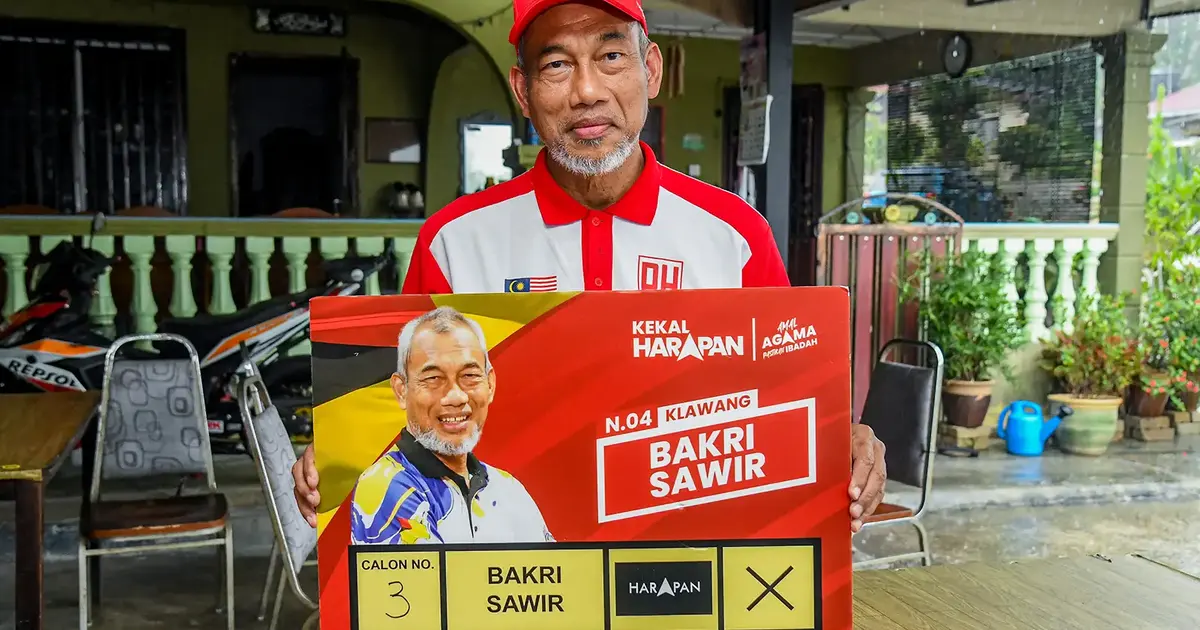
Bakri Sawir, the two-term assemblyman representing the Klawang state constituency, has expressed confidence that he can retain his seat in the next election despite the recent strengthening of ties between Barisan Nasional and Perikatan Nasional. The Pakatan Harapan politician's bullish stance stems from his successful 2023 campaign, during which he was abandoned by Umno and yet still managed to capture the Klawang mandate, demonstrating his personal appeal among local voters regardless of traditional party machinery.
The emergence of a formal BN-PN electoral pact has sparked renewed speculation about constituencies where Barisan's traditional grip may be vulnerable or where opposition parties have established grassroots momentum. Klawang, a Selangor state seat that has oscillated between different political coalitions in recent election cycles, represents precisely the type of battleground that such alliances are designed to consolidate. However, Bakri appears unmoved by the prospect of facing a united right-wing coalition, banking instead on the electoral credibility he has already accumulated in the constituency.
The backdrop to Bakri's current confidence involves a significant political rupture that occurred during the 2023 Selangor state elections. At that juncture, Umno, which had traditionally contested the Klawang seat as part of its broader Barisan apparatus, withdrew its endorsement and effectively ceded the contest to Pakatan Harapan. Rather than capitulate, Bakri campaigned vigorously on his own record and local standing, ultimately convincing voters to return him to office. This episode fundamentally altered the political calculus in Klawang, proving that success in the constituency was not dependent on Umno's blessing or the BN machinery's full mobilisation.
From a broader political perspective, Bakri's assertion that he can repeat his 2023 result carries implications for how fragmented Malaysia's electoral landscape has become at the state level. The formation of the BN-PN alliance represents an attempt to rebuild traditional right-wing dominance through formal electoral coordination, yet constituencies like Klawang illustrate that local factors, incumbent performance, and grassroots organisation can still determine outcomes independently of grand coalition politics. For Pakatan Harapan, which has struggled to maintain momentum in Selangor in recent years, Bakri's resilience offers a rare example of a seat where the opposition coalition retains genuine electoral leverage.
The Klawang assemblyman's comments also reflect a subtle but significant shift in how Malaysian politicians calculate electoral viability. Rather than viewing alliance frameworks as deterministic, Bakri positions his personal mandate as the primary asset. This approach aligns with a growing pattern in Malaysian politics where individual political brands, local welfare provisions, and direct constituent engagement sometimes outweigh party affiliation or coalition membership. Voters in Klawang, if Bakri's reading is accurate, are more concerned with the incumbent's performance and accessibility than with which larger political bloc nominally controls state governance.
From the perspective of opposition strategists in Selangor, Klawang represents a meaningful test case for whether Pakatan Harapan can defend seats in a state where it governs but where voter loyalty remains conditional. The state is economically significant and populous, home to industrial areas, sprawling suburban communities, and diverse voter demographics. If Bakri can successfully mobilise this constituency independently of traditional coalition support, it would suggest that Pakatan's brand of governance has struck root sufficiently to withstand challenges from a coordinated BN-PN challenge. Conversely, if the unified right-wing alliance proves too formidable, Klawang would signal broader difficulties for the opposition coalition's viability in Selangor's marginal seats.
The timing of Bakri's remarks is also strategically relevant. By publicly expressing confidence now, rather than appearing defensive about the BN-PN pact, the Pakatan politician shapes the narrative around his candidacy. He casts himself as proven and battle-tested rather than as a challenger who must overcome structural disadvantages. This positioning is particularly important given that voters often interpret displays of political confidence as indicators of organisational preparedness and internal morale. A candidate who sounds anxious about emerging alliances signals that his party's machinery is struggling; one who dismisses such concerns projects strength and command of the ground.
However, Bakri's assertion carries inherent risks. If he loses or if his margin of victory narrows significantly compared to 2023, his pre-election confidence will be retrospectively cited as evidence of political miscalculation. The BN-PN alliance does bring material benefits to constituent parties—resource pooling, coordinated campaigning, and mutual backing. Even if Umno formally withdrew from Klawang in 2023, the alliance framework means that Barisan's organisational infrastructure and Perikatan's growing northern presence could be mobilised differently this time. Bakri's past victory, therefore, may prove a less reliable predictor of future success.
For Malaysian observers tracking the state-level consequences of the broader national political realignment, Klawang embodies a larger question about whether electoral outcomes in the post-2020 era remain contingent on local factors or whether the BN-PN consolidation represents a genuinely transformative shift toward more deterministic coalition politics. Bakri's confidence and his track record suggest reason to believe the former; but the coming contest will provide empirical clarity on whether personality-driven, incumbent-driven politics can reliably withstand organised coalition machinery.

