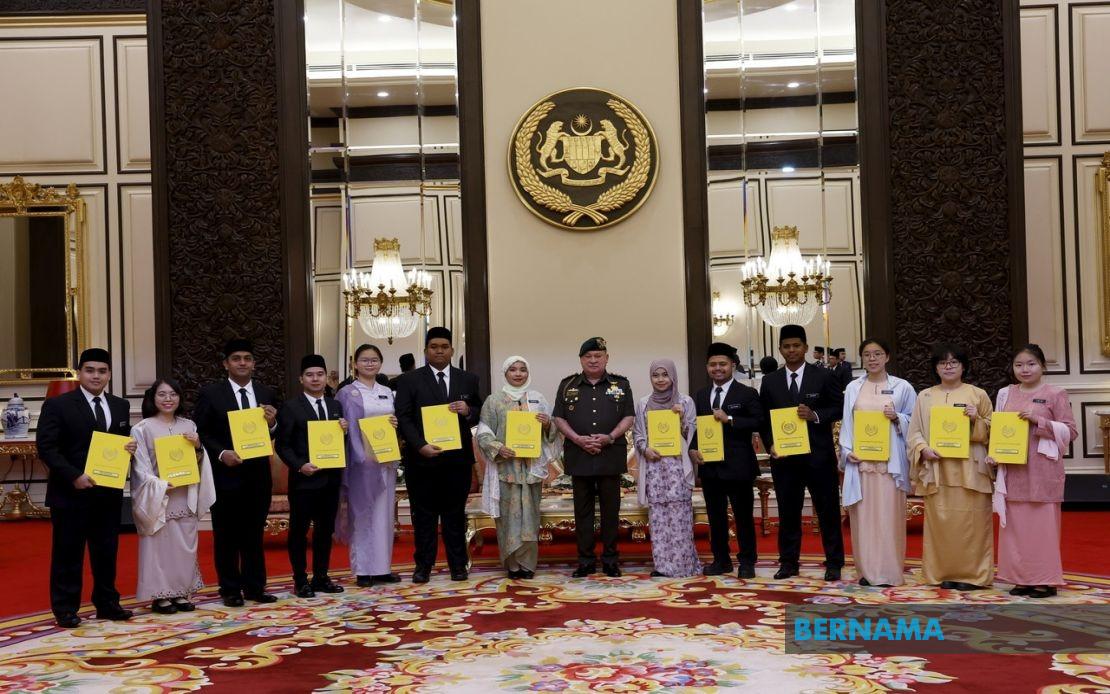
His Majesty Sultan Ibrahim, King of Malaysia, presented the 2026 Yang di-Pertuan Agong Scholarships (BYDPA) to 14 deserving scholars during a formal investiture ceremony at Istana Negara in Kuala Lumpur on June 24. The occasion underscored the monarchy's ongoing commitment to fostering academic excellence and nurturing the nation's brightest minds for advanced research and intellectual contribution.
The recipients encompassed two distinct cohorts pursuing different levels of postgraduate qualification. Seven scholars were selected for doctoral studies, positioning them at the apex of academic qualification, while a parallel group of seven recipients secured funding for Master's (Research) programmes. This balanced distribution reflects the scholarship's dual focus on cultivating both emerging researchers and established academics transitioning into independent investigative work.
Geographically, the cohort remains predominantly anchored within Malaysia's research ecosystem, with ten recipients advancing their studies at domestic universities recognised for their research capabilities and institutional standing. However, four recipients will undertake their postgraduate journeys at international universities abroad, reflecting the scholarship's recognition that exposure to global academic environments enriches scholarly development and facilitates knowledge exchange across borders. This outward-looking approach enables Malaysian scholars to establish international research networks while maintaining connections to local institutions.
The BYDPA occupies a distinctive position within Malaysia's scholarship landscape. As Tan Sri Wan Ahmad Dahlan Abdul Aziz, the Director-General of the Public Service, noted following the ceremony, the scheme represents the most generously funded government scholarship initiative available to Malaysian scholars. The designation of "Yang di-Pertuan Agong Scholarship" carries ceremonial weight and institutional prestige, signalling the state's investment in human capital development at the highest academic levels.
The significance of this scholarship programme extends beyond mere financial support. BYDPA recipients join an elite alumni network of past awardees who have gone on to contribute meaningfully to Malaysia's scientific, technological, and intellectual advancement. For many scholars, the award validates years of academic dedication and provides the security necessary to undertake intensive, multi-year research projects without financial constraint.
The ceremony's formal setting at Istana Negara, attended by high-ranking officials including Tan Sri Dr Azmi Rohani, the Comptroller of the Royal Household, emphasised the official character and national importance of the occasion. The personal involvement of the King in presenting the scholarships directly, rather than through a proxy, conveyed a message that advancement of knowledge and research capacity commands attention at the highest levels of government.
For Malaysian universities and research institutions, such scholarship awards serve multiple functions. They attract accomplished scholars to undertake intensive research that enhances institutional reputations and research output metrics. Universities hosting BYDPA recipients benefit from enhanced research productivity, publications, and the potential for groundbreaking discoveries that elevate Malaysia's standing in global academic rankings and scientific contribution.
The demographic and disciplinary composition of this year's cohort remains unspecified in official announcements, yet the representation across both domestic and international institutions suggests a diverse range of research interests spanning various academic domains. This diversity strengthens the nation's research portfolio and reduces dependency on any single field of investigation.
From a Southeast Asian perspective, Malaysia's commitment to high-level scholarship funding reflects broader regional trends emphasising human capital development and technological advancement. As regional economies compete for research talent and innovation leadership, countries investing in postgraduate education and research training position themselves favourably for knowledge-economy transitions.
The BYDPA programme also addresses a critical pipeline challenge in academic succession. By supporting doctoral and master's-level research training, the scheme contributes to developing the next generation of university lecturers, research scientists, and knowledge leaders who will shape Malaysia's intellectual trajectory across coming decades. Many recipients will eventually assume leadership positions in academia, government research institutions, or private sector innovation functions.
For aspiring Malaysian scholars, the BYDPA represents both tangible financial security and symbolic recognition of merit-based achievement. The highly competitive nature of the selection process means recipients represent the uppermost tier of their academic cohorts, individuals demonstrating exceptional intellectual capability and research promise. The award thus functions as a significant career milestone, enhancing professional credibility and opening doors to subsequent opportunities in the global academic community.
Looking forward, the continued availability and expansion of such prestigious scholarships will remain crucial as Malaysia endeavours to strengthen its knowledge base and research infrastructure. Investment in human capital through postgraduate education ultimately generates returns spanning multiple decades as scholars contribute innovations, train subsequent generations, and elevate national competitiveness in knowledge-intensive sectors. The King's presentation of these 2026 BYDPA scholarships reaffirms the state's commitment to this enduring investment strategy.