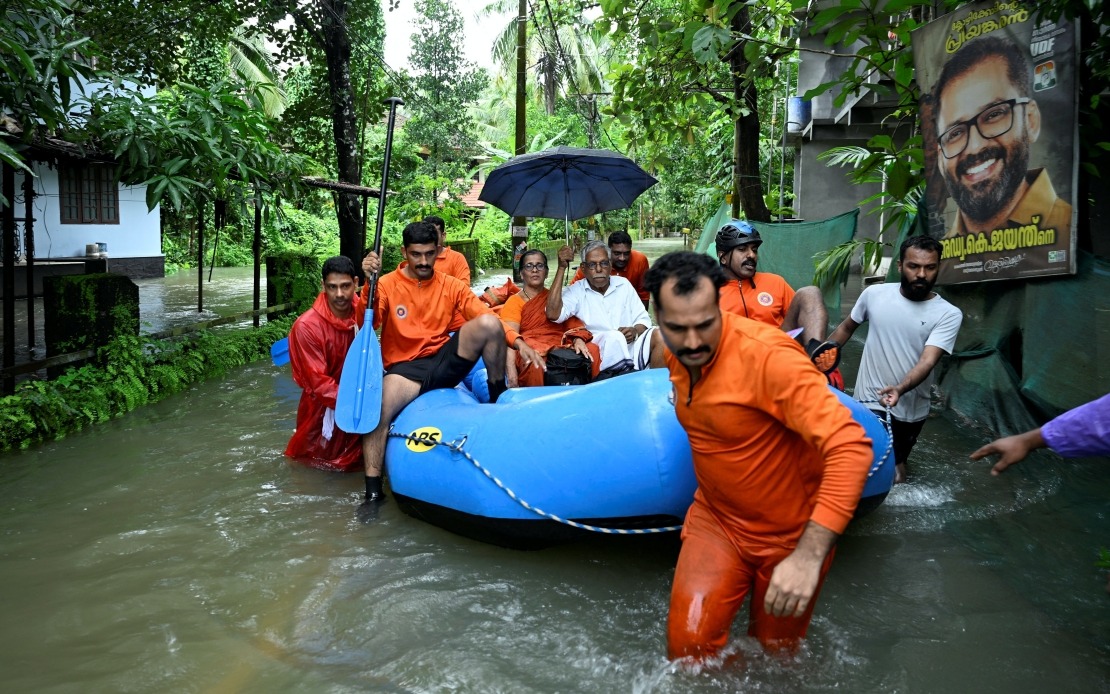
Southern India's Kerala state has been devastated by torrential monsoon rains that have claimed at least 26 lives, injured eleven others, and left four people unaccounted for, according to provincial authorities in a Wednesday briefing. Chief Minister V D Satheesan detailed the scale of the emergency facing the southwestern coastal state, which sits at the frontline of India's annual monsoon system and has long struggled with climate-related hazards.
The human displacement resulting from the deluge has proven equally severe. More than 27,000 residents have been evacuated from their homes, overwhelming local emergency services and compelling authorities to establish 462 relief camps across Kerala's districts. These makeshift shelters now house all those rendered homeless by floodwaters that continue to inundate low-lying communities. Many families remain stranded in partially submerged dwellings awaiting rescue operations, while relief workers race to prevent further casualties as water levels remain dangerously high across most affected regions.
The agricultural sector has absorbed tremendous damage in what represents a critical blow to Kerala's rural economy. Official assessments confirm that heavy rains have destroyed crops across 1,882 hectares of farmland, directly harming the livelihoods of 23,537 farming families. For a state where significant populations depend on agricultural income, this destruction threatens food security and creates additional economic hardship beyond immediate humanitarian needs. Many farmers face potential debt and reduced harvests that will ripple through local markets for months ahead.
The Chief Minister's administration has moved swiftly to announce compensatory relief measures designed to assist those bearing the heaviest losses. Enhanced payments have been promised to bereaved families who have lost relatives to the disaster, while home reconstruction grants and property damage compensation packages are being mobilised. These interventions underscore the government's acknowledgment of the severe financial strain facing affected communities, though questions persist about whether rapid bureaucratic processing can match the scale of need on the ground.
Meteorological forecasts indicate that the crisis is unlikely to ease substantially in the near term. The India Meteorological Department issued an orange alert—signalling severe weather conditions—for Wednesday, projecting sustained heavy rainfall across Kerala through 11 August. The weather bulletin extends warnings to coastal Karnataka and Telangana, suggesting that the monsoon system responsible for Kerala's devastation will continue generating dangerous precipitation across a broad geographical area. This extended forecast means relief and rescue operations will need to persist through at least the middle of the coming week.
The particular ferocity of this monsoon episode stems partly from the northern regions of Kerala receiving exceptionally concentrated rainfall since 1 August. Kozhikode and Kannur, districts in the state's high-range areas, have borne the brunt of precipitation, triggering cascading hazards including flash flooding and destructive landslides. Geological destabilisation in mountainous terrain has proven especially deadly, as hillside collapses have buried homes and severed transportation routes, complicating rescue efforts and isolating communities. The convergence of flood and landslide risk in elevated regions creates compounded dangers that first responders struggle to counter effectively.
For Malaysian and Southeast Asian observers, Kerala's monsoon crisis carries significant implications. Regional nations sharing similar tropical monsoon climates—including Malaysia, Indonesia, Thailand, and the Philippines—face comparable vulnerability to extreme precipitation events. Climate scientists have increasingly documented how warming ocean temperatures and shifting atmospheric patterns are intensifying monsoon rainfall in South Asia and Southeast Asia alike. Kerala's experience serves as a cautionary indicator of hazards that could intensify across the broader region as global climate dynamics continue evolving.
The interconnection between monsoon intensity and geographical vulnerability becomes starkly apparent in Kerala's situation. The state's dense population, substantial agricultural dependence, and challenging topography—featuring steep coastal areas transitioning to high-altitude interior regions—create a particularly hazardous environment when extreme rainfall occurs. Infrastructure designed for historical rainfall patterns proves inadequate when precipitation significantly exceeds long-term averages. Similar structural vulnerabilities exist throughout Southeast Asia, where rapid urbanisation in monsoon zones and legacy infrastructure systems often lack resilience against intensified weather events.
Indian federal and state authorities face mounting pressure to demonstrate effective disaster response capabilities at a time when such crises appear to be increasing in frequency and magnitude. The establishment of hundreds of relief camps and the mobilisation of rescue teams represent substantial bureaucratic undertakings, yet the persistence of missing persons and ongoing hazards suggests that response mechanisms remain stretched. As Kerala enters what appears to be several more days of dangerous weather, the challenge of maintaining operations while protecting both displaced populations and rescue workers will test emergency management systems severely.

